


Is decreased bone mineral density associated with development of scoliosis? A bipedal osteopenic rat model
- PMID: 22040734
- PMCID: PMC3217908
- DOI: 10.1186/1748-7161-6-24
Is decreased bone mineral density associated with development of scoliosis? A bipedal osteopenic rat model
Abstract
Background: An association between adolescent idiopathic scoliosis and osteopenia has been proposed to exist. It is still not clear whether there is such an association and if so, whether osteopenia is a causative factor or a consequence. Our previous pilot studies have suggested the presence of osteopenia in scoliotic animals. The aim of this study was to investigate the development of scoliosis in an unpinealectomized bipedal osteopenic rat model, implementing osteoporosis as a causative factor.
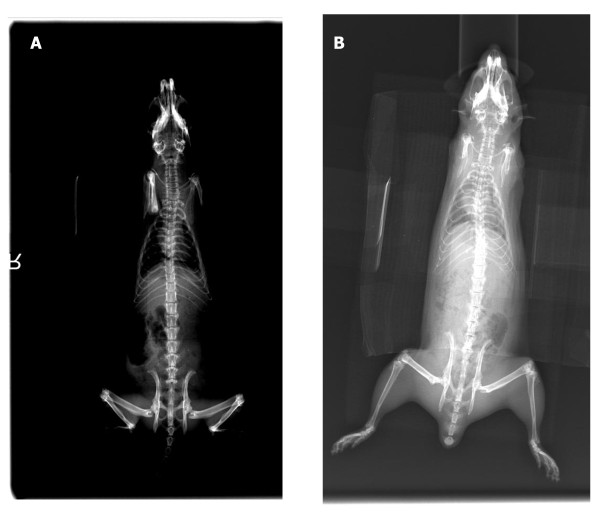
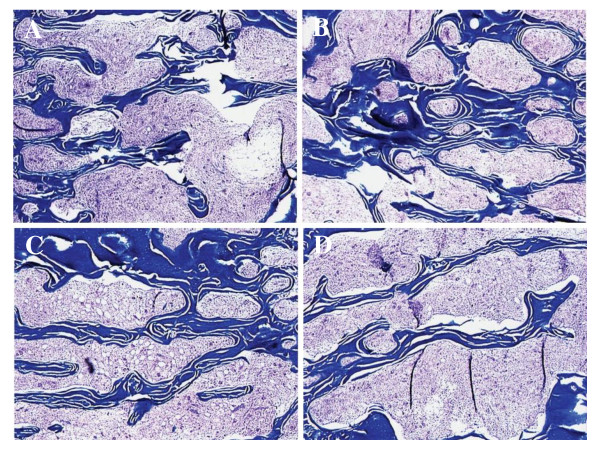
Methods: Fifty Sprague-Dawley rats were rendered bipedal at the 3rd postnatal week and separated into control (25 rats) and heparin (25 rats receiving 1 IU/gr body weight/day) groups. DEXA scans after 4 weeks of heparin administration showed low bone mass in the heparin group. Anteroposterior and lateral x-rays of the surviving 42 animals (19 in heparin and 23 in control groups) were taken under anesthesia at the 40th week to evaluate for spinal deformity. Additional histomorphometric analysis was done on spine specimens to confirm the low bone mass in heparin receiving animals. Results of the DEXA scans, histomorphometric analysis and radiological data were compared between the groups.
Results: Bone mineral densities of rats in the heparin group were significantly lower than the control group as evidenced by both the DEXA scans and histomorphometric analyses. However, the incidence of scoliosis (82% in heparin and 65% in control; p > 0.05) as well as the curve magnitudes (12.1 ± 3.8 in heparin versus 10.1 ± 4.3 degrees in control; p > 0.05) were not significantly different. Osteopenic rats were significantly less kyphotic compared to control specimens (p = 0.001).
Conclusions: This study has revealed two important findings. One is that bipedality (in the absence of pinealectomy) by itself may be a cause of scoliosis in this animal model. Further studies on animal models need to consider bipedality as an independent factor. Secondly, relative hypokyphosis in osteopenic animals may have important implications. The absence of sagittal plane analyses in previous studies makes comparison impossible, but nonetheless these findings suggest that osteopenia may be important in the development of 3D deformity in adolescent idiopathic scoliosis.
Figures
References
-
- Lowe TG, Edgar M, Margulies JY, Miller NH, Raso VJ, Reinker KA, Rivard CH. Etiology of idiopathic scoliosis: current trends in research. J Bone Joint Surg Am. 2000;82-A:1157–1168. - PubMed
-
- Miller NH. Genetics of familial idiopathic scoliosis. Clin Orthop Relat Res. 2002. pp. 60–64. - PubMed
-
- Miller NH. Idiopathic scoliosis: cracking the genetic code and what does it mean? J Pediatr Orthop. 2011;31:S49–52. - PubMed
