


Criterion-based laparoscopic training reduces total training time
- PMID: 22042592
- PMCID: PMC3310991
- DOI: 10.1007/s00464-011-2005-6
Criterion-based laparoscopic training reduces total training time
Abstract
Introduction: The benefits of criterion-based laparoscopic training over time-oriented training are unclear. The purpose of this study is to compare these types of training based on training outcome and time efficiency.
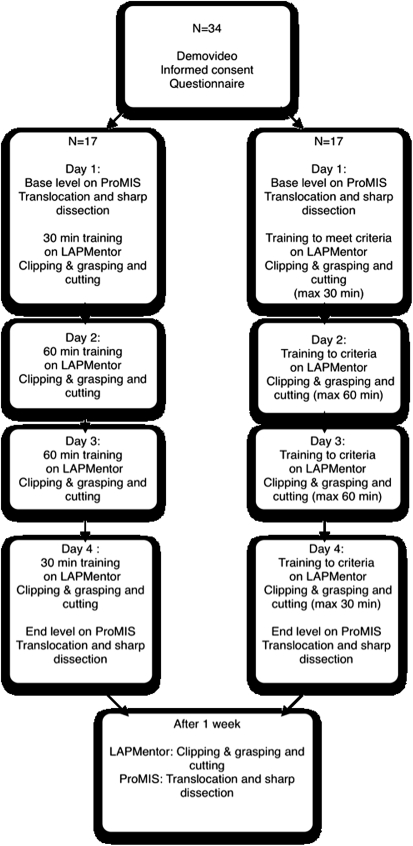
Methods: During four training sessions within 1 week (one session per day) 34 medical interns (no laparoscopic experience) practiced on two basic tasks on the Simbionix LAP Mentor virtual-reality (VR) simulator: 'clipping and grasping' and 'cutting'. Group C (criterion-based) (N = 17) trained to reach predefined criteria and stopped training in each session when these criteria were met, with a maximum training time of 1 h. Group T (time-based) (N = 17) trained for a fixed time of 1 h each session. Retention of skills was assessed 1 week after training. In addition, transferability of skills was established using the Haptica ProMIS augmented-reality simulator.
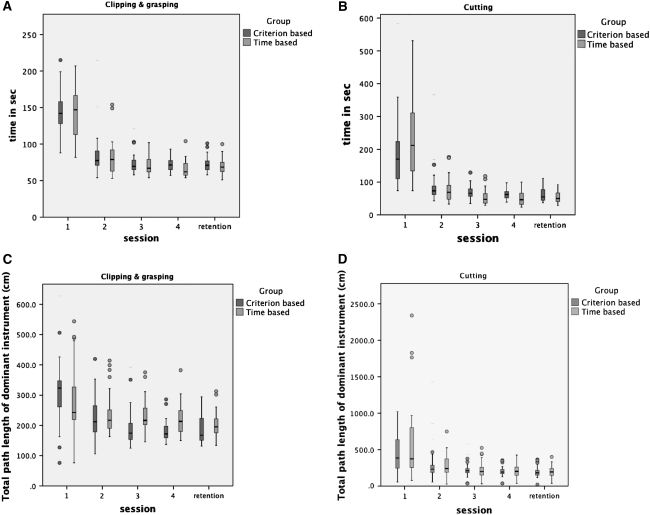
Results: Both groups improved their performance significantly over the course of the training sessions (Wilcoxon signed ranks, P < 0.05). Both groups showed skill transferability and skill retention. When comparing the performance parameters of group C and group T, their performances in the first, the last and the retention training sessions did not differ significantly (Mann-Whitney U test, P > 0.05). The average number of repetitions needed to meet the criteria also did not differ between the groups. Overall, group C spent less time training on the simulator than did group T (74:48 and 120:10 min, respectively; P < 0.001). Group C performed significantly fewer repetitions of each task, overall and in session 2, 3 and 4.
Conclusions: Criterion-based training of basic laparoscopic skills can reduce the overall training time with no impact on training outcome, transferability or retention of skills. Criterion-based should be the training of choice in laparoscopic skills curricula.
Figures
References
-
- Schijven M, Jakimowicz J, Broeders IAMJ, Tseng LNL. The Eindhoven laparoscopic cholecystectomy training course—improving operating room performance using virtual reality training: results from the first EAES accredited virtual reality trainings curriculum. Surg Endosc. 2005;19:1220–1226. doi: 10.1007/s00464-004-2240-1. - DOI - PubMed
MeSH terms
LinkOut - more resources
Full Text Sources
Medical
Research Materials
Miscellaneous
