. 2011 Nov 8;108(45):18238-43.
doi: 10.1073/pnas.1103002108. Epub 2011 Oct 31.

Bayesian modeling to unmask and predict influenza A/H1N1pdm dynamics in London

Affiliations

Bayesian modeling to unmask and predict influenza A/H1N1pdm dynamics in London

Paul J Birrell et al. Proc Natl Acad Sci U S A. .

Abstract

The tracking and projection of emerging epidemics is hindered by the disconnect between apparent epidemic dynamics, discernible from noisy and incomplete surveillance data, and the underlying, imperfectly observed, system. Behavior changes compound this, altering both true dynamics and reporting patterns, particularly for diseases with nonspecific symptoms, such as influenza. We disentangle these effects to unravel the hidden dynamics of the 2009 influenza A/H1N1pdm pandemic in London, where surveillance suggests an unusual dominant peak in the summer. We embed an age-structured model into a bayesian synthesis of multiple evidence sources to reveal substantial changes in contact patterns and health-seeking behavior throughout the epidemic, uncovering two similar infection waves, despite large differences in the reported levels of disease. We show how this approach, which allows for real-time learning about model parameters as the epidemic progresses, is also able to provide a sequence of nested projections that are capable of accurately reflecting the epidemic evolution.


Conflict of interest statement

The authors declare no conflict of interest.

Figures
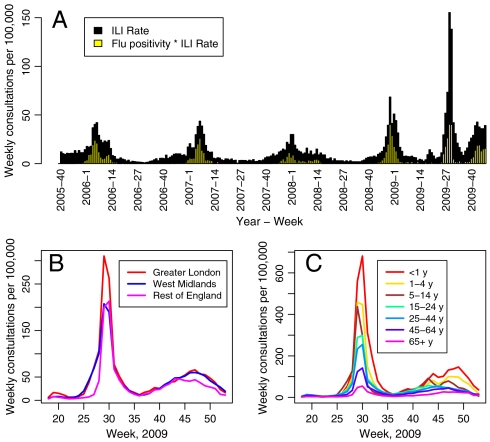
Fig. 1.
Fig. 1.
(A) Time series of GP consultation rate for ILI and virological positivity within the RCGP surveillance scheme in England and Wales (1), by week, from end-2005 to end-2009. The positivity is given by the proportion of each bar shaded yellow. (B) Observed weekly consultation rates per 100,000 within each group (see ref.  and SI Data, section 1.1) by region (Greater London, West Midlands, and Rest of England) and (C) by age group, over the weeks 18–53, 2009.
Fig. 2.
Fig. 2.
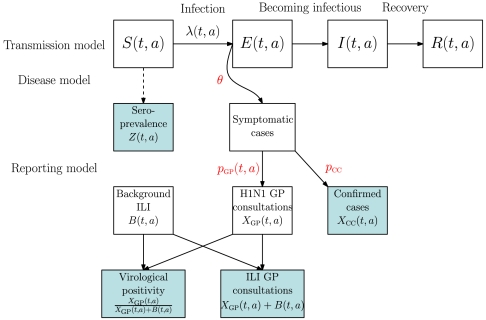
Model schematic diagram representing the data-generating process. The shaded boxes represent the quantities upon which we make observation.
Fig. 3.
Fig. 3.
(A) Estimated weekly infections for Greater London, spanning weeks 18 to 52 of 2009, as reconstructed from the model. The black line is the total incidence of infections over all ages and the dotted lines represent a 95% CrI. (B) The cumulative incidence of GP consultations (black line) versus the estimated (posterior median) cumulative incidence of infection (red line), both expressed as a fraction of the respective total incidence. (C) The estimated propensity for incident adult symptomatic cases to consult with a GP over time (black line). The red and blue lines present the propensity for ILI cases to call and visit (respectively) their GP from an Internet-based survey, FluSurvey (SI Materials and Methods).
Fig. 4.
Fig. 4.
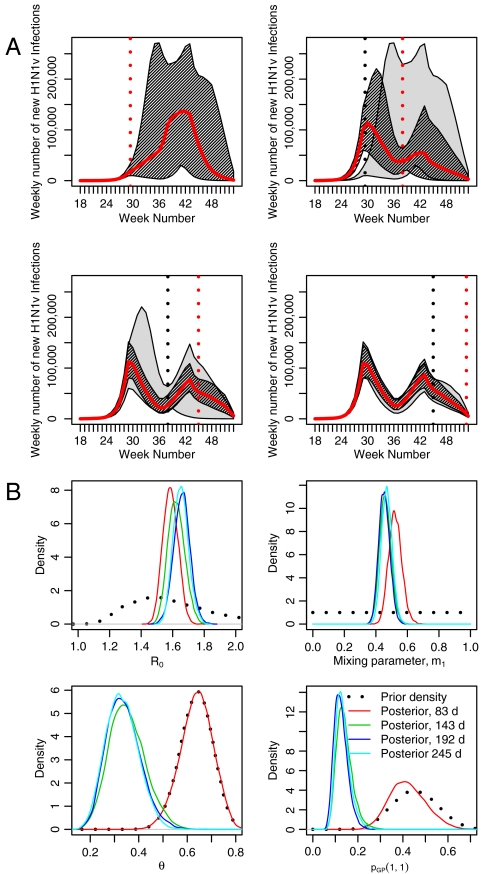
(A) Sequential epidemic reconstructions/projections based on 83, 143, 192, and 245 d of surveillance data. The gray shaded area shows the 95% CrI for the epidemic construction from the temporally previous analysis, with the darker shaded area showing the “current” analysis. The solid red line indicates the posterior median number of infections, the dotted red vertical line shows the time at which the surveillance data ends, and the dotted gray vertical line shows the time at which the previous batch of surveillance data ended. (B) Sequentially obtained posterior density estimates, plotted alongside corresponding prior distributions for the parameters R0, m1, θ, and pGP(1,1).

References

    1. Fleming DM. Weekly Returns Service of the Royal College of General Practitioners. Commun Dis Public Health. 1999;2:96–100. - PubMed
    1. Harcourt SE, et al. Use of a large general practice syndromic surveillance system to monitor the progress of the influenza A(H1N1) pandemic 2009 in the UK. Epidemiol Infect. 2011 . - DOI - PubMed
    1. Miller E, et al. Incidence of 2009 pandemic influenza A H1N1 infection in England: a cross-sectional serological study. Lancet. 2010;375:1100–1108. - PubMed
    1. Fleming DM. Influenza surveillance, the swine-flu pandemic, and the importance of virology. Clin Evid. 2009 Nov 16;
    1. Rubin GJ, Potts HW, Michie S. The impact of communications about swine flu (influenza A H1N1v) on public responses to the outbreak: Results from 36 national telephone surveys in the UK. Health Technol Assess (Rocky) 2010;14:183–266. - PubMed

Publication types

MeSH terms