


MET amplification identifies a small and aggressive subgroup of esophagogastric adenocarcinoma with evidence of responsiveness to crizotinib
- PMID: 22042947
- PMCID: PMC3255989
- DOI: 10.1200/JCO.2011.35.4928
MET amplification identifies a small and aggressive subgroup of esophagogastric adenocarcinoma with evidence of responsiveness to crizotinib
Abstract
Purpose: Amplification of the MET proto-oncogene in gastroesophageal cancer (GEC) may constitute a molecular marker for targeted therapy. We examined a GEC cohort with follow-up and reported the clinical response of four additional patients with MET-amplified tumors to the small molecule inhibitor crizotinib as part of an expanded phase I cohort study.
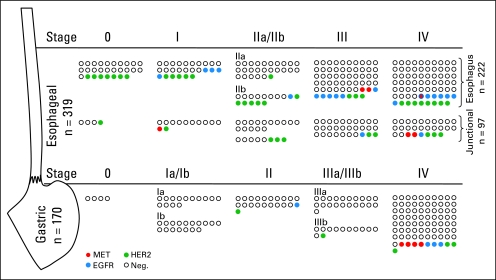
Patients and methods: From 2007 to 2009, patients with GEC were genetically screened as a consecutive series of 489 tumors (stages 0, I, and II, 39%; III, 25%; IV, 36%; n = 222 esophageal, including n = 21 squamous carcinomas). MET, EGFR, and HER2 amplification status was assessed by using fluorescence in situ hybridization.
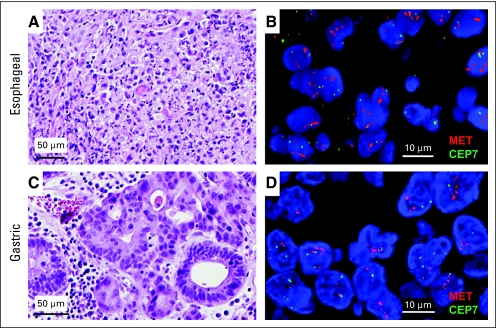
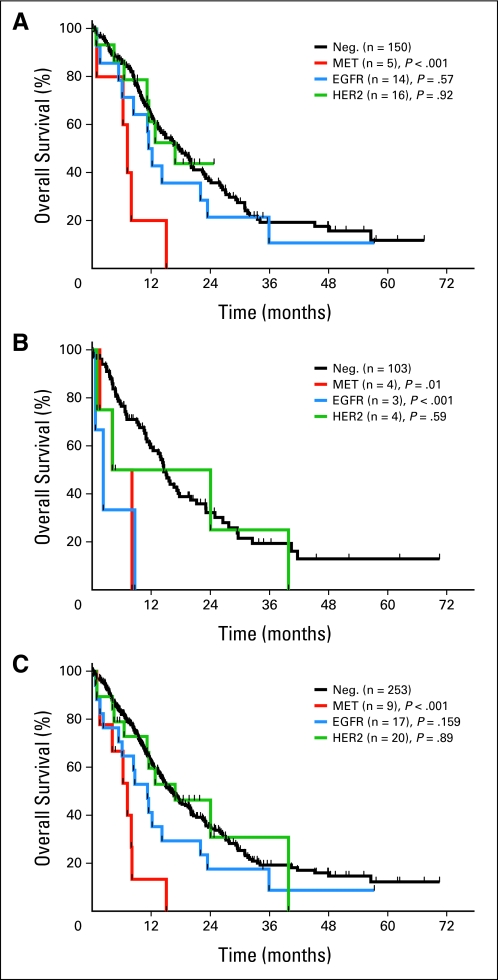
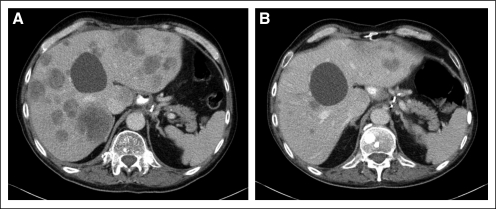
Results: Ten (2%) of 489 patients screened harbored MET amplification; 23 (4.7%) harbored EGFR amplification; 45 (8.9%) harbored HER2 amplification; and 411 (84%) were wild type for all three genes (ie, negative). MET-amplified tumors were typically high-grade adenocarcinomas that presented at advanced stages (5%; n = 4 of 80). EGFR-amplified tumors showed the highest fraction of squamous cell carcinoma (17%; n = 4 of 23). HER2, MET, and EGFR amplification were, with one exception (MET and EGFR positive), mutually exclusive events. Survival analysis in patients with stages III and IV disease showed substantially shorter median survival in MET/EGFR-amplified groups, with a rank order for all groups by median survival (from most to least aggressive): MET (7.1 months; P < .001) less than EGFR (11.2 months; P = .16) less than HER2 (16.9 months; P = .89) when compared with the negative group (16.2 months). Two of four patients with MET-amplified tumors treated with crizotinib experienced tumor shrinkage (-30% and -16%) and experienced progression after 3.7 and 3.5 months.
Conclusion: MET amplification defines a small and aggressive subset of GEC with indications of transient sensitivity to the targeted MET inhibitor crizotinib (PF-02341066).
Conflict of interest statement
Authors' disclosures of potential conflicts of interest and author contributions are found at the end of this article.
Figures
Comment in
-
MET signaling pathway: a rational target for cancer therapy.J Clin Oncol. 2011 Dec 20;29(36):4837-8. doi: 10.1200/JCO.2011.37.7929. Epub 2011 Oct 31. J Clin Oncol. 2011. PMID: 22042966 No abstract available.
References
-
- Ajani JA. Gastroesophageal cancers: Progress and problems. J Natl Compr Canc Netw. 2008;6:813–814. - PubMed
-
- Macdonald JS, Smalley SR, Benedetti J, et al. Chemoradiotherapy after surgery compared with surgery alone for adenocarcinoma of the stomach or gastroesophageal junction. N Engl J Med. 2001;345:725–730. - PubMed
-
- Cooper JS, Guo MD, Herskovic A, et al. Chemoradiotherapy of locally advanced esophageal cancer: Long-term follow-up of a prospective randomized trial (RTOG 85-01)—Radiation Therapy Oncology Group. JAMA. 1999;281:1623–1627. - PubMed
-
- Juergens RA, Forastiere A. Combined modality therapy of esophageal cancer. J Natl Compr Canc Netw. 2008;6:851–860. quiz 861. - PubMed
-
- Javeri H, Arora R, Correa AM, et al. Influence of induction chemotherapy and class of cytotoxics on pathologic response and survival after preoperative chemoradiation in patients with carcinoma of the esophagus. Cancer. 2008;113:1302–1308. - PubMed
Publication types
MeSH terms
Substances
Grants and funding
LinkOut - more resources
Full Text Sources
Other Literature Sources
Medical
Research Materials
Miscellaneous
