. 2010 Nov;1(1):8-16.
doi: 10.3945/an.110.1004. Epub 2010 Nov 16.

Epigenetics: A New Bridge between Nutrition and Health

Affiliations

Epigenetics: A New Bridge between Nutrition and Health

Sang-Woon Choi et al. Adv Nutr. 2010 Nov.

Abstract

Nutrients can reverse or change epigenetic phenomena such as DNA methylation and histone modifications, thereby modifying the expression of critical genes associated with physiologic and pathologic processes, including embryonic development, aging, and carcinogenesis. It appears that nutrients and bioactive food components can influence epigenetic phenomena either by directly inhibiting enzymes that catalyze DNA methylation or histone modifications, or by altering the availability of substrates necessary for those enzymatic reactions. In this regard, nutritional epigenetics has been viewed as an attractive tool to prevent pediatric developmental diseases and cancer as well as to delay aging-associated processes. In recent years, epigenetics has become an emerging issue in a broad range of diseases such as type 2 diabetes mellitus, obesity, inflammation, and neurocognitive disorders. Although the possibility of developing a treatment or discovering preventative measures of these diseases is exciting, current knowledge in nutritional epigenetics is limited, and further studies are needed to expand the available resources and better understand the use of nutrients or bioactive food components for maintaining our health and preventing diseases through modifiable epigenetic mechanisms.


Conflict of interest statement

Author disclosures: S-W. Choi and S. Friso, no conflicts of interest.

Figures
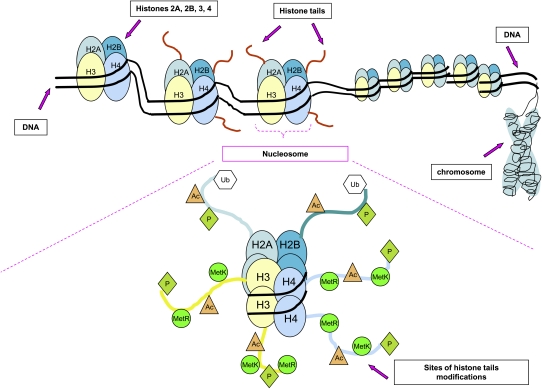
Figure 1
Figure 1
Nucleosome and histone modifications. Each nucleosome comprises an octamer of histone molecules and double-stranded DNA. The amino termini of histones, which are called histone tails, can be post-translationally modified and function as signal integration platforms. The main epigenetic modifications at histone tail sites are: lysine and arginine methylation (MetK and MetR, respectively), phosphorylation (P), acetylation (Ac), and ubiquitination (Ub).
Figure 2
Figure 2
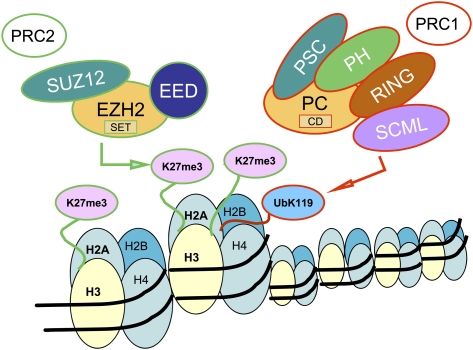
Scheme for the PRC signaling. Polycomb group proteins are structurally and functionally diverse and form large multimeric complexes of 2 general types: PRC1 and PRC2. The PRC2 (green contours) possesses H3K27 methyltransferase activity through the function of the EZH2 subunit, together with embryonic ectoderm development (EED) and suppressor of Zeste 12 homolog (SUZ12). The PRC1 complex (red contours) is recruited by the affinity of chromodomains in chromobox proteins to the H3K27 trimethylation mark. PRC1 exists in multiple forms that contain polycomb proteins (PC), RING proteins, PH proteins, and Sex combs on midleg proteins (SCML) and catalyzes the ubiquitination of histone H2A on lysine 119 following the H3K27 methylation.

References

    1. Kirkland JB. Niacin status impacts chromatin structure. J Nutr. 2009;139:2397–401 - PubMed
    1. Zhu JK. Active DNA demethylation mediated by DNA glycosylases. Annu Rev Genet. 2009;43:143–66 - PMC - PubMed
    1. Tahiliani M, Koh KP, Shen Y, Pastor WA, Bandukwala H, Brudno Y, Agarwal S, Iyer LM, Liu DR, et al. Conversion of 5-methylcytosine to 5-hydroxymethylcytosine in mammalian DNA by MLL partner TET1. Science. 2009;324:930–5 - PMC - PubMed
    1. Liutkeviciute Z, Lukinavicius G, Masevicius V, Daujotyte D, Klimasauskas S. Cytosine-5-methyltransferases add aldehydes to DNA. Nat Chem Biol. 2009;5:400–2 - PubMed
    1. Jin SG, Kadam S, Pfeifer GP. Examination of the specificity of DNA methylation profiling techniques towards 5-methylcytosine and 5-hydroxymethylcytosine. Nucleic Acids Res. 2010;38:e125. - PMC - PubMed