


Red blood cell transfusion and increased length of storage are not associated with deep vein thrombosis in medical and surgical critically ill patients: a prospective observational cohort study
- PMID: 22044745
- PMCID: PMC3388665
- DOI: 10.1186/cc10526
Red blood cell transfusion and increased length of storage are not associated with deep vein thrombosis in medical and surgical critically ill patients: a prospective observational cohort study
Abstract
Introduction: With prolonged storage times, cell membranes of red blood cells (RBCs) undergo morphologic and biochemical changes, termed 'RBC storage lesions'. Storage lesions may promote inflammation and thrombophilia when transfused. In trauma patients, RBC transfusion was an independent risk factor for deep vein thrombosis (DVT), specifically when RBC units were stored > 21 days or when 5 or more units were transfused. The objective of this study was to determine if RBC transfusions or RBC storage age predicts incident DVT in medical or surgical intensive care unit (ICU) patients.
Methods: Using a database which prospectively enrolled 261 patients over the course of 1 year with an ICU stay of at least 3 days, we analyzed DVT and RBC transfusions using Cox proportional hazards regression. Transfusions were analyzed with 4 thresholds, and storage age using 3 thresholds. DVTs were identified by twice-weekly proximal leg ultrasounds. Multivariable analyses were adjusted for 4 significant DVT predictors in this population (venous thrombosis history, chronic dialysis, platelet transfusion and inotropes).
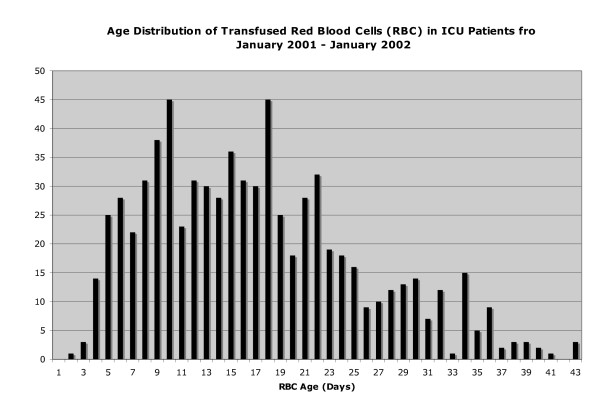
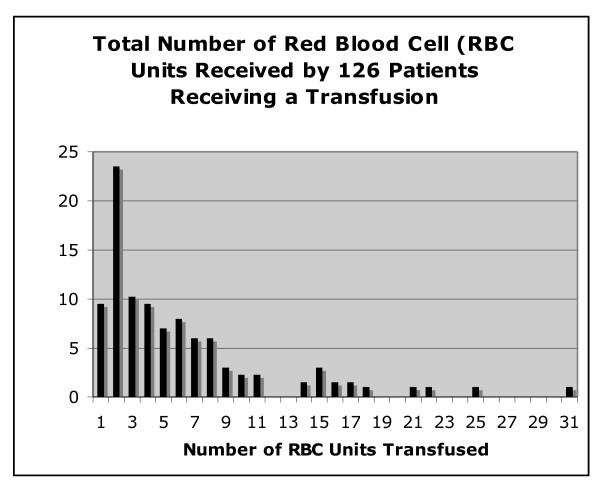
Results: Of 261 patients, 126 (48.3%) had at least 1 RBC transfusion; 46.8% of those transfused had ≥ 5 units in ICU. Patients receiving RBCs were older (68.8 vs 64.1 years), more likely to be female (47.0 vs 30.7), sicker (APACHEII 26.8 vs 24.4), and more likely to be surgical (21.4 vs 8.9) (P < 0.05). The total number of RBCs per patient was 1-64, mean was 6.3 (SD 7.5), median was 4 (IQR 2,8). In univariate analyses, there was no association between DVT and RBC exposure (1 day earlier, 3 days earlier, 7 days earlier, or ever) or RBC storage (≤ 7 or > 7 days, ≤ 14 or > 14 days, ≤ 21 or > 21 days). Among patients transfused, no multivariable analyses showed that RBC transfusion or storage age predicted DVT. Trends were counter to the hypothesis (e.g., RBC storage for ≤ 7 days suggested a higher DVT risk compared to > 7 days (HR 5.3; 95% CI 1.3-22.1).
Conclusions: We were unable to detect any association between RBC transfusions or prolonged red cell storage and increased risk of DVT in medical or surgical ICU patients. Alternate explanations include a lack of sufficient events or patients' interaction, between patient groups, a mixing of red cell storage times creating differential effects on DVT risk, and unmeasured confounders.
Figures
References
-
- Corwin HL, Gettinger A, Pearl RG, Fink MP, Levy MM, Abraham E, MacIntyre NR, Shabot MM, Duh MS, Shapiro MJ. The CRIT Study: anemia and blood transfusion in the critically ill--current clinical practice in the United States. Crit Care Med. 2004;32:39–52. doi: 10.1097/01.CCM.0000104112.34142.79. - DOI - PubMed
-
- Oliver E, Carrio ML, Rodríguez-Castro D, Javierre C, Farrero E, Torrado H, Castells E, Ventura JL. Relationships among haemoglobin level, packed red cell transfusion and clinical outcomes in patients after cardiac surgery. Int Care Med. 2009;35:1548–1555. doi: 10.1007/s00134-009-1526-0. - DOI - PubMed
Publication types
MeSH terms
Grants and funding
LinkOut - more resources
Full Text Sources
Medical
