


Metabolic reserve as a determinant of cognitive aging
- PMID: 22045480
- PMCID: PMC4445414
- DOI: 10.3233/JAD-2011-110899
Metabolic reserve as a determinant of cognitive aging
Abstract
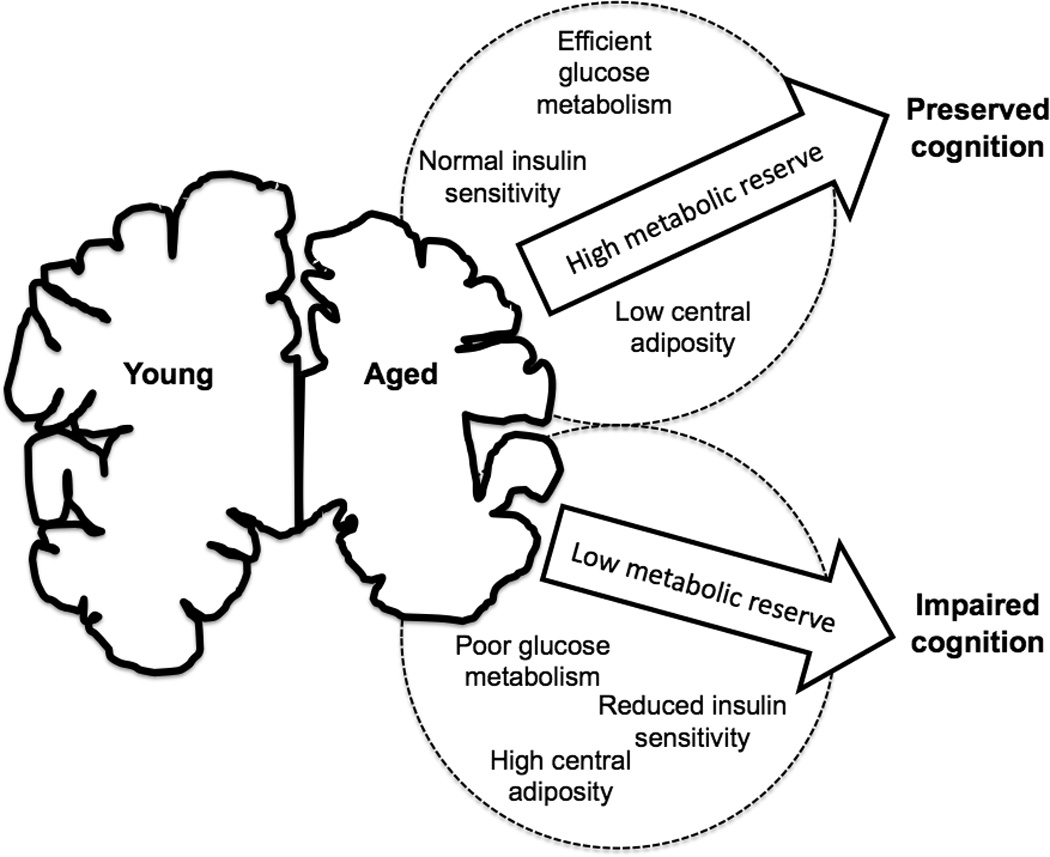
Mild cognitive impairment (MCI) and Alzheimer's disease (AD) represent points on a continuum of cognitive performance in aged populations. Cognition may be impaired or preserved in the context of brain aging. One theory to account for memory maintenance in the context of extensive pathology involves 'cognitive reserve', or the ability to compensate for neuropathology through greater recruitment of remaining neurons. In this review, we propose a complementary hypothesis of 'metabolic reserve', where a brain with high metabolic reserve is characterized by the presence of neuronal circuits that respond adaptively to perturbations in cellular and somatic energy metabolism and thereby protects against declining cognition. Lifestyle determinants of metabolic reserve, such as exercise, reduced caloric intake, and intake of specific dietary components can promote neuroprotection, while pathological states arising from sedentary lifestyles and excessive caloric intake contribute to neuronal endangerment. This bidirectional relationship between metabolism and cognition may be mediated by alterations in central insulin and neurotrophic factor signaling and glucose metabolism, with downstream consequences for accumulation of amyloid-β and hyperphosphorylated tau. The metabolic reserve hypothesis is supported by epidemiological findings and the spectrum of individual cognitive trajectories during aging, with additional data from animal models identifying potential mechanisms for this relationship. Identification of biomarkers for metabolic reserve could assist in generating a predictive model for the likelihood of cognitive decline with aging.
Figures
References
-
- Albert MS, Blacker D. Mild cognitive impairment and dementia. Annu Rev Clin Psychol. 2008;2:379–388. - PubMed
-
- Evans DA, Beckett LA, Field TS, Feng L, Albert MS, Bennett DA, Tycko B, Mayeux R. Apolipoprotein E epsilon4 and incidence of Alzheimer disease in a community population of older persons. JAMA. 1997;277:822–824. - PubMed
-
- Hillman CH, Erickson KI, Kramer AF. Be smart, exercise your heart: exercise effects on brain and cognition. Nat Rev Neurosci. 2008;9:58–65. - PubMed
-
- Luchsinger JA, Tang MX, Shea S, Mayeux R. Caloric intake and the risk of Alzheimer disease. Arch Neurol. 2002;59:1258–1263. - PubMed
Publication types
MeSH terms
Grants and funding
LinkOut - more resources
Full Text Sources
Other Literature Sources
Medical
