


Review
doi: 10.1007/s00018-011-0870-8.
Epub 2011 Nov 2.
Regulation of neutrophil trafficking from the bone marrow
Affiliations
- PMID: 22045556
- PMCID: PMC11114822
- DOI: 10.1007/s00018-011-0870-8
Item in Clipboard
Review
Regulation of neutrophil trafficking from the bone marrow
Cell Mol Life Sci.
2012 May.
Abstract
Neutrophils are an essential component of the innate immune response and a major contributor to inflammation. Consequently, neutrophil homeostasis in the blood is highly regulated. Neutrophil number in the blood is determined by the balance between neutrophil production in the bone marrow and release from the bone marrow to blood with neutrophil clearance from the circulation. This review will focus on mechanisms regulating neutrophil release from the bone marrow. In particular, recent data demonstrating a central role for the chemokines CXCL12 and CXCL2 in regulating neutrophil egress from the bone marrow will be discussed.
Figures
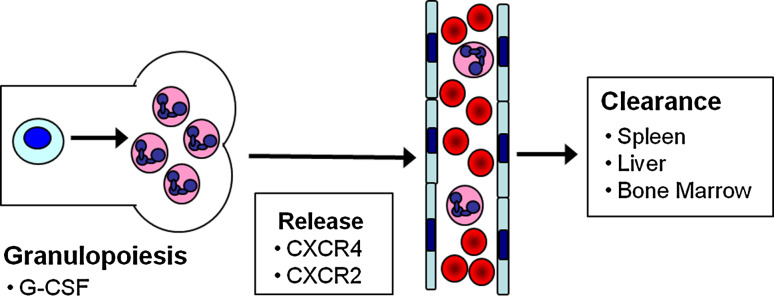
Neutrophil homeostasis: neutrophil number in the blood reflects a balance between neutrophil production (granulopoiesis) in the bone marrow and release into the blood with clearance from the blood in the spleen, liver and bone marrow. G-CSF is the principal cytokine driving granulopoiesis. Neutrophil release from the bone marrow is regulated by the opposing actions of CXCR4 and CXCR2 signaling. CXCR4 also contributes to neutrophil clearance from the blood

Tug-of-war model: CXCL12 (pink diamonds) expression from endosteal osteoblasts and other bone marrow stromal cells promotes the retention of neutrophils in the bone marrow, while endothelial and megakaryocytic CXCL2 (yellow circles) promotes the entry of neutrophils into the circulation. Under basal conditions, the balance of these chemokines favors neutrophil retention, with only a small fraction of neutrophils released into the circulation. In myelokathexis, mutations enhancing CXCR4 signaling or decreasing CXCR2 signaling result in abnormal bone marrow retention of neutrophils. G-CSF treatment alters the balance of chemokines in the bone marrow by both increasing CXCL2 expression from the endothelium and decreasing CXCL12 expression from osteoblast lineage cells. The net result of these changes is neutrophil mobilization into the circulation
References
-
- Demetri GD, Griffin JD. Granulocyte colony-stimulating factor and its receptor. Blood. 1991;78(11):2791–2808. - PubMed
-
- Lieschke GJ, Grail D, Hodgson G, Metcalf D, Stanley E, Cheers C, Fowler KJ, Basu S, Zhan YF, Dunn AR. Mice lacking granulocyte colony-stimulating factor have chronic neutropenia, granulocyte and macrophage progenitor cell deficiency, and impaired neutrophil mobilization. Blood. 1994;84(6):1737–1746. - PubMed
Publication types
MeSH terms
Substances
Grants and funding
LinkOut - more resources
Full Text Sources
