


The biology of aging: 1985-2010 and beyond
- PMID: 22046003
- PMCID: PMC4050331
- DOI: 10.1096/fj.11-1102.ufm
The biology of aging: 1985-2010 and beyond
Erratum in
- FASEB J. 2012 Oct;26(10):4384
Abstract
In this contribution to the series of reflective essays celebrating the 25th anniversary of The FASEB Journal, our task is to assess the growth of research on the biology of aging during this period and to suggest where we might be heading during the next 25 yr. A review of the literature suggests a healthy acceleration of progress during the past decade, perhaps largely due to progress on the genetics of longevity of model organisms. Progress on the genetics of health span in these model organisms has lagged, however. Research on the genetic basis of the remarkable interspecific variations in life span has only recently begun to be seriously addressed. The spectacular advances in genomics should greatly accelerate progress. Research on environmental effects on life span and health span needs to be accelerated. Stochastic variations in gene expression in aging have only recently been addressed. These can lead to random departures from homeostasis during aging.-Martin, G. M. The biology of aging: 1985-2010 and beyond.
Conflict of interest statement
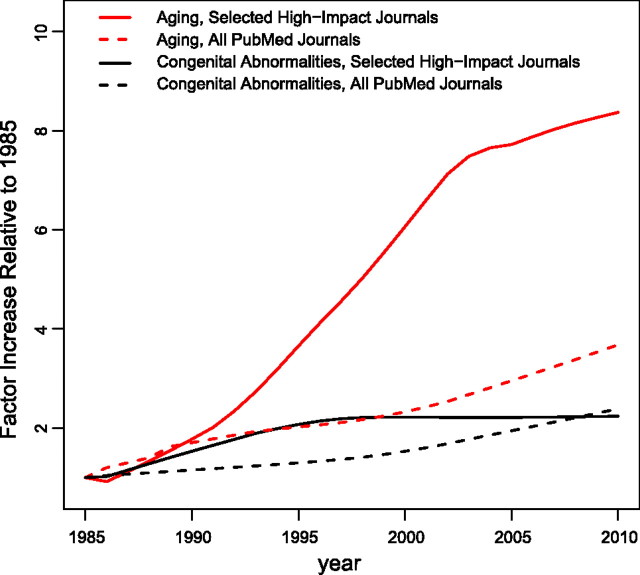
The author thanks Mr. Brian Park for PubMed searches and Dr. Mary Emond (Department of Biostatistics, University of Washington, Seattle, WA, USA) for statistical analysis of the data of Fig. 1. Supported in part by NIH grants R24CA078088, P01AG001751 and R01AG019711.
Figures
References
-
- Wadman M. (2010) Funding crisis hits US ageing research. Nature , 148 - PubMed
-
- Morris J. Z., Tissenbaum H. A., Ruvkun G. (1996) A phosphatidylinositol-3-OH kinase family member regulating longevity and diapause in Caenorhabditis elegans. Nature , 536–539 - PubMed
-
- Kenyon C., Chang J., Gensch E., Rudner A., Tabtiang R. (1993) A C-elegans mutant that lives twice as long as wild-type. Nature , 461–464 - PubMed
Publication types
MeSH terms
Substances
Grants and funding
LinkOut - more resources
Full Text Sources
Medical
Miscellaneous
