


High prevalence of primary multidrug resistant tuberculosis in persons with no known risk factors
- PMID: 22046266
- PMCID: PMC3203110
- DOI: 10.1371/journal.pone.0026276
High prevalence of primary multidrug resistant tuberculosis in persons with no known risk factors
Abstract
Introduction: In high multidrug resistant (MDR) tuberculosis (TB) prevalence areas, drug susceptibility testing (DST) at diagnosis is recommended for patients with risk factors for MDR. However, this approach might miss a substantial proportion of MDR-TB in the general population. We studied primary MDR in patients considered to be at low risk of MDR-TB in Lima, Peru.
Methods: We enrolled new sputum smear-positive TB patients who did not report any MDR-TB risk factor: known exposure to a TB patient whose treatment failed or who died or who was known to have MDR-TB; immunosuppressive co-morbidities, ex prison inmates; prison and health care workers; and alcohol or drug abuse. A structured questionnaire was applied to all enrolled participants to confirm the absence of these factors and thus minimize underreporting. Sputum from all participants was cultured on Löwenstein-Jensen media and DST for first line drugs was performed using the 7H10 agar method.
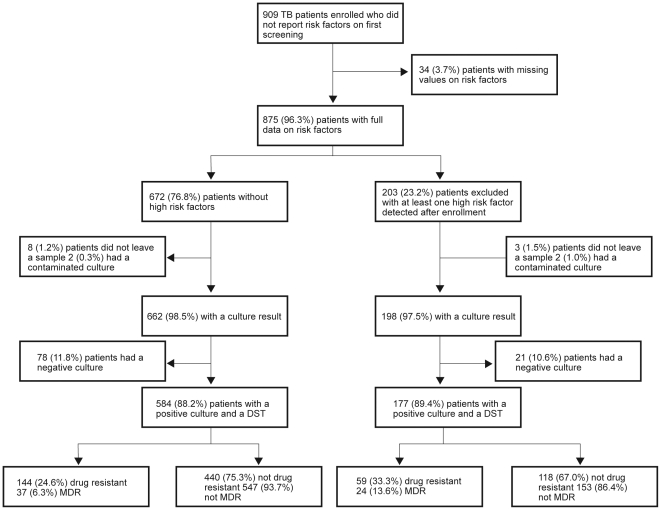
Results: Of 875 participants with complete data, 23.2% (203) had risk factors for MDR-TB elicited after enrolment. Among the group with no reported risk factors who had a positive culture, we found a 6.3% (95%CI 4.4-8.3) (37/584) rate of MDR-TB. In this group no epidemiological characteristics were associated with MDR-TB. Thus, in this group, multidrug resistance occurred in patients with no identifiable risk factors.
Conclusions: We found a high rate of primary MDR-TB in a general population with no identifiable risk factors for MDR-TB. This suggests that in a high endemic area targeting patients for MDR-TB based on the presence of risk factors is an insufficient intervention.
Conflict of interest statement
Figures
References
-
- World Health Organization (WHO) World Health Organization Global Report 2009. 2010. Available: http://www.who.int/tb/publications/global_report/en/ Accessed 2011 Jan 12.
-
- WHO. Guidelines for the programmatic management of drug-resistant tuberculosis WHO/HTM/TB/2008.402. 2008. Available: http://whqlibdoc.who.int/publications/2008/9789241547581_eng.pdf. Accessed 2011 Jan 4.
-
- Caminero JA. Multidrug-resistant tuberculosis: epidemiology, risk factors and case finding. Int J Tuberc Lung Dis. 2010;14(4):382–390. - PubMed
-
- WHO. The WHO/IUATLD Global project of anti-tuberculosis drug resistance surveillance. . 2008. Anti-tuberculosis Drug Resistance in the World. Report N°4. WHO/HTM/TB/2008.394. Available: http://www.who.int/tb/publications/2008/drs_report4_26feb08.pdf. Accessed 2011 Jan 4.
Publication types
MeSH terms
LinkOut - more resources
Full Text Sources
