


Assessing the dream-lag effect for REM and NREM stage 2 dreams
- PMID: 22046336
- PMCID: PMC3202556
- DOI: 10.1371/journal.pone.0026708
Assessing the dream-lag effect for REM and NREM stage 2 dreams
Abstract
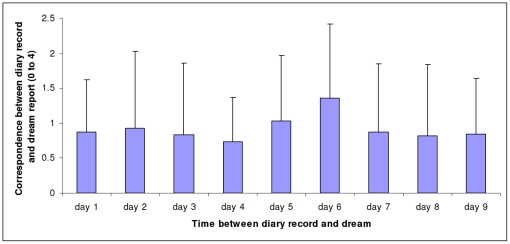
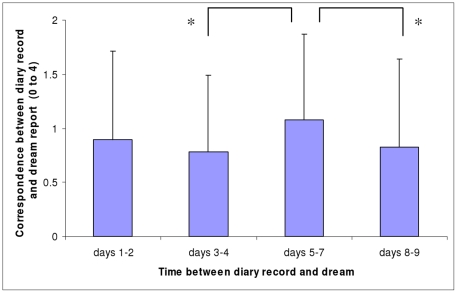
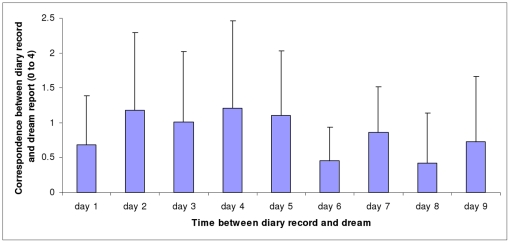
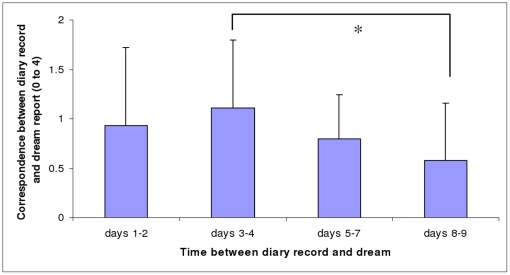
This study investigates evidence, from dream reports, for memory consolidation during sleep. It is well-known that events and memories from waking life can be incorporated into dreams. These incorporations can be a literal replication of what occurred in waking life, or, more often, they can be partial or indirect. Two types of temporal relationship have been found to characterize the time of occurrence of a daytime event and the reappearance or incorporation of its features in a dream. These temporal relationships are referred to as the day-residue or immediate incorporation effect, where there is the reappearance of features from events occurring on the immediately preceding day, and the dream-lag effect, where there is the reappearance of features from events occurring 5-7 days prior to the dream. Previous work on the dream-lag effect has used spontaneous home recalled dream reports, which can be from Rapid Eye Movement Sleep (REM) and from non-Rapid Eye Movement Sleep (NREM). This study addresses whether the dream-lag effect occurs only for REM sleep dreams, or for both REM and NREM stage 2 (N2) dreams. 20 participants kept a daily diary for over a week before sleeping in the sleep laboratory for 2 nights. REM and N2 dreams collected in the laboratory were transcribed and each participant rated the level of correspondence between every dream report and every diary record. The dream-lag effect was found for REM but not N2 dreams. Further analysis indicated that this result was not due to N2 dream reports being shorter, in terms of number of words, than the REM dream reports. These results provide evidence for a 7-day sleep-dependent non-linear memory consolidation process that is specific to REM sleep, and accord with proposals for the importance of REM sleep to emotional memory consolidation.
Conflict of interest statement
Figures
References
-
- Kramer M. The dream experience. A systematic exploration. New York: Brunner-Routledge; 2007. 243
-
- Fosse MJ, Fosse R, Hobson JA, Stickgold RJ. Dreaming and episodic memory: a functional dissociation? J Cogn Neurosci. 2003;15:1–9. - PubMed
-
- Nielsen TA, Kuiken D, Alain G, Stenstrom P, Powell RA. Immediate and delayed incorporations of events into dreams: further replication and implications for dream function. J Sleep Res. 2004;13:327–336. - PubMed
-
- Nielsen TA, Powell RA. Longitudinal dream incorporation: Preliminary evidence of cognitive processing with an infradian period. Sleep Res. 1988;17:112.
-
- Nielsen TA, Powell RA. The ‘dream-lag’ effect: a 6-day temporal delay in dream content incorporation. Psychiat J U Ottawa. 1989;14:561–565. - PubMed
Publication types
MeSH terms
LinkOut - more resources
Full Text Sources
Medical
