. 2011 Nov 2:12:62.
doi: 10.1186/1471-2172-12-62.

Differential expression of CD300a/c on human TH1 and TH17 cells

Affiliations

Differential expression of CD300a/c on human TH1 and TH17 cells

Venkateswara R Simhadri et al. BMC Immunol. .

Abstract

Background: Human memory CD4+ T cells can be either CD300a/c+ or CD300a/c- and subsequent analyses showed that CD4+ effector memory T (T(EM)) cells are mostly CD300a/c+, whereas CD4+ central memory T (T(CM)) cells have similar frequencies of CD300a/c+ and CD300a/c- cells.

Results: Extensive phenotypical and functional characterization showed that in both T(CM) and T(EM) cells, the CD300a/c+ subset contained a higher number of TH1 (IFN-γ producing) cells. Alternatively, TH17 (IL-17a producing) cells tend to be CD300a/c-, especially in the T(EM) subset. Further characterization of the IL-17a+ cells showed that cells that produce only this cytokine are mostly CD300a/c-, while cells that produce IL-17a in combination with other cytokines, especially IFN-γ, are mostly CD300a/c+, indicating that the expression of this receptor is associated with cells that produce IFN-γ. Co-ligation of the TCR and CD300a/c in CD4+ T cells inhibited Ca2+ mobilization evoked by TCR ligation alone and modulated IFN-γ production on TH1 polarized cells.

Conclusion: We conclude that the CD300a/c receptors are differentially expressed on human TH1 and TH17 cells and that their ligation is capable of modulating TCR mediated signals.


Figures
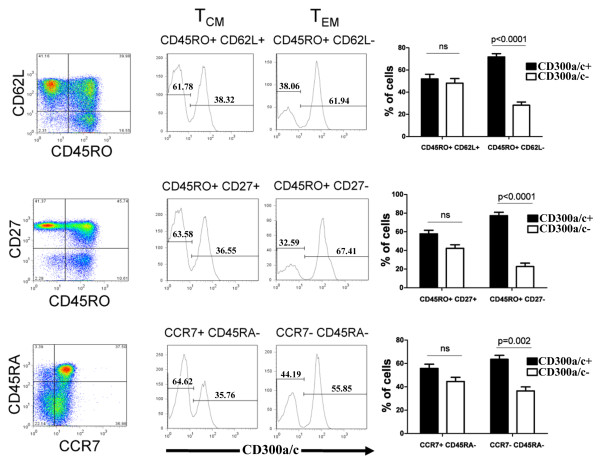
Figure 1
Figure 1
Flow cytometric analysis of human peripheral blood CD4+ T cells. The expression of CD300a/c on central (TCM) and effector memory (TEM) CD4+ T cells was determined with three staining strategies: CD45RO and CD62L (upper panels), CD45RO and CD27 (middle panels) and CD45RA and CCR7 (lower panels). A representative donor is shown for each staining. Bar graphs represent the average ± SEM of the percentage of CD300a/c+ cells within TCM and TEM. Results shown are from 12 healthy donors.
Figure 2
Figure 2
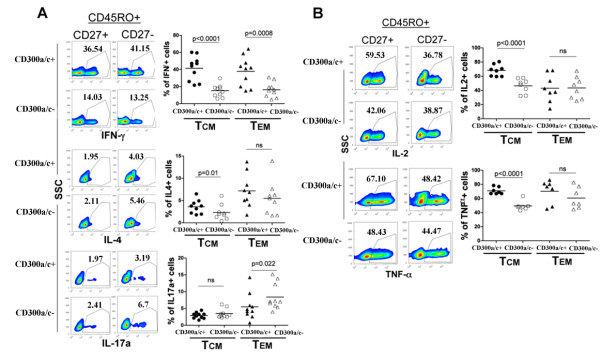
Flow cytometric analyses of stimulated CD4+ T cells. Purified CD4+ T cells were stimulated with PMA and ionomycin for 4-5 h in the presence of GolgiStop (monensin). The expression of CD300a/c was determined in the TCM (CD45RO+CD27+) and TEM (CD45RO+CD27-) cytokine producing cells. A representative healthy donor is shown for (A) the IFN-γ, IL-4 and IL-17a, and (B) IL-2 and TNF-α producing cells. Each graph represents the percentage of CD300a/c+ and CD300a/c- TCM and TEM cells that produce a given cytokine. Each symbol corresponds to a different donor.
Figure 3
Figure 3
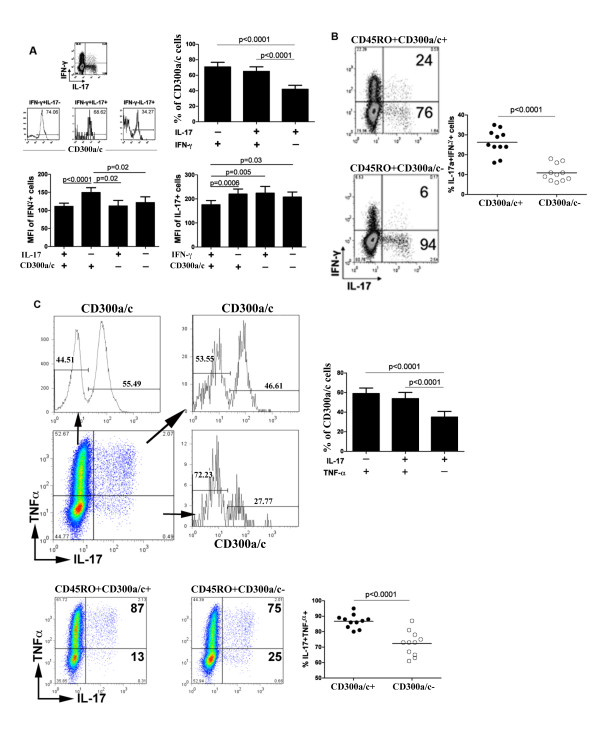
CD300a/c is differentially expressed on IFN-γ, TNF-α and IL-17a producing CD4+ T cells. (A) Purified CD4+ T cells were stimulated with PMA and ionomycin for 4-5 h in the presence of GolgiStop (monensin). Then, cells were stained for intracellular production of IFN-γ and IL-17a, and cell surface expression of CD300a/c. Analysis of cells from a representative donor is shown. The bar graphs represent the average ± SEM of the percentage of CD300a/c+ cells within the cytokine producing cells and the average ± SEM of the MFI of IFN-γ expression and IL-17a expression within the cytokine producing cells. Results are from 11 healthy donors. (B) Percentage of cells producing both IFN-γ and IL-17a within the IL-17a producing CD45RO+CD300a/c+ and CD45RO+CD300a/c- subsets is shown. Analysis of cells from a representative donor (left) and a graph (right) with the results for all donors are presented. (C) The experiments are the same as in A and B, except cells were stained for intracellular production of TNF-α and IL-17a.
Figure 4
Figure 4
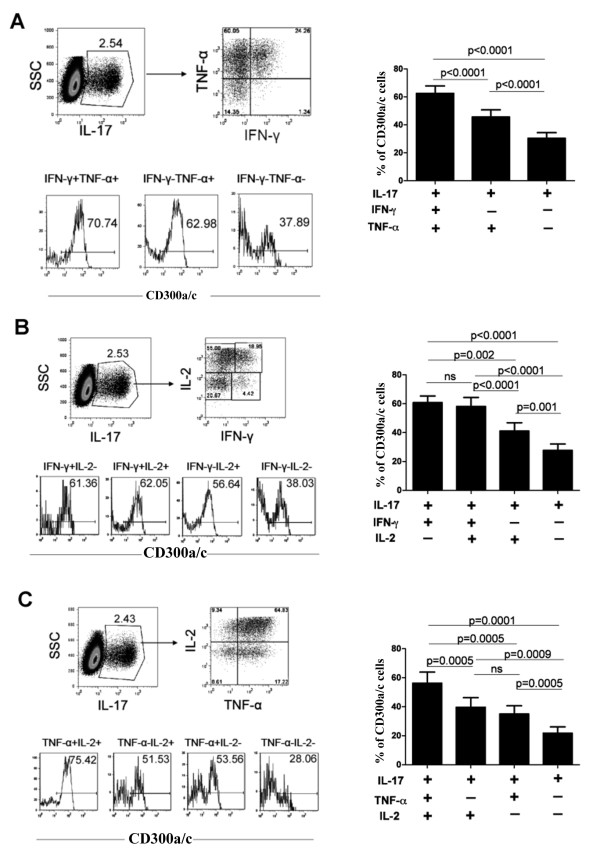
IL-17a single producing cells tend to be CD300a/c-. Purified CD4+ T cells were stimulated with PMA and ionomycin for 4-5 h in the presence of GolgiStop (monensin). Then, cells were stained for cell surface expression of CD300a/c and intracellular production of IL-17a and other cytokines. A representative donor is shown for (A) IL-17a, for TNF-α and IFN-γ producing cells, (B) IL-17a, IL-2 and IFN-γ producing cells, and for (C) IL-17a, IL-2 and TNF-α producing cells. Graph bars represent the average ± SEM of the percentage of CD300a/c+ cells within the cytokine producing cells. Results are from 8-12 healthy donors.
Figure 5
Figure 5
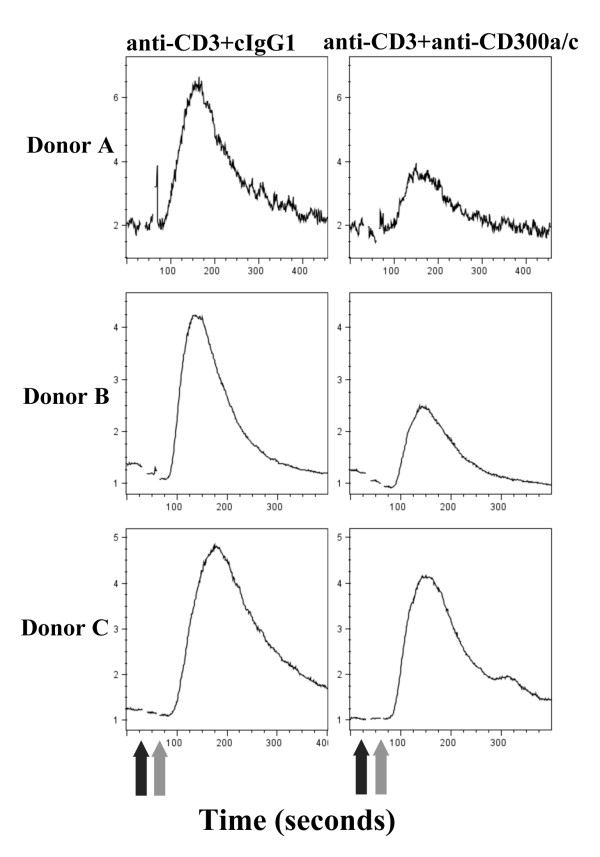
CD300a/c modulates TCR mediated Ca2+ flux. CD4+ T cell lines were generated from healthy donors. Cells were loaded with Fluo-4 and Fura-Red. Then, cells were acquired in a flow cytometer, and after a baseline reading of 30 s, anti-CD3 plus anti-CD300a/c mAb or anti-CD3 plus isotype control mAb (black arrows) were added. Goat anti-mouse Ab was added 30 s later to cross-link the primary mAb (grey arrows). Intracellular Ca2+ concentration was measured by the ratio of Fluo-4/Fura Red as a function of time.

References

    1. Zhu J, Paul WE. CD4 T cells: fates, functions, and faults. Blood. 2008;112:1557–69. doi: 10.1182/blood-2008-05-078154. - DOI - PMC - PubMed
    1. Afkarian M, Sedy JR, Yang J, Jacobson NG, Cereb N, Yang SY, Murphy TL, Murphy KM. T-bet is a STAT1-induced regulator of IL-12R expression in naive CD4+ T cells. Nat Immunol. 2002;3:549–57. - PubMed
    1. Bafica A, Scanga CA, Feng CG, Leifer C, Cheever A, Sher A. TLR9 regulates Th1 responses and cooperates with TLR2 in mediating optimal resistance to Mycobacterium tuberculosis. J Exp Med. 2005;202:1715–24. doi: 10.1084/jem.20051782. - DOI - PMC - PubMed
    1. Caspi R. Autoimmunity in the immune privileged eye: pathogenic and regulatory T cells. Immunol Res. 2008;42:41–50. doi: 10.1007/s12026-008-8031-3. - DOI - PMC - PubMed
    1. Foulds KE, Wu CY, Seder RA. Th1 memory: implications for vaccine development. Immunol Rev. 2006;211:58–66. doi: 10.1111/j.0105-2896.2006.00400.x. - DOI - PubMed

Publication types

MeSH terms

LinkOut - more resources