


Mapping and pyramiding of two major genes for resistance to the brown planthopper (Nilaparvata lugens [Stål]) in the rice cultivar ADR52
- PMID: 22048639
- PMCID: PMC3265730
- DOI: 10.1007/s00122-011-1723-4
Mapping and pyramiding of two major genes for resistance to the brown planthopper (Nilaparvata lugens [Stål]) in the rice cultivar ADR52
Abstract
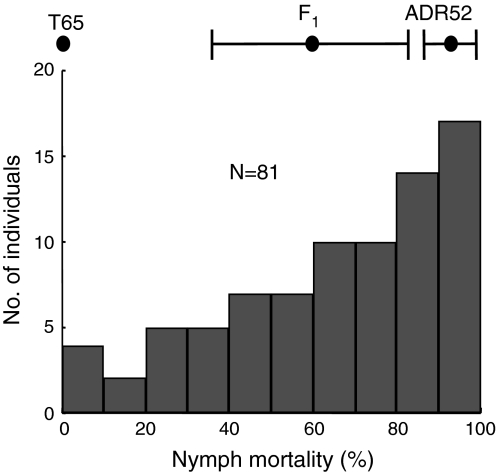
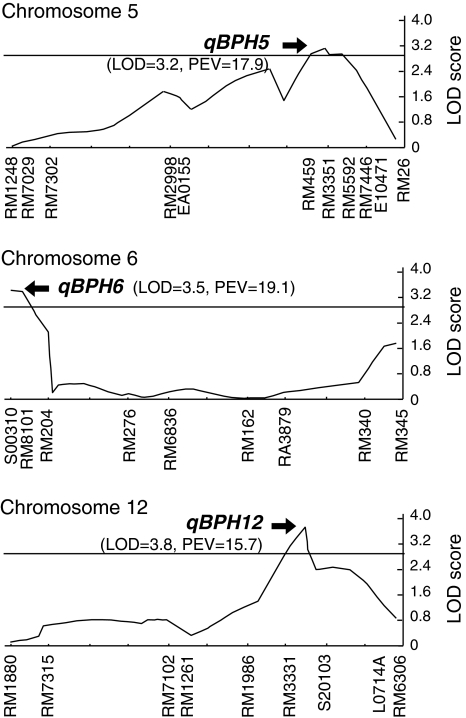
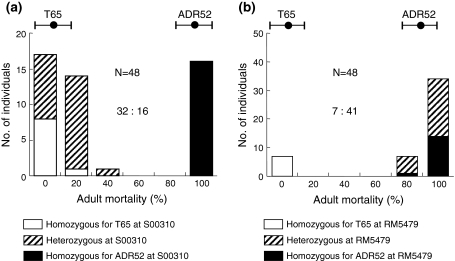
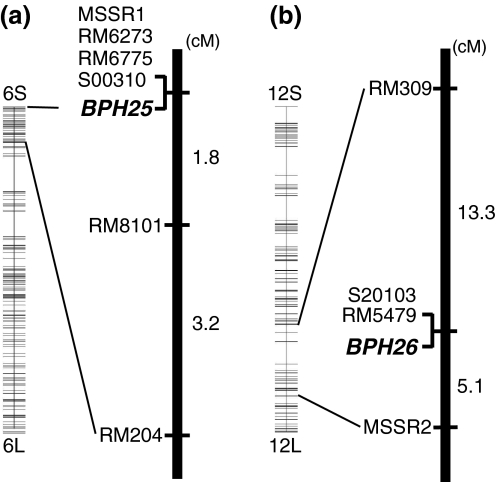
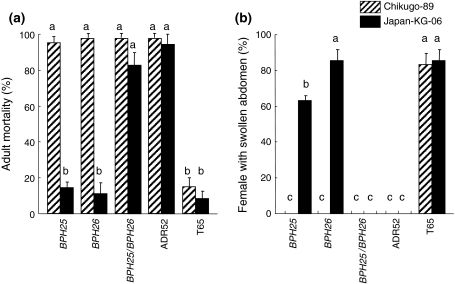
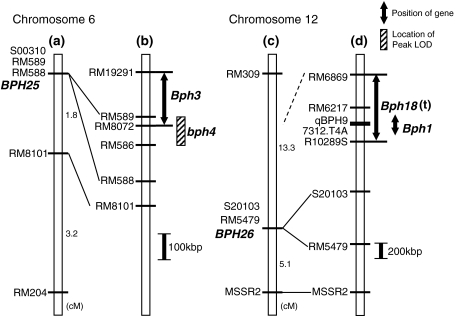
The brown planthopper (BPH), Nilaparvata lugens (Stål), is one of the most serious and destructive pests of rice, and can be found throughout the rice-growing areas of Asia. To date, more than 24 major BPH-resistance genes have been reported in several Oryza sativa ssp. indica cultivars and wild relatives. Here, we report the genetic basis of the high level of BPH resistance derived from an Indian rice cultivar, ADR52, which was previously identified as resistant to the whitebacked planthopper (Sogatella furcifera [Horváth]). An F(2) population derived from a cross between ADR52 and a susceptible cultivar, Taichung 65 (T65), was used for quantitative trait locus (QTL) analysis. Antibiosis testing showed that multiple loci controlled the high level of BPH resistance in this F(2) population. Further linkage analysis using backcross populations resulted in the identification of BPH-resistance (antibiosis) gene loci from ADR52. BPH25 co-segregated with marker S00310 on the distal end of the short arm of chromosome 6, and BPH26 co-segregated with marker RM5479 on the long arm of chromosome 12. To characterize the virulence of the most recently migrated BPH strain in Japan, preliminary near-isogenic lines (pre-NILs) and a preliminary pyramided line (pre-PYL) carrying BPH25 and BPH26 were evaluated. Although both pre-NILs were susceptible to the virulent BPH strain, the pre-PYL exhibited a high level of resistance. The pyramiding of resistance genes is therefore likely to be effective for increasing the durability of resistance against the new virulent BPH strain in Japan.
Figures
References
-
- Cha YS, Ji H, Yun DW, Ahn BO, Lee MC, Suh SC, Lee CS, Ahn EK, Jeon YH, Jin ID, Sohn JK, Koh HJ, Eun MY. Fine mapping of the rice Bph1 gene, which confers resistance to the brown planthopper (Nilaparvata lugens Stål), and development of STS markers for marker-assisted selection. Mol Cells. 2008;26:146–151. - PubMed
-
- Deen R, Ramesh K, Gautam SK, Rao YK, Lakshmi VJ, Viraktamath BC, Brar DS, Ram T. Identification of new gene for BPH resistance introgressed from O. rufipogon. Rice Genet Newsl. 2010;25:70–72.
-
- Dellaporta SL, Wood J, Hicks JB. A plant DNA mini preparation: version II. Plant Mol Biol Rep. 1983;1:19–21. doi: 10.1007/BF02712670. - DOI
Publication types
MeSH terms
Substances
LinkOut - more resources
Full Text Sources
Other Literature Sources
Research Materials
Miscellaneous
