. 2012 Jan;166(1):69-75.
doi: 10.1530/EJE-11-0571. Epub 2011 Nov 2.

Nuclear receptor NR5A2 and bone: gene expression and association with bone mineral density

Affiliations

Nuclear receptor NR5A2 and bone: gene expression and association with bone mineral density

José A Riancho et al. Eur J Endocrinol. 2012 Jan.

Abstract

Objective: There is growing evidence for a link between energy and bone metabolism. The nuclear receptor subfamily 5 member A2 (NR5A2) is involved in lipid metabolism and modulates the expression of estrogen-related genes in some tissues. The objective of this study was to explore the influence of NR5A2 on bone cells and to determine whether its allelic variations are associated with bone mineral density (BMD).

Design: Analyses of gene expression by quantitative PCR and inhibition of NR5A2 expression by siRNAs were used to explore the effects of NR5A2 in osteoblasts. Femoral neck BMD and 30 single nucleotide polymorphisms (SNPs) were first analyzed in 935 postmenopausal women and the association of NR5A2 genetic variants with BMD was explored in other 1284 women in replication cohorts.

Results: NR5A2 was highly expressed in bone. The inhibition of NR5A2 confirmed that it modulates the expression of osteocalcin, osteoprotegerin, and podoplanin in osteoblasts. Two SNPs were associated with BMD in the Spanish discovery cohort (rs6663479, P=0.0014, and rs2816948, P=0.0012). A similar trend was observed in another Spanish cohort, with statistically significant differences across genotypes in the combined analysis (P=0.03). However, the association in a cohort from the United States was rather weak. Electrophoretic mobility assays and studies with luciferase reporter vectors confirmed the existence of differences in the binding of nuclear proteins and the transcriptional activity of rs2816948 alleles.

Conclusions: NR5A2 modulates gene expression in osteoblasts and some allelic variants are associated with bone mass in Spanish postmenopausal women.


Conflict of interest statement

Declaration of interest

The authors declare that there is no conflict of interest that could be perceived as prejudicing the impartiality of the research reported.

Figures
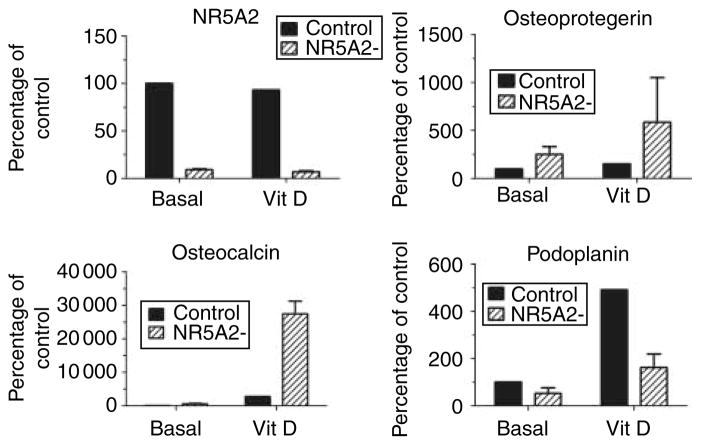
Figure 1
Figure 1
Gene expression in unstimulated and 1,25-dihydroxyvitamin D3-stimulated HOS-TE85 osteoblastic cells. The results represent the mean and S.D. of gene expression in two clones with stable inhibition of NR5A2, shown as the percentage of gene expression in unstimulated control cells. Similar results were obtained in three independent experiments.
Figure 2
Figure 2
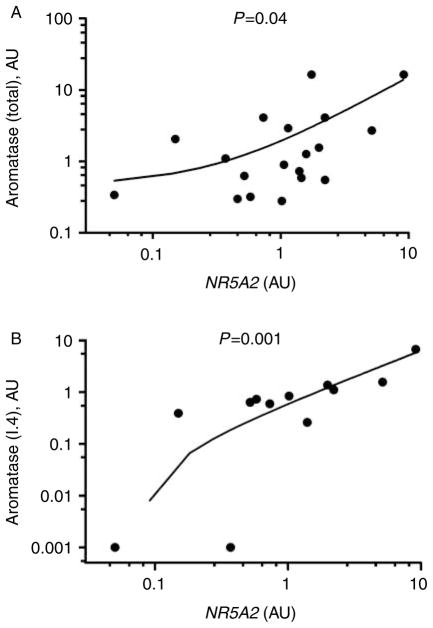
Relationship between NR5A2 and aromatase expression in bone samples (A, total aromatase; B, I.4-transcripts). Arbitrary units after normalization by TBP expression.
Figure 3
Figure 3
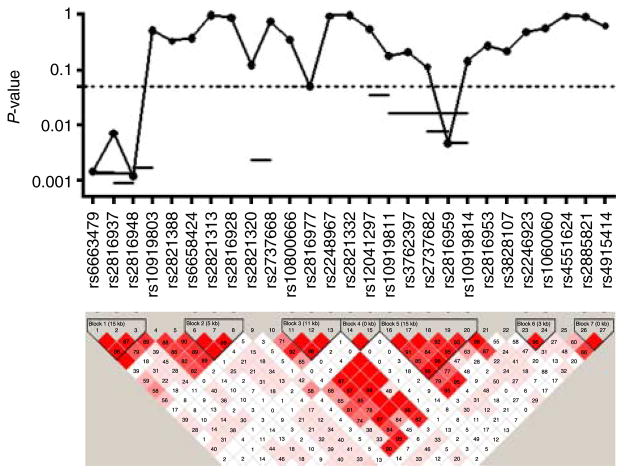
Association of NR5A2 polymorphisms with femoral neck BMD in the Cantabria cohort. P values for the single-locus and haplotypic analyses (only significant haplotypes are shown). The haplotypic structure of the NR5A2 gene is also shown. Full colour version of this figure available via http://dx.doi.org/10.1530/EJE-11-0571.
Figure 4
Figure 4
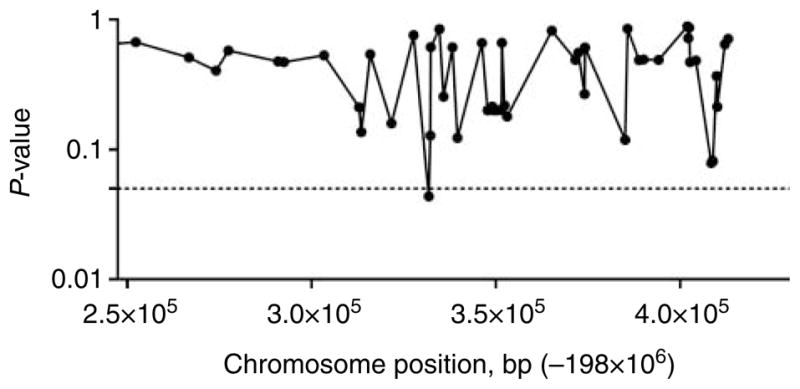
Association of NR5A2 polymorphisms with femoral neck BMD in postmenopausal women of the Kansas City cohort. The chromosome position of the SNPs included in the array is shown in the horizontal axis (from 198247394 through 198429625, which is the region explored in the discovery cohort with the SNPs included in Fig. 3).
Figure 5
Figure 5
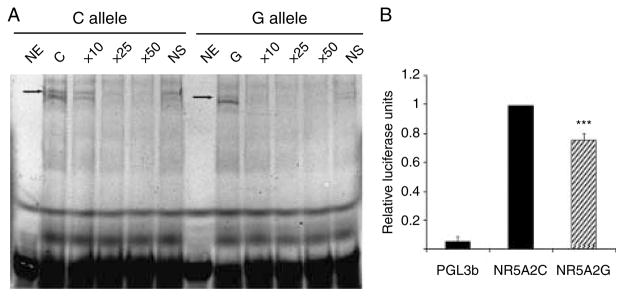
Functional studies. (A) The six lanes on the left correspond to experiments done with a labeled oligonucleotide specific for allele C of the rs2816948 polymorphism, whereas in the six lanes on the right a labeled oligonucleotide specific for allele G was used. NE indicates that no extract was added to the labeled probe. In lanes labeled C and G, nuclear extracts were added to labeled C- and G-specific probes respectively. In lanes labeled 10×, 25×, and 50×, a 10-, 25-, and 50-fold excess of an unlabeled C-specific oligonucleotide was used for interfering the formation of the complexes by either C-specific or G-specific probes. In the lanes labeled as NS, a 50-fold excess of a nonspecific probe was used for competition. The specific complex is indicated with an arrow. (B) Differences in the transcriptional activities of C- and G-specific fragments when cloned in a luciferase reporter vector. The results are the average of four different experiments (***P<0.005).

References

    1. Lee NK, Sowa H, Hinoi E, Ferron M, Ahn JD, Confavreux C, Dacquin R, Mee PJ, McKee MD, Jung DY, Zhang Z, Kim JK, Mauvais-Jarvis F, Ducy P, Karsenty G. Endocrine regulation of energy metabolism by the skeleton. Cell. 2007;130:456–469. doi: 10.1016/j.cell.2007.05.047. - DOI - PMC - PubMed
    1. Clemens TL, Karsenty G. The osteoblast: an insulin target cell controlling glucose homeostasis. Journal of Bone and Mineral Research. 2011;26:677–680. doi: 10.1002/jbmr.321. - DOI - PubMed
    1. Russell M, Mendes N, Miller KK, Rosen CJ, Lee H, Klibanski A, Misra M. Visceral fat is a negative predictor of bone density measures in obese adolescent girls. Journal of Clinical Endocrinology and Metabolism. 2010;95:1247–1255. doi: 10.1210/jc.2009-1475. - DOI - PMC - PubMed
    1. Zhao J, Bradfield JP, Li M, Zhang H, Mentch FD, Wang K, Sleiman PM, Kim CE, Glessner JT, Frackelton EC, Chiavacci RM, Berkowitz RI, Zemel BS, Hakonarson H, Grant SF. BMD-associated variation at the osterix locus is correlated with childhood obesity in females. Obesity. 2011;19:1311–1314. doi: 10.1038/oby.2010.324. - DOI - PubMed

    1. Xu Z, Ouyang L, Castillo-Olivares A, Pandak WM, Gil G. Alpha(1)-fetoprotein transcription factor (FTF)/liver receptor homolog-1 (LRH-1) is an essential lipogenic regulator. Biochimica et Biophysica Acta. 2010;1801:473–479. - PMC - PubMed

Publication types

Substances