


A high intake of saturated fatty acids strengthens the association between the fat mass and obesity-associated gene and BMI
- PMID: 22049296
- PMCID: PMC3223879
- DOI: 10.3945/jn.111.143826
A high intake of saturated fatty acids strengthens the association between the fat mass and obesity-associated gene and BMI
Abstract
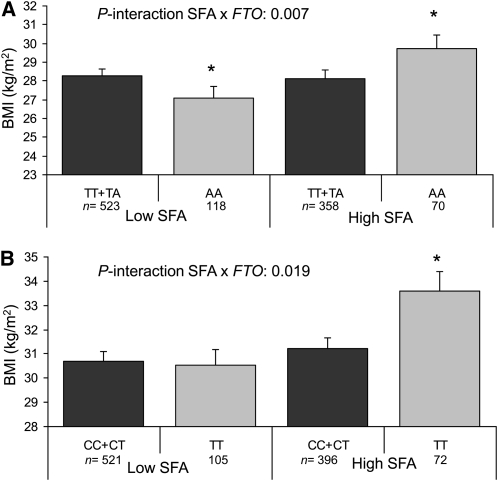
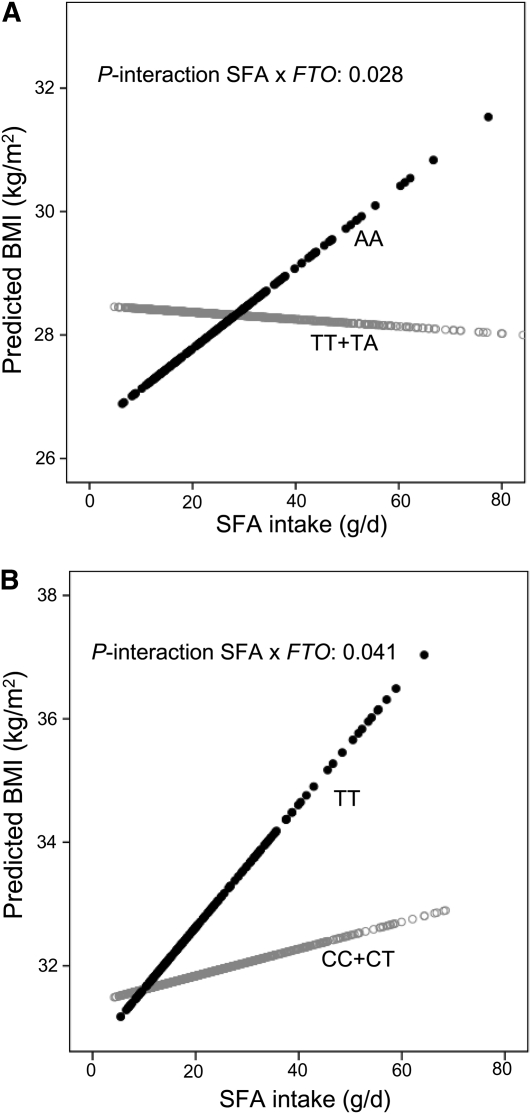
Evidence that physical activity (PA) modulates the association between the fat mass and obesity-associated gene (FTO) and BMI is emerging; however, information about dietary factors modulating this association is scarce. We investigated whether fat and carbohydrate intake modified the association of FTO gene variation with BMI in two populations, including participants in the Genetics of Lipid Lowering Drugs and Diet Network (GOLDN) study (n = 1069) and in the Boston Puerto Rican Health (BPRHS) study (n = 1094). We assessed energy, nutrient intake, and PA using validated questionnaires. Genetic variability at the FTO locus was characterized by polymorphisms rs9939609 (in the GOLDN) and rs1121980 (in the GOLDN and BPRHS). We found significant interactions between PA and FTO on BMI in the GOLDN but not in the BPRHS. We found a significant interaction between SFA intake and FTO on BMI, which was stronger than that of total fat and was present in both populations (P-interaction = 0.007 in the GOLDN and P-interaction = 0.014 in BPRHS for categorical; and P-interaction = 0.028 in the GOLDN and P-interaction = 0.041 in BPRHS for continuous SFA). Thus, homozygous participants for the FTO-risk allele had a higher mean BMI than the other genotypes only when they had a high-SFA intake (above the population mean: 29.7 ± 0.7 vs. 28.1 ± 0.5 kg/m²; P = 0.037 in the GOLDN and 33.6. ± 0.8 vs. 31.2 ± 0.4 kg/m²; P = 0.006 in BPRHS). No associations with BMI were found at lower SFA intakes. We found no significant interactions with carbohydrate intake. In conclusion, SFA intake modulates the association between FTO and BMI in American populations.
Conflict of interest statement
Author disclosures: D. Corella, D. K. Arnett, K. L. Tucker, E. K. Kabagambe, M. Tsai, L. D. Parnell, C. Q. Lai, Y. C. Lee, D. Warodomwichit, P. N. Hopkins, and J. M. Ordovas, no conflicts of interest.
Figures
References
-
- Dina C, Meyre D, Gallina S, Durand E, Körner A, Jacobson P, Carlsson LM, Kiess W, Vatin V, Lecoeur C, et al. Variation in FTO contributes to childhood obesity and severe adult obesity. Nat Genet. 2007;39:724–6 - PubMed
-
- Peeters A, Beckers S, Verrijken A, Roevens P, Peeters P, Van Gaal L, Van Hul W. Variants in the FTO gene are associated with common obesity in the Belgian population. Mol Genet Metab. 2008;93:481–4 - PubMed
Publication types
MeSH terms
Substances
Grants and funding
LinkOut - more resources
Full Text Sources
Medical
Molecular Biology Databases
