


Preoperative proteinuria predicts acute kidney injury in patients undergoing cardiac surgery
- PMID: 22050987
- PMCID: PMC3341084
- DOI: 10.1016/j.jtcvs.2011.09.023
Preoperative proteinuria predicts acute kidney injury in patients undergoing cardiac surgery
Abstract
Objective: The study objective was to examine the utility of using proteinuria in preoperative risk stratification for acute kidney injury. Acute kidney injury is a common and important complication for patients undergoing cardiac surgery. Proteinuria, which reflects structural damage to the glomeruli or renal tubules, may aid the prediction of acute kidney injury.
Methods: The urine albumin to creatinine ratio and dipstick proteinuria concentration were prospectively measured in 1159 patients undergoing cardiac surgery. The cohort was organized into 4 clinical risk categories based on the preoperative urine albumin to creatinine ratio: 10 mg/g or less (≤ 1.1 mg/mmol), 11 to 29 mg/g (1.2-3.3 mg/mmol), 30 to 299 mg/g (3.4-33.8 mg/mmol), and 300 mg/g or greater (≥ 33.9 mg/mmol). The primary outcome was postoperative acute kidney injury, defined by the Acute Kidney Injury Network stage I criterion (serum creatinine increase ≥ 50% or ≥ 0.3 mg/dL; 26.5 μmol/L).
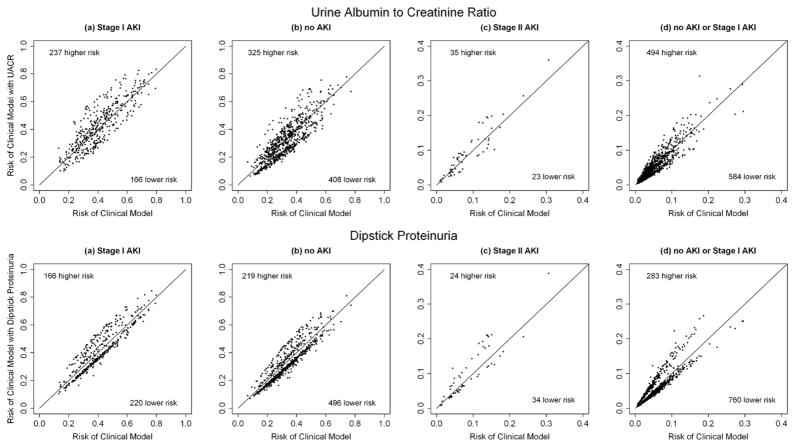
Results: An increase in the incidence of acute kidney injury was noted across the urine albumin to creatinine ratio categories. Adding the urine albumin to creatinine ratio to the clinical model to predict acute kidney injury improved the area under the curve from 0.67 to 0.70 (P < .001), and the continuous net reclassification improvement was 29% (P < .001). The urine albumin to creatinine ratio was also independently associated with the risk of in-hospital dialysis and intensive care unit and hospital lengths of stay. Surgery status and preoperative glomerular filtration rate were effect modifiers; the association was stronger among those undergoing elective surgery and those with an estimated glomerular filtration rate of 45 mL/min/1.73 m(2) or greater.
Conclusions: Preoperative proteinuria provides graded stratification risk for acute kidney injury and is an independent predictor of other outcomes in patients undergoing cardiac surgery.
Trial registration: ClinicalTrials.gov NCT00774137.
Copyright © 2012 The American Association for Thoracic Surgery. Published by Mosby, Inc. All rights reserved.
Figures
References
-
- Loef BG, Epema AH, Smilde TD, Henning RH, Ebels T, Navis G, et al. Immediate postoperative renal function deterioration in cardiac surgical patients predicts in-hospital mortality and long-term survival. J Am Soc Nephrol. 2005;16:195–200. - PubMed
-
- Ishani A, Nelson D, Clothier B, Schult T, Nugent S, Greer N, et al. The magnitude of acute serum creatinine increase after cardiac surgery and the risk of chronic kidney disease, progression of kidney disease, and death. Arch Intern Med. 2011;14:226–33. - PubMed
-
- Higgins TL, Estafanous FG, Loop FD, Beck GJ, Blum JM, Paranandi L. Stratification of morbidity and mortality outcome by preoperative risk factors in coronary artery bypass patients. A clinical severity score. JAMA. 1992;267:2344–8. - PubMed
-
- Lombardi R, Ferreiro A. Risk factors profile for acute kidney injury after cardiac surgery is different according to the level of baseline renal function. Ren Fail. 2008;30:155–60. - PubMed
