


"Environmental hypertensionology" the effects of environmental factors on blood pressure in clinical practice and research
- PMID: 22051429
- PMCID: PMC8108751
- DOI: 10.1111/j.1751-7176.2011.00543.x
"Environmental hypertensionology" the effects of environmental factors on blood pressure in clinical practice and research
Abstract
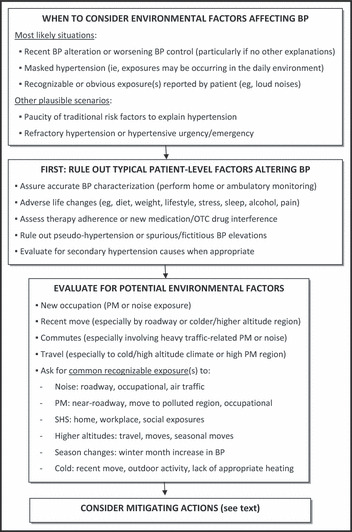
Blood pressure (BP) is affected by many environmental factors including ambient temperature, altitude, latitude, noise, and air pollutants. Given their pervasiveness, it is plausible that such factors may also have an impact on hypertension prevalence and control rates. Health care providers should be aware that the environment can play a significant role in altering BP. Although not among the established modifiable risk factors (eg, obesity) for hypertension, reducing exposures when pertinent should be considered to prevent or control hypertension. The authors provide a concise review of the evidence linking diverse environmental factors with BP and suggest an approach for incorporating this knowledge into clinical practice. The authors propose using the term environmental hypertensionology to refer to the study of the effects of environmental factors on BP in clinical and research settings.
© 2011 Wiley Periodicals, Inc.
Figures
References
-
- Mancia G, Laurent S, Agabiti‐Rosei E, et al. Reappraisal of European guidelines on hypertension management: a European Society of Hypertension Take Force document. J Hypertens. 2009;27:2121–2158. - PubMed
-
- Chobaninan AV, Bakris GL, Black HR, et al. The seventh report of the Joint National Committee on prevention, detection, evaluation, and treatment of high blood pressure. JAMA. 2003;289:2560–2572. - PubMed
-
- Bhatnagar A. Environmental cardiology. Studying mechanistic links between pollution and heart disease. Circ Res. 2006;99:692–705. - PubMed
-
- Alpérovitch A, Lacombe J‐M, Hanon O, et al. Relationship between blood pressure and outdoor temperature in a large sample of elderly individuals. The Three‐City Study. Arch Intern Med. 2009;169:75–80. - PubMed
-
- Barnett AG, Sans S, Salomaa V, et al. The effect of temperature on systolic blood pressure. Blood Press Monit. 2007;12:195–203. - PubMed
