


Cigarette smoking and lung cancer--relative risk estimates for the major histological types from a pooled analysis of case-control studies
- PMID: 22052329
- PMCID: PMC3296911
- DOI: 10.1002/ijc.27339
Cigarette smoking and lung cancer--relative risk estimates for the major histological types from a pooled analysis of case-control studies
Abstract
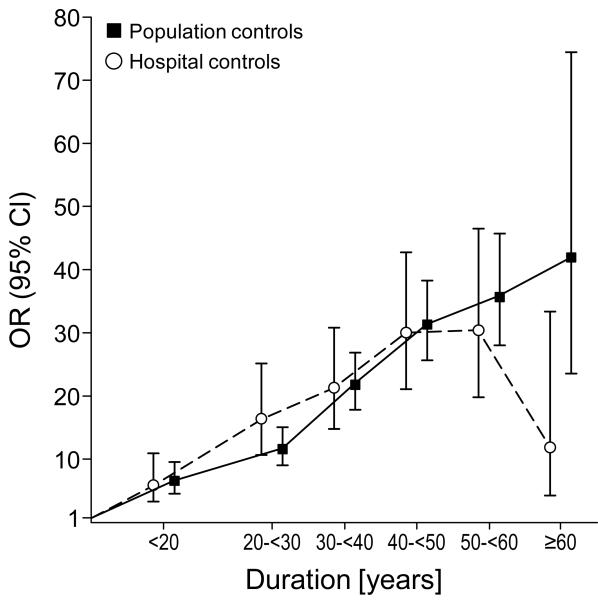
Lung cancer is mainly caused by smoking, but the quantitative relations between smoking and histologic subtypes of lung cancer remain inconclusive. By using one of the largest lung cancer datasets ever assembled, we explored the impact of smoking on risks of the major cell types of lung cancer. This pooled analysis included 13,169 cases and 16,010 controls from Europe and Canada. Studies with population controls comprised 66.5% of the subjects. Adenocarcinoma (AdCa) was the most prevalent subtype in never smokers and in women. Squamous cell carcinoma (SqCC) predominated in male smokers. Age-adjusted odds ratios (ORs) were estimated with logistic regression. ORs were elevated for all metrics of exposure to cigarette smoke and were higher for SqCC and small cell lung cancer (SCLC) than for AdCa. Current male smokers with an average daily dose of >30 cigarettes had ORs of 103.5 (95% confidence interval (CI): 74.8-143.2) for SqCC, 111.3 (95% CI: 69.8-177.5) for SCLC and 21.9 (95% CI: 16.6-29.0) for AdCa. In women, the corresponding ORs were 62.7 (95% CI: 31.5-124.6), 108.6 (95% CI: 50.7-232.8) and 16.8 (95% CI: 9.2-30.6), respectively. Although ORs started to decline soon after quitting, they did not fully return to the baseline risk of never smokers even 35 years after cessation. The major result that smoking exerted a steeper risk gradient on SqCC and SCLC than on AdCa is in line with previous population data and biological understanding of lung cancer development.
Copyright © 2011 UICC.
Figures
References
-
- Sun S, Schiller JH, Gazdar AF. Lung cancer in never smokers--a different disease. Nat Rev Cancer. 2007 Oct;7(10):778–90. - PubMed
-
- Travis WD, Colby TV, Corrin B, Shimosato Y, Brambilla E. Histological typing of lung and pleural tumors. 3 ed. World Health Organisation, Springer; Berlin: 1999. collaborators from 14 countries.
-
- Khuder SA, Dayal HH, Mutgi AB, Willey JC, Dayal G. Effect of cigarette smoking on major histological types of lung cancer in men. Lung Cancer. 1998 Oct;22(1):15–21. - PubMed
-
- Devesa SS, Bray F, Vizcaino AP, Parkin DM. International lung cancer trends by histologic type: male:female differences diminishing and adenocarcinoma rates rising. Int J Cancer. 2005 Nov 1;117(2):294–9. - PubMed
Publication types
MeSH terms
Grants and funding
LinkOut - more resources
Full Text Sources
Other Literature Sources
Medical
