. 2012 Jan;53(1):43-50.
doi: 10.1194/jlr.M019851. Epub 2011 Nov 3.

Crystal structure of the predicted phospholipase LYPLAL1 reveals unexpected functional plasticity despite close relationship to acyl protein thioesterases

Affiliations

Crystal structure of the predicted phospholipase LYPLAL1 reveals unexpected functional plasticity despite close relationship to acyl protein thioesterases

Marco Bürger et al. J Lipid Res. 2012 Jan.

Abstract

Sequence homology indicates the existence of three human cytosolic acyl protein thioesterases, including APT1 that is known to depalmitoylate H- and N-Ras. One of them is the lysophospholipase-like 1 (LYPLAL1) protein that on the one hand is predicted to be closely related to APT1 but on the other hand might also function as a potential triacylglycerol lipase involved in obesity. However, its role remained unclear. The 1.7 Å crystal structure of LYPLAL1 reveals a fold very similar to APT1, as expected, but features a shape of the active site that precludes binding of long-chain substrates. Biochemical data demonstrate that LYPLAL1 exhibits neither phospholipase nor triacylglycerol lipase activity, but rather accepts short-chain substrates. Furthermore, extensive screening efforts using chemical array technique revealed a first small molecule inhibitor of LYPLAL1.


Figures
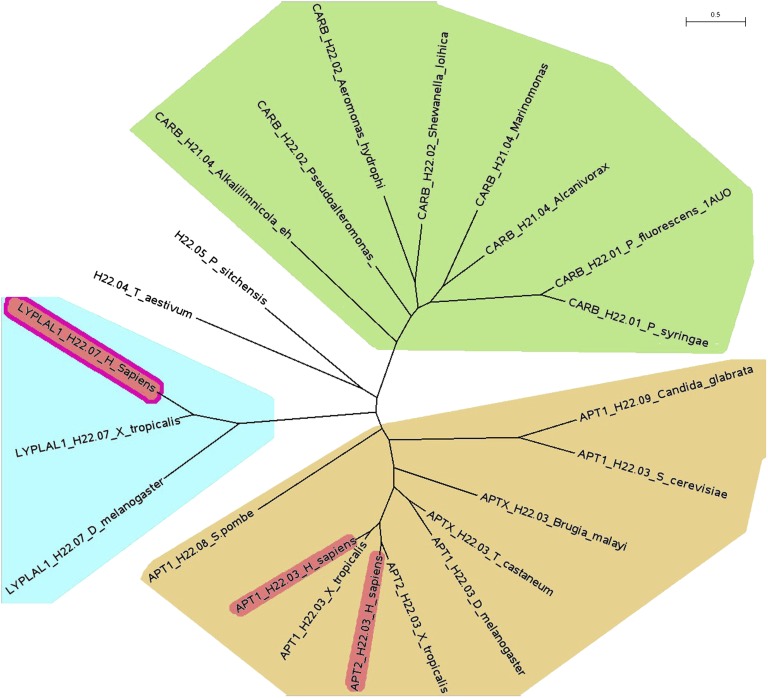
Fig. 1.
Fig. 1.
Phylogenetic tree (23) of LYPLAL1, the closely related acyl protein thioesterases (APT) and representatives of the most similar carboxylesterases. Proteins are labeled with the group identifier, the family name used in the “lipase engineering database” (1) and the species. The LYPLAL1 group (family H22.07) is highlighted in light blue, the APTs (family H22.03) in ochre and the carboxylesterases (several different families) in green. The proteins highlighted in red are the only human representatives in the superfamily H22, the superfamily H21 does not comprise any human proteins. The only available structures in the PDB database are human APT1 (highlighted in red, PDB ID 1fj2), carboxylesterase from Pseudomonas fluorescens (PDB ID 1auo, 2nd from right in the green area) and human LYPLAL1 (highlighted red, from this work).
Fig. 2.
Fig. 2.
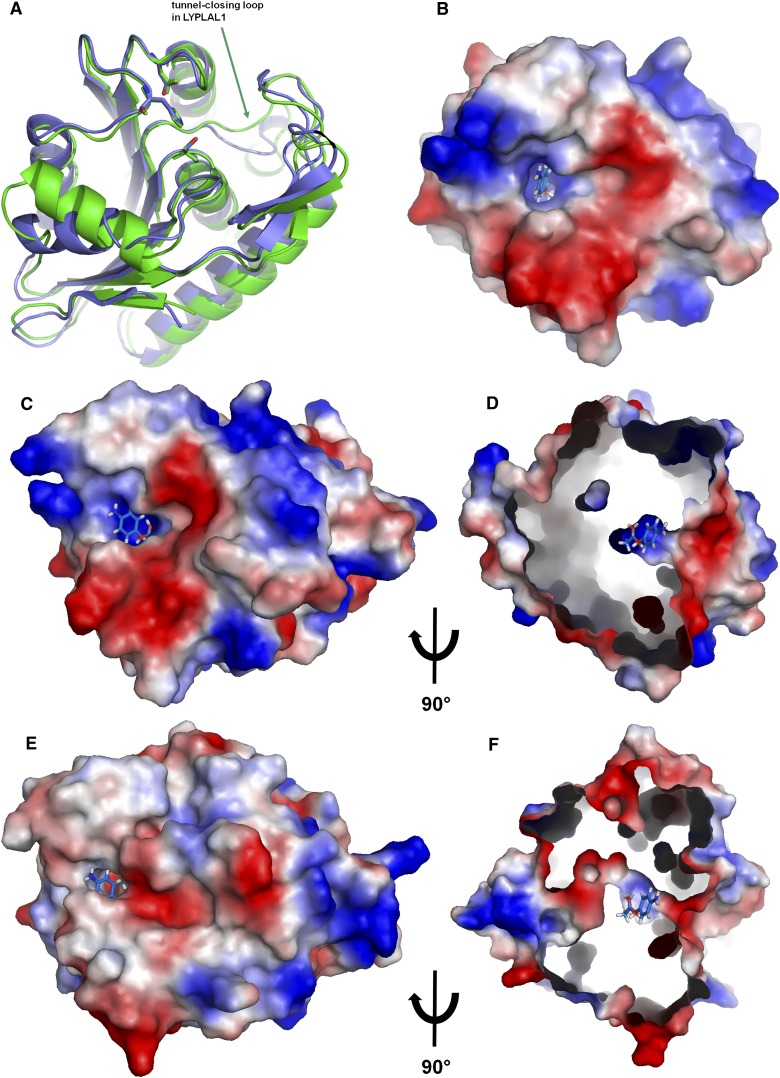
Structural representations of LYPLAL1. A: Crystal structure of LYPLAL1 compared with APT1 (PDB ID 1fj2). The catalytic triad is shown as sticks. B: Active site of LYPLAL1 with a docked 4-nitrophenyl acetate molecule in the same orientation as A. C–F: Comparison of the active site shape between LYPLAL1 [top (C and D)] and APT1 in the same orientation [bottom (E and F), PDB ID 1fj2]. D and F are shown in a side view and the surfaces are cut open to show the active site tunnel of APT1 extending through the protein, in contrast to the shallower active site of LYPLAL1 that does not form a tunnel. The 4-nitrophenyl acetate molecule docked into LYPLAL1 is shown in all four views for comparison. The surfaces are colored according to the electrostatic surface properties. Red represents negative, blue positive potential.
Fig. 3.
Fig. 3.
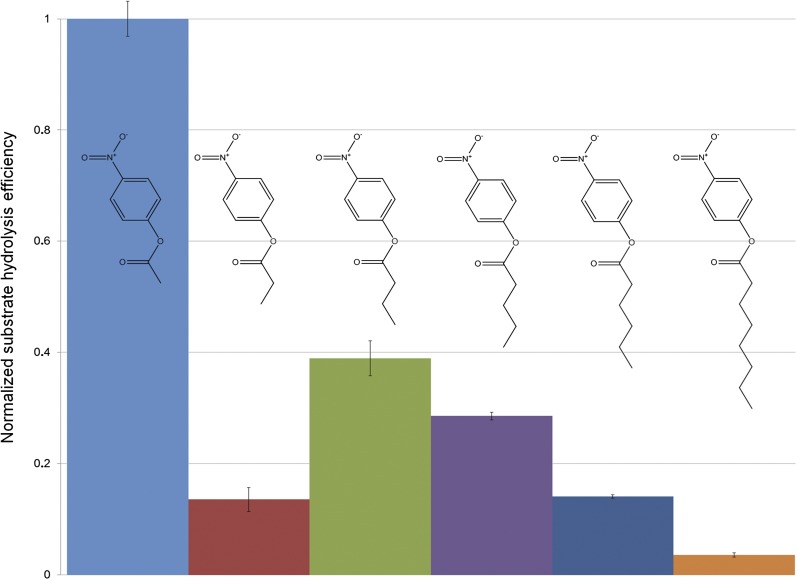
Normalized hydrolysis of different substrates by LYPLAL1. Release of 4-nitrophenol upon hydrolysis of different PNP esters (each at a concentration of 500 μM) by 150 nM LYPLAL1 was measured in triplicates, the slopes of the regression lines were averaged and then normalized against the slope of the most efficiently hydrolyzed compound (PNPA). The error bars represent the standard deviation of the results. The following compounds were used as drawn above the bars (from left to right): PNP acetate, PNP propionate, PNP butyrate, PNP valerate, PNP hexanoate, and PNP octanoate. The specific activity of the LYPLAL1 preparation was 1.3 U/mg for PNP acetate.
Fig. 4.
Fig. 4.
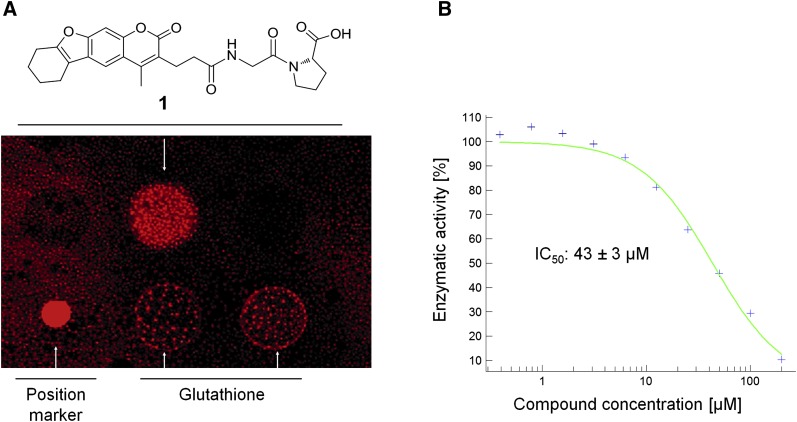
Detection and evaluation of the LYPLAL1 inhibitor. A: Chemical array showing that compound 1 binds to GST-LYPLAL1. B: IC50 value determination of LYPLAL1 inhibition by compound 1.

References

    1. Fischer M., Pleiss J. 2003. The Lipase Engineering Database: a navigation and analysis tool for protein families. Nucleic Acids Res. 31: 319–321. - PMC - PubMed
    1. Devedjiev Y., Dauter Z., Kuznetsov S. R., Jones T. L., Derewenda Z. S. 2000. Crystal structure of the human acyl protein thioesterase I from a single X-ray data set to 1.5 A. Structure. 8: 1137–1146. - PubMed
    1. Murzin A. G., Brenner S. E., Hubbard T., Chothia C. 1995. SCOP: a structural classification of proteins database for the investigation of sequences and structures. J. Mol. Biol. 247: 536–540. - PubMed
    1. Rocks O., Peyker A., Kahms M., Verveer P. J., Koerner C., Lumbierres M., Kuhlmann J., Waldmann H., Wittinghofer A., Bastiaens P. I. H. 2005. An acylation cycle regulates localization and activity of palmitoylated Ras isoforms. Science. 307: 1746–1752. - PubMed
    1. Dekker F. J., Rocks O., Vartak N., Menninger S., Hedberg C., Balamurugan R., Wetzel S., Renner S., Gerauer M., Schölermann B., et al. 2010. Small-molecule inhibition of APT1 affects Ras localization and signaling. Nat. Chem. Biol. 6: 449–456. - PubMed

Publication types