


More than just lysins: peptidoglycan hydrolases tailor the cell wall
- PMID: 22055466
- PMCID: PMC3347972
- DOI: 10.1016/j.mib.2011.10.003
More than just lysins: peptidoglycan hydrolases tailor the cell wall
Abstract
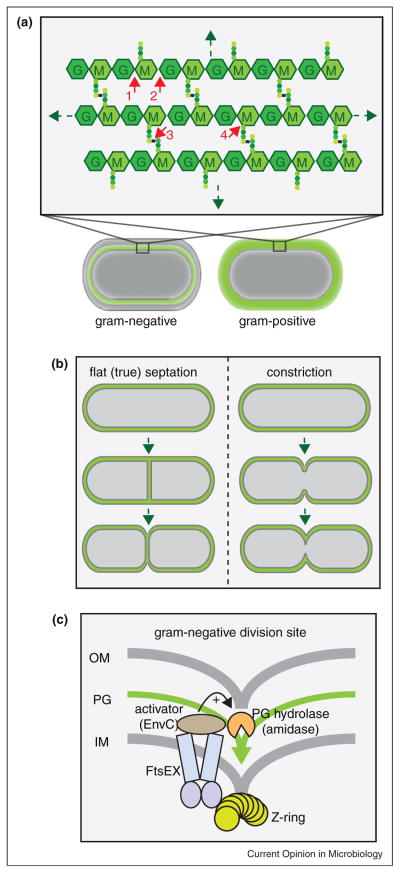
Enzymes that degrade the peptidoglycan (PG) cell wall layer called PG hydrolases or autolysins are often thought of as destructive forces. Phages employ them to lyse their host for the release of virion particles and some bacteria secrete them to eliminate (lyse) their competition. However, bacteria also harness the activity of PG hydrolases for important aspects of growth, division, and development. Of course, using PG hydrolases in this capacity requires that they be tightly regulated. While this has been appreciated for some time, we are only just beginning to understand the mechanisms governing the activities of these 'tailoring' enzymes. This review will focus on recent advances in this area with an emphasis on the regulation of PG hydrolases involved in cell division.
Copyright © 2011 Elsevier Ltd. All rights reserved.
Figures
References
-
- Vollmer W, Blanot D, de Pedro MA. Peptidoglycan structure and architecture. FEMS Microbiol Rev. 2008;32:149–167. - PubMed
-
- Sauvage E, Kerff F, Terrak M, Ayala J, Charlier P. The penicillin-binding proteins: structure and role in peptidoglycan biosynthesis. FEMS Microbiol Rev. 2008;32:234–258. - PubMed
-
- den Blaauwen T, de Pedro MA, Nguyen-Distèche M, Ayala JA. Morphogenesis of rod-shaped sacculi. FEMS Microbiol Rev. 2008;32:321–344. - PubMed
-
- Vollmer W, Joris B, Charlier P, Foster S. Bacterial peptidoglycan (murein) hydrolases. FEMS Microbiol Rev. 2008;32:259–286. - PubMed
Publication types
MeSH terms
Substances
Grants and funding
LinkOut - more resources
Full Text Sources
