


doi: 10.1038/nn.2971.
Cholinergic modulation of a specific memory function of prefrontal cortex
Affiliations
- PMID: 22057191
- PMCID: PMC3432567
- DOI: 10.1038/nn.2971
Item in Clipboard
Cholinergic modulation of a specific memory function of prefrontal cortex
Nat Neurosci.
.
Abstract
Deficits in prefrontal cholinergic function are implicated in cognitive impairment in many neuropsychiatric diseases, but acetylcholine's specific role remains elusive. Rhesus monkeys with selective lesions of cholinergic input to prefrontal cortex (PFC) were unimpaired in tests of decision making and episodic memory that require intact PFC, but were severely impaired on a spatial working memory task. These observations are consistent with a specific role for prefrontal acetylcholine in working memory.
Figures

Cholinergic lesions. The lesions were specific to cholinergic innervation of the prefrontal cortex. (a) Extent of intended lesions. (b) Cholinergic depletion for a representative monkey, PFC1. (c) Magnification of subregions of PFC in monkey PFC1, demonstrating ACh fibre loss (1– principal sulcus; 2– cingulate sulcus; 3– inferior convexity; 4– medial orbital sulcus). (d) Magnification of area indicated by solid box in a control brain, stained for (left to right) acetylcholinesterase, cresyl violet, tyrosine hydroxylase (dopaminergic fibres) and parvalbumin (GABAergic interneurons) in a control brain. (e) Magnification of the same region in a lesioned brain (with the same stains). These stains show that the cholinergic lesions were extensive and there was no non-specific cell body or noncholinergic fibre damage.
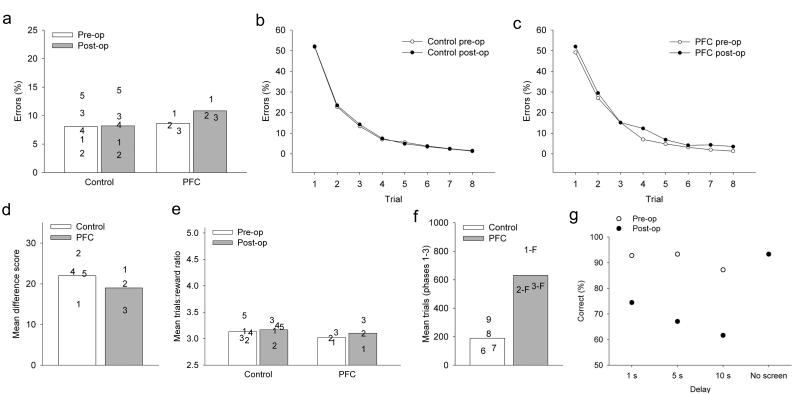
Task performance. (a-c) Object-in-place scene learning. (a) Mean data for each group across repetitions 2-8 (scores for the first repetition are at chance as the scenes are new on each day). Data points = individual scores. Monkeys with depletions of acetylcholine in lateral and orbital prefrontal cortex (PFC) were unimpaired. Mean numbers of errors on scene learning for each repetition (1-8, horizontal axis) in pre- and postoperative phases, for (b) controls, and (c) PFC. (d) Strategy implementation. Performance measured the ratio of rewards earned to trials completed; perfect performance = 2.5. Mean ratio of responses to rewards for control and PFC monkeys. Data points = individual scores. The PFC monkeys were unimpaired. (e) Reward devaluation. Mean difference scores across the two devaluation tests for control and PFC monkeys. Data points = individual scores. The PFC monkeys were unimpaired. (f-g) Spatial delayed response. (f) Mean errors to criterion for control and PFC monkeys that learned the task postoperatively. The PFC monkeys made significantly more errors than the controls, even though two of the PFC monkeys failed to reach the final phase of the task. (g) Performance of two additional monkeys that received PFC depletions following preoperative training on spatial delayed response. Mean scores are shown for each delay length both pre– and postoperatively. Their performance was worse at all delay lengths postoperatively (preoperative mean 91.1% correct; postoperative mean 67.7% correct), but not in the condition with no screen.
References
-
- Johnson JK, Head E, Kim R, Starr A, Cotman CW. Clinical and pathological evidence for a frontal variant of Alzheimer disease. Arch Neurol. 1999;56:1233–1239. - PubMed
-
- Bartus RT. On neurodegenerative diseases, models, and treatment strategies: lessons learned and lessons forgotten a generation following the cholinergic hypothesis. Exp Neurol. 2000;163:495–529. - PubMed
-
- Bierer LM, et al. Neurochemical correlates of dementia severity in Alzheimer’s disease: relative importance of the cholinergic deficits. J Neurochem. 1995;64:749–760. - PubMed
-
- Bartus RT, Dean RL., 3rd Pharmaceutical treatment for cognitive deficits in Alzheimer’s disease and other neurodegenerative conditions: exploring new territory using traditional tools and established maps. Psychopharmacology (Berl) 2009;202:15–36. - PubMed
Publication types
MeSH terms
Substances
Grants and funding
LinkOut - more resources
Full Text Sources
Miscellaneous
