Editorial
doi: 10.3324/haematol.2011.055392.
The JAK2 46/1 haplotype: a marker of inappropriate myelomonocytic response to cytokine stimulation, leading to increased risk of inflammation, myeloid neoplasm, and impaired defense against infection?
- PMID: 22058280
- PMCID: PMC3208673
- DOI: 10.3324/haematol.2011.055392
Item in Clipboard
Editorial
The JAK2 46/1 haplotype: a marker of inappropriate myelomonocytic response to cytokine stimulation, leading to increased risk of inflammation, myeloid neoplasm, and impaired defense against infection?
Haematologica.
2011 Nov.
No abstract available
Figures
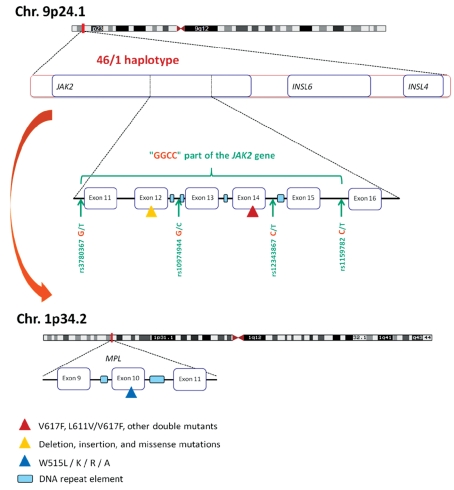
The 46/1 haplotype associated with a predisposition to mutation in the JAK2 and MPL genes and MPN. The 46/1 haplotype is a 280 Kb-long region of chromosome 9p which includes the entire JAK2, INSL6 and INSL4 genes. Most of the JAK2 mutations detected in MPN are localized in the “GGCC” part of the JAK2 gene, represented in green. The “GGCC” part, which begins in intron 10 and finishes in intron 15 of the JAK2 gene, is characterized by four single nucleotide polymorphisms: rs3780367 in intron 10, rs10974944 in intron 12, rs12343867 in intron 14, and rs1159782 in intron 15. These four single nucleotide polymorphisms are in complete linkage disequilibrium. The “GGCC” part of the 46/1 haplotype includes the most frequently mutated JAK2 exons: exon 14 (mainly the V617F mutation, represented by a red triangle), exon 12 (mutations and deletions are represented by a yellow triangle) and to a lesser degree, exons 13 and 15. In addition, the 46/1 haplotype has been reported to be associated with a predisposition to the acquisition of mutations in exon 10 of the MPL gene, located on a different chromosome. MPL exon 10 mutations are represented by a blue triangle. DNA repeat elements (represented by light blue rectangles) can be found close to JAK2 exons 12–15 and close to MPL exon 10. Such repeat sequences are known to increase the risk of DNA mutation or recombination. The presence of repeat elements being independent of the 46/1 haplotype, the mechanisms that make individuals carrying the 46/1 haplotype at higher risk of JAK2 and MPL mutation and MPN are currently not understood.
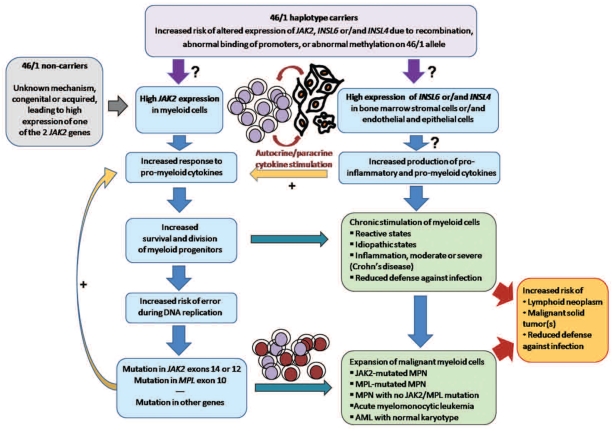
The JAK2 46/1 haplotype as a marker of inappropriate myelomonocytic response to cytokine stimulation, leading to increased risk of inflammation, myeloid neoplasm, and impaired defense against infection. One hypothesis is that the 46/1 haplotype may be linked to high expression of the JAK2 gene and/or of other genes that constitute the haplotype: INSL6 and INSL4. The 46/1 haplotype could lead to high expression of the JAK2 gene on the recombined allele through DNA recombination, mutation, altered promoter accessibility or abnormal methylation. This hypothesis is supported by the fact that high mRNA expression of JAK2 is frequently observed in MPN patients, and required for certain MPN phenotypes in murine models. Thanks to high Jak2 levels, affected myeloid cells would be more likely to divide in response to Jak2-activating cytokines, making genes important for myelopoiesis, such as JAK2 and MPL, at greater risk of copy errors. Acquisition of mutations in JAK2, MPL or other genes would accelerate progression toward myeloid neoplasms. For patients who develop MPN, the presence of the 46/1 haplotype could influence disease evolution and survival. Carriers of the 46/1 haplotype who develop AML with normal karyotype (NK-AML) could have reduced survival due to death from infection, according to Nahajevszky et al. (this issue). In addition, the 46/1 haplotype may facilitate expression of INSL6 and INSL4 in non-hematopoietic cells, for instance in bone marrow stromal cells. Possible consequences could be excessive production of cytokines with dual action, pro-myeloid and pro-inflammatory, which would further stimulate expansion of myelomonocytic cells and thus facilitate an inflammatory response and perhaps impair defense against infection. Finally, patients with MPN, AML or severe chronic inflammation have been reported to be at greater risk of lymphoid neoplasms and malignant solid tumors.
Comment on
-
The prognostic impact of germline 46/1 haplotype of Janus kinase 2 in cytogenetically normal acute myeloid leukemia.Haematologica. 2011 Nov;96(11):1613-8. doi: 10.3324/haematol.2011.043885. Epub 2011 Jul 26. Haematologica. 2011. PMID: 21791467 Free PMC article. Clinical Trial.
References
-
- Pardanani A, Fridley BL, Lasho TL, Gilliland DG, Tefferi A. Host genetic variation contributes to phenotypic diversity in myeloproliferative disorders. Blood. 2008;111(5):2785–9. - PubMed
-
- Olcaydu D, Harutyunyan A, Jäger R, Berg T, Gisslinger B, Pabinger I, et al. A common JAK2 haplotype confers susceptibility to myeloproliferative neoplasms. Nat Genet. 2009;41(4):450–4. - PubMed
-
- Tefferi A, Lasho TL, Patnaik MM, Finke CM, Hussein K, Hogan WJ, et al. JAK2 germline genetic variation affects disease susceptibility in primary myelofibrosis regardless of V617F mutational status: nullizygosity for the JAK2 46/1 haplotype is associated with inferior survival. Leukemia. 2010;24(1):105–9. - PubMed
Publication types
MeSH terms
Substances
LinkOut - more resources
Full Text Sources
Medical
Miscellaneous