


Branched-chain amino acid levels are associated with improvement in insulin resistance with weight loss
- PMID: 22065088
- PMCID: PMC3667157
- DOI: 10.1007/s00125-011-2356-5
Branched-chain amino acid levels are associated with improvement in insulin resistance with weight loss
Abstract
Aims/hypothesis: Insulin resistance (IR) improves with weight loss, but this response is heterogeneous. We hypothesised that metabolomic profiling would identify biomarkers predicting changes in IR with weight loss.
Methods: Targeted mass spectrometry-based profiling of 60 metabolites, plus biochemical assays of NEFA, β-hydroxybutyrate, ketones, insulin and glucose were performed in baseline and 6 month plasma samples from 500 participants who had lost ≥4 kg during Phase I of the Weight Loss Maintenance (WLM) trial. Homeostatic model assessment of insulin resistance (HOMA-IR) and change in HOMA-IR with weight loss (∆HOMA-IR) were calculated. Principal components analysis (PCA) and mixed models adjusted for race, sex, baseline weight, and amount of weight loss were used; findings were validated in an independent cohort of patients (n = 22).
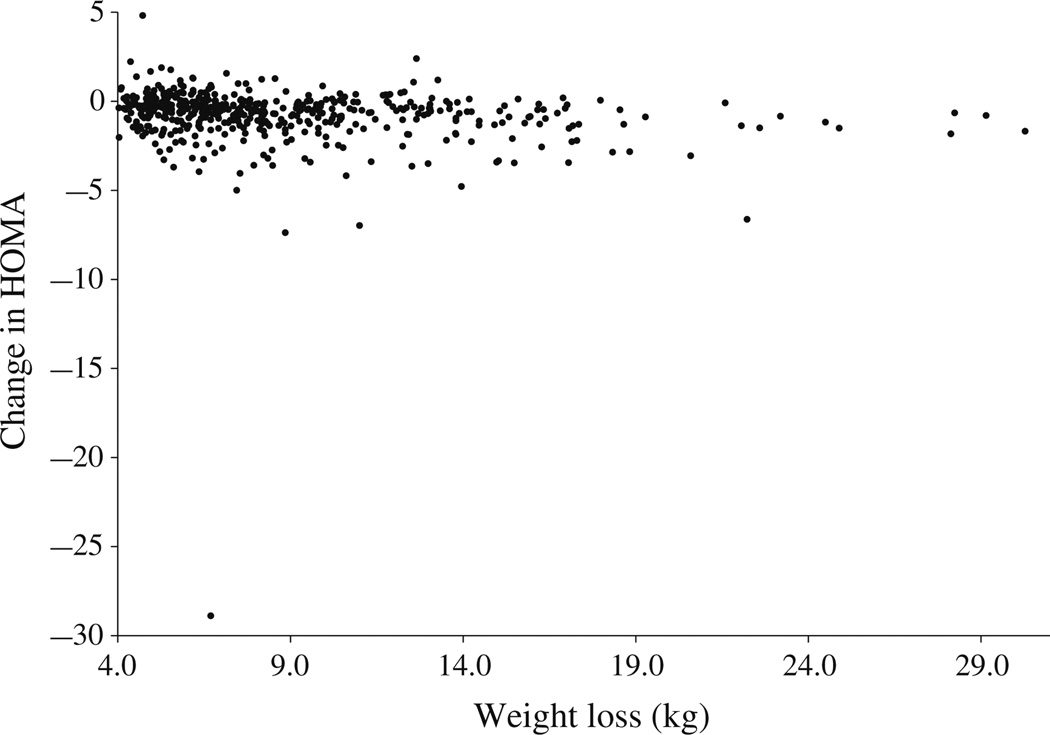
Results: Mean weight loss was 8.67 ± 4.28 kg; mean ∆HOMA-IR was -0.80 ± 1.73, range -28.9 to 4.82). Baseline PCA-derived factor 3 (branched chain amino acids [BCAAs] and associated catabolites) correlated with baseline HOMA-IR (r = 0.50, p < 0.0001) and independently associated with ∆HOMA-IR (p < 0.0001). ∆HOMA-IR increased in a linear fashion with increasing baseline factor 3 quartiles. Amount of weight loss was only modestly correlated with ∆HOMA-IR (r = 0.24). These findings were validated in the independent cohort, with a factor composed of BCAAs and related metabolites predicting ∆HOMA-IR (p = 0.007).
Conclusions/interpretation: A cluster of metabolites comprising BCAAs and related analytes predicts improvement in HOMA-IR independent of the amount of weight lost. These results may help identify individuals most likely to benefit from moderate weight loss and elucidate novel mechanisms of IR in obesity.
Figures

References
-
- Tuomilehto J, Lindstrom J, Eriksson JG, et al. Prevention of type 2 diabetes mellitus by changes in lifestyle among subjects with impaired glucose tolerance. N Engl J Med. 2001;344:1343–1350. - PubMed
-
- Svetkey LP, Stevens VJ, Brantley PJ, et al. Comparison of strategies for sustaining weight loss: the weight loss maintenance randomized controlled trial. JAMA. 2008;299:1139–1148. - PubMed
-
- Harlan LC, Block G. Use of adjustment factors with a brief food frequency questionnaire to obtain nutrient values. Epidemiology. 1990;1:224–231. - PubMed
-
- McCullough ML, Feskanich D, Stampfer MJ, et al. Diet quality and major chronic disease risk in men and women: moving toward improved dietary guidance. Am J Clin Nutr. 2002;76:1261–1271. - PubMed
Publication types
MeSH terms
Substances
Grants and funding
- R01 DK067561/DK/NIDDK NIH HHS/United States
- HL68734/HL/NHLBI NIH HHS/United States
- R01-DK67561/DK/NIDDK NIH HHS/United States
- UL1 RR024156/RR/NCRR NIH HHS/United States
- 1UL1 RR024128-01/RR/NCRR NIH HHS/United States
- UL1 RR024128/RR/NCRR NIH HHS/United States
- DK-26687/DK/NIDDK NIH HHS/United States
- HL68955/HL/NHLBI NIH HHS/United States
- P30 AG028716/AG/NIA NIH HHS/United States
- R01 MH048858/MH/NIMH NIH HHS/United States
- U01 HL068955/HL/NHLBI NIH HHS/United States
- HL68676/HL/NHLBI NIH HHS/United States
- HL68790/HL/NHLBI NIH HHS/United States
- U01 HL068676/HL/NHLBI NIH HHS/United States
- P30 DK026687/DK/NIDDK NIH HHS/United States
- HL68920/HL/NHLBI NIH HHS/United States
- 1 UL1 RR024156-02/RR/NCRR NIH HHS/United States
- U01 HL068734/HL/NHLBI NIH HHS/United States
- DK-63068-05/DK/NIDDK NIH HHS/United States
- MH-48858/MH/NIMH NIH HHS/United States
- U01 HL068790/HL/NHLBI NIH HHS/United States
- U01 HL068920/HL/NHLBI NIH HHS/United States
LinkOut - more resources
Full Text Sources
Other Literature Sources
