. 2011 Nov 3:4:39.
doi: 10.3389/fnmol.2011.00039. eCollection 2011.

ROCKing Regeneration: Rho Kinase Inhibition as Molecular Target for Neurorestoration

Affiliations

ROCKing Regeneration: Rho Kinase Inhibition as Molecular Target for Neurorestoration

Lars Tönges et al. Front Mol Neurosci. .

Abstract

Regenerative failure in the CNS largely depends on pronounced growth inhibitory signaling and reduced cellular survival after a lesion stimulus. One key mediator of growth inhibitory signaling is Rho-associated kinase (ROCK), which has been shown to modulate growth cone stability by regulation of actin dynamics. Recently, there is accumulating evidence the ROCK also plays a deleterious role for cellular survival. In this manuscript we illustrate that ROCK is involved in a variety of intracellular signaling pathways that comprise far more than those involved in neurite growth inhibition alone. Although ROCK function is currently studied in many different disease contexts, our review focuses on neurorestorative approaches in the CNS, especially in models of neurotrauma. Promising strategies to target ROCK by pharmacological small molecule inhibitors and RNAi approaches are evaluated for their outcome on regenerative growth and cellular protection both in preclinical and in clinical studies.

Keywords: ROCK; Rho kinase; axon outgrowth; cell survival; neuroprotection; neurorestoration.


Figures
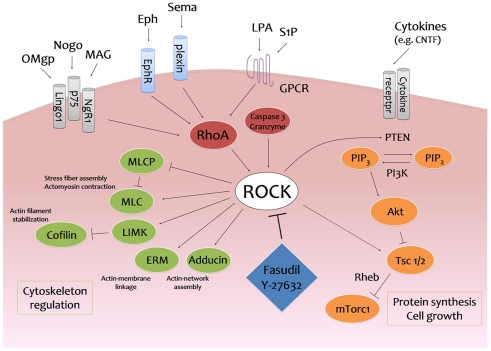
Figure 1
Figure 1
The ROCK signaling pathway with focus on survival and regeneration. Nogo, MAG, OMgp present on the surface of oligodendrocytes confer their inhibitory activity via a trimeric receptor complex comprising NgR1, LINGO-1, and p75NTR to activate RhoA. Sema5A and several Ephrins can also contribute to RhoA activation via their plexin or Eph receptors, respectively. Additionally, G protein-coupled receptor (GPCR) stimulation by lysophosphatidic acid (LPA) or sphingosine-1 phosphate (S1P) results in the activation of the small GTPase RhoA. GTP-bound RhoA further activates ROCK to phosphorylate several substrates that are involved in regulation of cell shape and motility but also in survival pathways. Caspase-3 and granzyme B are able to proteolytically cleave and thus activate ROCK. Myosin light chain (MLC) is a substrate of activated ROCK and its phosphorylation results in actomyosin contraction. In addition ROCK can inactivate MLC phosphatase (MLCP) and thus indirectly regulate MLC phosphorylation. Being a serine/threonine kinase, ROCK can activate LIM kinase-1 (LIMK1) that then inactivates cofilin/actin depolymerizing factor (ADF) by phosphorylation promoting actin filament stabilization. The phosphorylation of ERM proteins leads to Actin-membrane linkage. Adducin is a protein that after activation binds to f-actin promoting the association of spectrin and f-actin and thus assembling the actin network. Another downstream target of ROCK is PTEN, which negatively regulates Akt/PKB signaling by antagonizing PIP3. If active, Akt in turn activates Rheb because of inhibition of Tsc1/2, and subsequently stimulates mTORC1, which finally leads to an enhancement of general translation with an increase in protein synthesis and cell. ROCK1 may also physically interact with Tsc2.

References

    1. Abe K., Shimokawa H., Morikawa K., Uwatoku T., Oi K., Matsumoto Y., Hattori T., Nakashima Y., Kaibuchi K., Sueishi K., Takeshit A. (2004). Long-term treatment with a Rho-kinase inhibitor improves monocrotaline-induced fatal pulmonary hypertension in rats. Circ. Res. 94, 385–39310.1161/01.RES.0000111804.34509.94 - DOI - PubMed
    1. Ahmed Z., Berry M., Logan A. (2009). ROCK inhibition promotes adult retinal ganglion cell neurite outgrowth only in the presence of growth promoting factors. Mol. Cell. Neurosci. 42, 128–13310.1016/j.mcn.2009.06.005 - DOI - PubMed
    1. Alabed Y. Z., Grados-Munro E., Ferraro G. B., Hsieh S. H., Fournier A. E. (2006). Neuronal responses to myelin are mediated by rho kinase. J. Neurochem. 96, 1616–162510.1111/j.1471-4159.2006.03670.x - DOI - PubMed
    1. Amano M., Chihara K., Nakamura N., Kaneko T., Matsuura Y., Kaibuchi K. (1999). The COOH terminus of Rho-kinase negatively regulates rho-kinase activity. J. Biol. Chem. 274, 32418–3242410.1074/jbc.274.30.21209 - DOI - PubMed
    1. Amano M., Ito M., Kimura K., Fukata Y., Chihara K., Nakano T., Matsuura Y., Kaibuchi K. (1996). Phosphorylation and activation of myosin by Rho-associated kinase (Rho-kinase). J. Biol. Chem. 271, 20246–2024910.1074/jbc.271.34.20246 - DOI - PubMed

LinkOut - more resources
