Review
. 2011 Dec;10(6):549-60.
doi: 10.1177/153303461101000605.

Using in-vivo fluorescence imaging in personalized cancer diagnostics and therapy, an image and treat paradigm

Affiliations
Review

Using in-vivo fluorescence imaging in personalized cancer diagnostics and therapy, an image and treat paradigm

Y Ardeshirpour et al. Technol Cancer Res Treat. 2011 Dec.

Abstract

The major goal in developing drugs targeting specific tumor receptors, such as Monoclonal AntiBodies (MAB), is to make a drug compound that targets selectively the cancer-causing biomarkers, inhibits their functionality, and/or delivers the toxin specifically to the malignant cells. Recent advances in MABs show that their efficacy depends strongly on characterization of tumor biomarkers. Therefore, one of the main tasks in cancer diagnostics and treatment is to develop non-invasive in-vivo imaging techniques for detection of cancer biomarkers and monitoring their down regulation during the treatment. Such methods can potentially result in a new imaging and treatment paradigm for cancer therapy. In this article we have reviewed fluorescence imaging approaches, including those developed in our group, to detect and monitor Human Epidermal Growth Factor 2 (HER2) receptors before and during therapy. Transition of these techniques from the bench to bedside is the ultimate goal of our project. Similar approaches can be used potentially for characterization of other cancer related cell biomarkers.


Conflict of interest statement

Conflict of interest: We certify that regarding this paper, no actual or potential conflicts of interests exist. NIH is a governmental institute and does not have any copyright for its publications. Since this paper is a review paper, we have used the results and data that were published in our previous publications.

Figures

Figure 1
Figure 1
Schematic of our small animal imaging system.
Figure 2
Figure 2
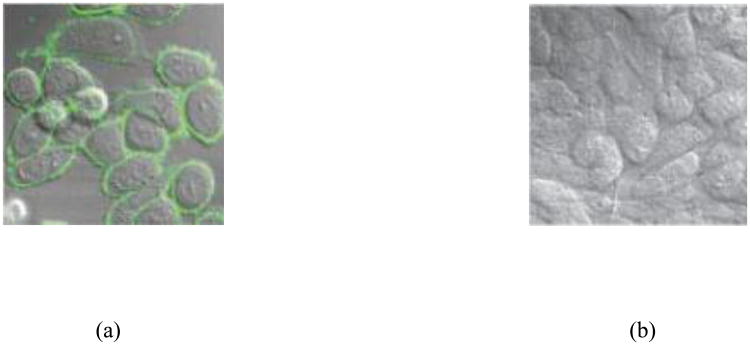
Confocal microscopy studies show (a) binding of HER2 specific affibody fluorescent probe with HER2 receptors in SKBR-3. (b) no binding was observed between HER2 specific affibody fluorescent probe and U251 cells (23).
Figure 3
Figure 3
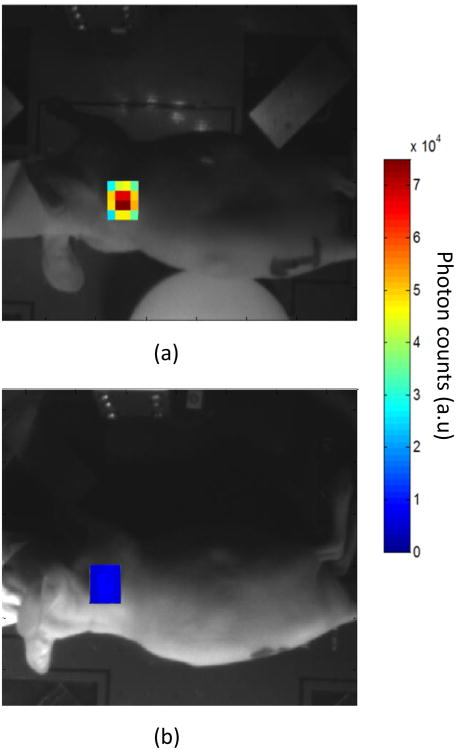
In-vivo fluorescence intensity map of xenograft mouse with (a) high HER2 expressing human tumor model (BT474) and (b) no HER2 expressing human tumor model (MDA-MB468), 2 hours after injection of the HER2 specific affibody® (His6-ZTaq-GS3-Cys) conjugated to DyLight 750.
Figure 4
Figure 4
Monitoring the uptake of AngioSense 750 at the tumor compared to the contralateral site (control). The higher uptake at tumor site indicates its higher vascularization. The fluorescence intensity at the tumor and contralateral sites was normalized to the background intensity of tumor area before injection.
Figure 5
Figure 5
a) In-vivo measurements of optical intensity at the tumor and contralateral sites over time (BT474 tumor) after injection of ABD-(ZHER2:342)2 affibody labeled with alexafluor 750, (b) Estimated NRA of several BT474 tumors with different HER2 expression vs. ex vivo measurement of HER2 concentration obtained by ELISA assay (28).
Figure 6
Figure 6
Fluorescence intensity (a) and lifetime (b) at the tumor site after injection of trastuzumab labeled with Alexafluor 750. The fluorescence lifetime, defined, as the decay time of time-resolved fluorescence signal, and intensity of contralateral site were estimated, using average values over 15 pixels and compared to the tumor region. The maximum accumulation of the dye at the tumor area occurs at about 20 hours after injection. At this time, the mean fluorescence lifetimes, corresponding to the tumor region was measured as 1.25 ps and 10% higher at contralateral site, while the mean fluorescence intensity at the tumor region was about two times higher than that of the contralateral site.
Figure 7
Figure 7
In-vitro study of binding affibody (probe) and trastuzumab (MAB drug) to different epitopes of HER2 receptors. (a) Image of SKBR-3 cells after adding the labeled HER2 specific affibody and labeled trastuzumab to the cell media. (b) Blocking HER2 epitopes with unlabeled 100-fold excess trastuzumab and image the high HER2 expressing cancer cells after adding the labeled HER2 specific affibody and labeled trastuzumab. (c) Blocking HER2 epitopes with unlabeled 100-fold excess HER2 specific affibody molecules and image the high HER2 expressing cancer cells after adding the labeled HER2 specific affibody and labeled trastuzumab. (d) Blocking HER2 epitopes with unlabeled 100-fold excess HER2 specific affibody molecules and unlabeled 100-fold excess trastuzumab and imaging the cells after adding the labeled HER2 specific affibody and labeled trastuzumab (23).
Figure 8
Figure 8
In-vivo study of binding HER2 specific affibody (probe) and trastuzumab (drug) to different epitopes of HER2 receptors. Y-axis shows the maximum fluorescent uptake at tumor site for labeled trastuzumab and labeled affibody alone, labeled affibody after blocking with unlabeled trastuzumab and labeled affibody after blocking with unlabeled affibody.

References

    1. Nelson AL, Dhimolea E, Reichert JM. Development trends for human monoclonal antibody therapeutics. Nature reviews drug discovery. 2010;9(10):767–774. - PubMed
    1. Reichert JM. Monoclonal antibodies as innovative therapeutics. Curr Pharm Biotechnol. 2008;9:423–430. - PubMed
    1. Reichert JM. Antibodies to watch in 2010. MAbs. 2010;2:84–100. - PMC - PubMed
    1. Adams GP, Weiner LM. Monoclonal antibody therapy of cancer. Nat Biotechnol. 2005;23:1147. - PubMed
    1. Hynes NE, Lane HA. ERBBreceptors and cancer: the complexity of targeted inhibitors. Nat Rev Cancer. 2005;5:341. - PubMed

Publication types