


Fatty acids in serum and diet--a canonical correlation analysis among toddlers
- PMID: 22066932
- PMCID: PMC6860655
- DOI: 10.1111/j.1740-8709.2011.00374.x
Fatty acids in serum and diet--a canonical correlation analysis among toddlers
Abstract
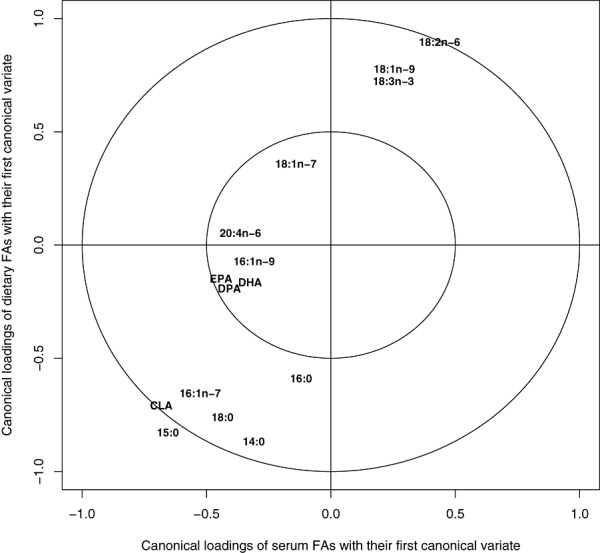
Fatty acid concentrations in blood are potential biomarkers of dietary fat intake, but methodological studies among children are scarce. The large number of fatty acids and their complex interrelationships pose a special challenge in research on fatty acids. Our target was to assess the interrelationships between the total fatty acid profiles in diet and serum of young children. The study subjects were healthy control children from the birth cohort of the Type 1 Diabetes Prediction and Prevention Study. A 3-day food record and a frozen serum sample were available from 135 children at the age of 1 year, from 133 at 2 years, and from 92 at 3 years. The relationship between dietary and serum fatty acid profiles was analysed using canonical correlation analysis. The consumption of fatty milk correlated positively with serum fatty acids, pentadecanoic acid, palmitic acid and conjugated linoleic acid (CLA) at all ages. Correlations between dietary and serum eicosapentaenoic and/or docosahexaenoic acid were observed at 2 and 3 years of age. Serum linoleic acid was positively associated with the consumption of infant formula at the age of 1 year, and with the consumption of vegetable margarine at 2 and 3 years. The results indicate a high quality of the 3-day food records kept by parents and other caretakers of the children, and suitability of non-fasting, un-fractioned serum samples for total fatty acid analyses. The correlation between intake of milk fat and serum proportion of CLA is a novel finding.
© 2011 John Wiley & Sons Ltd.
Conflict of interest statement
One of the authors (CK‐K) moved from the National Institute for Health and Welfare to work at Danone Nutricia Baby after the analyses and writing of the current manuscript were completed. Danone Nutricia Baby is a producer of infant formulas and other baby foods. Danone Nutricia Baby has not sponsored the research.
Figures
References
-
- Amiano P., Dorronsoro M., de Renobales M., Ruiz de Gordoa J.C. & Irigoien I. (2001) Very‐long‐chain omega‐3 fatty acids as markers for habitual fish intake in a population consuming mainly lean fish: the EPIC cohort of Gipuzkoa. European Prospective Investigation into Cancer and Nutrition. European Journal of Clinical Nutrition 55, 827–832. - PubMed
-
- Andersen L.F., Solvoll K., Johansson L.R., Salminen I., Aro A. & Drevon C.A. (1999) Evaluation of a food frequency questionnaire with weighed records, fatty acids, and alpha‐tocopherol in adipose tissue and serum. American Journal of Epidemiology 150, 75–87. - PubMed
-
- Baylin A. & Campos H. (2006) The use of fatty acid biomarkers to reflect dietary intake. Current Opinion in Lipidology 17, 22–27. - PubMed
-
- Baylin A., Kim M.K., Donovan‐Palmer A., Siles X., Dougherty L., Tocco P. et al (2005) Fasting whole blood as a biomarker of essential fatty acid intake in epidemiologic studies: comparison with adipose tissue and plasma. American Journal of Epidemiology 162, 373–381. - PubMed
-
- Bonaa K.H., Bjerve K.S. & Nordoy A. (1992) Habitual fish consumption, plasma phospholipid fatty acids, and serum lipids: the Tromso study. The American Journal of Clinical Nutrition 55, 1126–1134. - PubMed
Publication types
MeSH terms
Substances
LinkOut - more resources
Full Text Sources
