


Distinct hydration properties of wild-type and familial point mutant A53T of α-synuclein associated with Parkinson's disease
- PMID: 22067166
- PMCID: PMC3207174
- DOI: 10.1016/j.bpj.2011.08.052
Distinct hydration properties of wild-type and familial point mutant A53T of α-synuclein associated with Parkinson's disease
Abstract
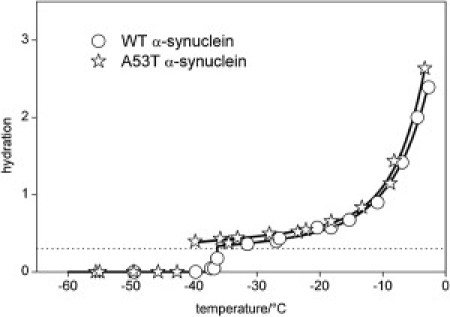
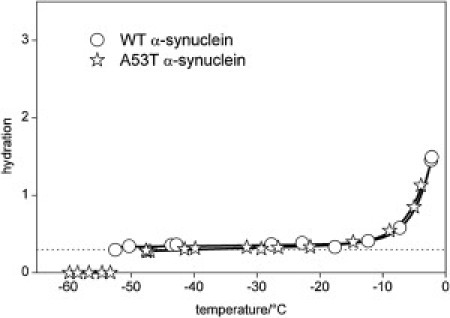
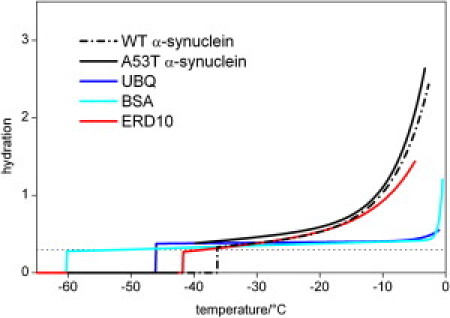
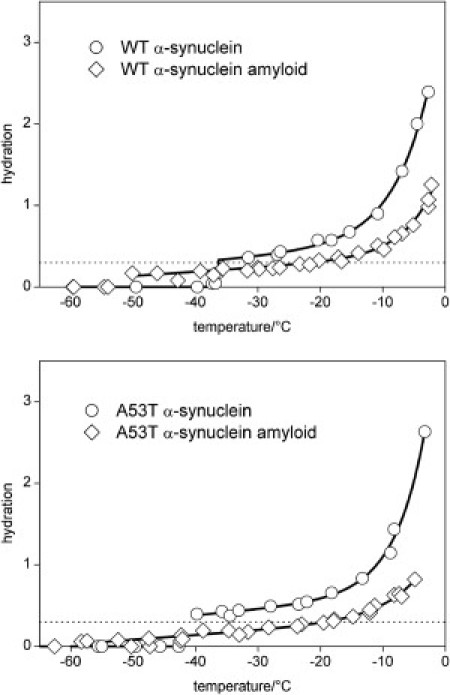
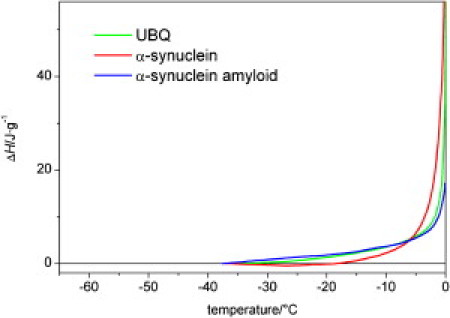
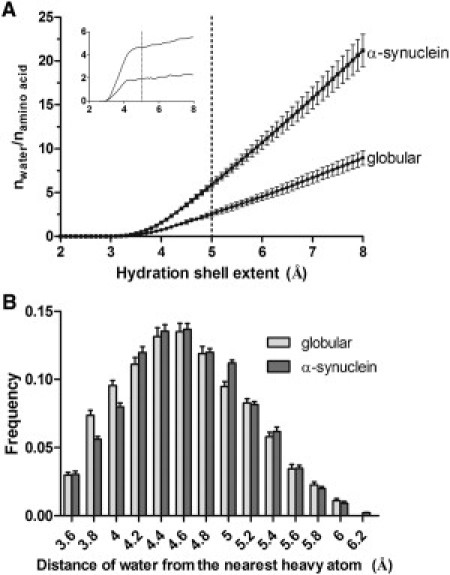
The propensity of α-synuclein to form amyloid plays an important role in Parkinson's disease. Three familial mutations, A30P, E46K, and A53T, correlate with Parkinson's disease. Therefore, unraveling the structural effects of these mutations has basic implications in understanding the molecular basis of the disease. Here, we address this issue through comparing details of the hydration of wild-type α-synuclein and its A53T mutant by a combination of wide-line NMR, differential scanning calorimetry, and molecular dynamics simulations. All three approaches suggest a hydrate shell compatible with a largely disordered state of both proteins. Its fine details, however, are different, with the mutant displaying a somewhat higher level of hydration, suggesting a bias to more open structures, favorable for protein-protein interactions leading to amyloid formation. These differences disappear in the amyloid state, suggesting basically the same surface topology, irrespective of the initial monomeric state.
Copyright © 2011 Biophysical Society. Published by Elsevier Inc. All rights reserved.
Figures
References
-
- Galvin J.E., Lee V.M., Trojanowski J.Q. Pathobiology of the Lewy body. Adv. Neurol. 1999;80:313–324. - PubMed
-
- Spillantini M.G., Schmidt M.L., Goedert M. α-Synuclein in Lewy bodies. Nature. 1997;388:839–840. - PubMed
-
- Forno L.S. Neuropathology of Parkinson's disease. J. Neuropathol. Exp. Neurol. 1996;55:259–272. - PubMed
-
- Polymeropoulos M.H., Lavedan C., Nussbaum R.L. Mutation in the α-synuclein gene identified in families with Parkinson's disease. Science. 1997;276:2045–2047. - PubMed
-
- Krüger R., Kuhn W., Riess O. Ala30Pro mutation in the gene encoding α-synuclein in Parkinson's disease. Nat. Genet. 1998;18:106–108. - PubMed
Publication types
MeSH terms
Substances
LinkOut - more resources
Full Text Sources
Medical
