


The unmasking of novel unipotent stem cells in the mammary gland
- PMID: 22068053
- PMCID: PMC3243632
- DOI: 10.1038/emboj.2011.415
The unmasking of novel unipotent stem cells in the mammary gland
Abstract
Nature 479 7372, 189–193 (2011); published online October 09 2011
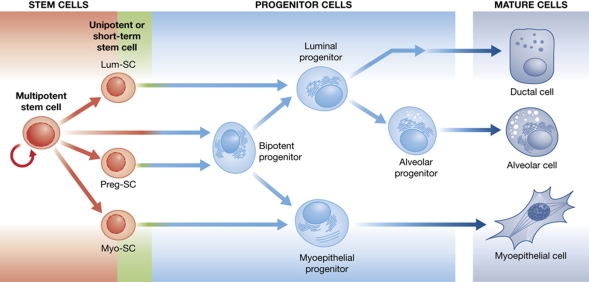
Mammary stem cells (MaSCs) have been prospectively isolated and shown to reconstitute a fully functional mammary gland in the mouse at the single cell level. These cells are self-renewing and can differentiate into all mature mammary epithelial cell types, thus fulfilling the defining characteristics of a stem cell. In a recent issue of Nature, Blanpain and colleagues (Van Keymeulen et al, 2011) add a new layer of complexity to the prevailing model of the mammary epithelial hierarchy through the recognition of novel unipotent stem cells that appear to maintain normal homeostasis of postnatal mammary epithelium. These data point to the existence of an unexpectedly complex hierarchy of stem cells that include multipotent as well as more restricted stem cells.
Conflict of interest statement
The authors declare that they have no conflict of interest.
Figures
Comment on
-
Distinct stem cells contribute to mammary gland development and maintenance.Nature. 2011 Oct 9;479(7372):189-93. doi: 10.1038/nature10573. Nature. 2011. PMID: 21983963
References
-
- Asselin-Labat ML, Vaillant F, Sheridan JM, Pal B, Wu D, Simpson ER, Yasuda H, Smyth GK, Martin TJ, Lindeman GJ, Visvader JE (2010) Control of mammary stem cell function by steroid hormone signalling. Nature 465: 798–802 - PubMed
-
- Boulanger CA, Wagner KU, Smith GH (2005) Parity-induced mouse mammary epithelial cells are pluripotent, self-renewing and sensitive to TGF-beta1 expression. Oncogene 24: 552–560 - PubMed
-
- Clayton E, Doupe DP, Klein AM, Winton DJ, Simons BD, Jones PH (2007) A single type of progenitor cell maintains normal epidermis. Nature 446: 185–189 - PubMed
-
- Morris RJ, Liu Y, Marles L, Yang Z, Trempus C, Li S, Lin JS, Sawicki JA, Cotsarelis G (2004) Capturing and profiling adult hair follicle stem cells. Nat Biotechnol 22: 411–417 - PubMed
Publication types
MeSH terms
LinkOut - more resources
Full Text Sources
Medical
