


Determinants of polypharmacy and compliance with GOLD guidelines in patients with chronic obstructive pulmonary disease
- PMID: 22069360
- PMCID: PMC3206765
- DOI: 10.2147/COPD.S24443
Determinants of polypharmacy and compliance with GOLD guidelines in patients with chronic obstructive pulmonary disease
Abstract
Background: Polypharmacy of respiratory medications is commonly observed in patients with chronic obstructive pulmonary disease (COPD). The aims of this study were to investigate determinants of polypharmacy and to study the consistency of actual respiratory drug use with current Global Initiative for Chronic Obstructive Lung Disease (GOLD) guidelines in pulmonary rehabilitation candidates with COPD.
Methods: Data were extracted from the records of all patients with a diagnosis of COPD referred for pulmonary rehabilitation to CIRO+ between 2005 and 2009. Use of respiratory medications, self-reported COPD exacerbations, lung function, blood gases, exercise capacity, Medical Research Council (MRC) dyspnea grade, and St George's Respiratory Questionnaire (SGRQ) were recorded as part of assessment of health status.
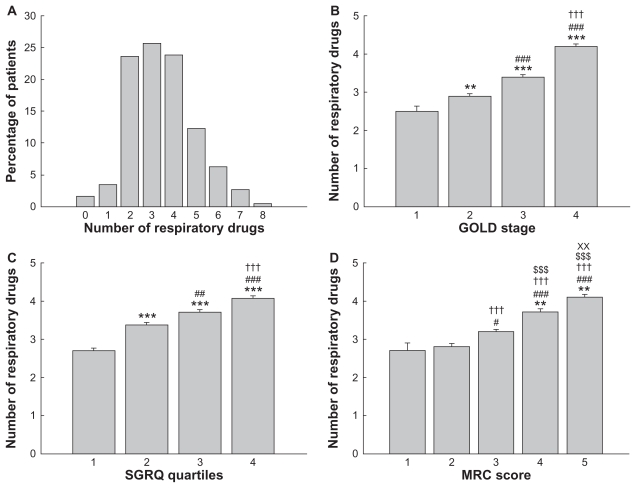
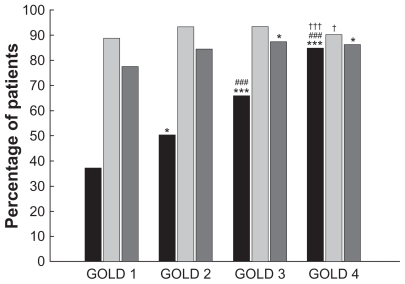
Results: In total, 1859 COPD patients of mean age (± standard deviation) 64.3 ± 9.7 years and with a forced expiratory volume in one second (FEV(1)) of 44.7% ± 18.2% were included. On average, patients used 3.5 ± 1.5 respiratory medications; this number increased with increasing GOLD stage, MRC score, and SGRQ scores. FEV(1) (% predicted), SGRQ, and number of recent exacerbations were independent determinants of polypharmacy. Use of long-acting bronchodilators and inhaled corticosteroids was substantial and comparable in all GOLD stages. Use of corticosteroids was not restricted to patients with frequent exacerbations.
Conclusion: Polypharmacy of respiratory medications is common in COPD patients with persistent symptoms. In addition to severity of disease, health status is an independent predictor of polypharmacy. Actual drug use in COPD patients referred for pulmonary rehabilitation is partially inconsistent with current GOLD guidelines.
Keywords: chronic obstructive pulmonary disease; management; pharmacotherapy; polypharmacy; pulmonary rehabilitation; respiratory drug use.
Figures
References
-
- Wouters EF. Economic analysis of the Confronting COPD survey: an overview of results. Respir Med. 2003;97(Suppl C):S3–S14. - PubMed
-
- Murray CJ, Lopez AD. Alternative projections of mortality and disability by cause 1990–2020: Global Burden of Disease Study. Lancet. 1997;349(9064):1498–1504. - PubMed
-
- Sestini P, Renzoni E, Robinson S, Poole P, Ram FS. Short-acting beta 2 agonists for stable chronic obstructive pulmonary disease. Cochrane Database Syst Rev. 2002;4:CD001495. - PubMed
-
- Lung Health Study Research Group. Effect of inhaled triamcinolone on the decline in pulmonary function in chronic obstructive pulmonary disease. N Engl J Med. 2000;343(26):1902–1909. - PubMed
-
- Tashkin DP, Celli B, Senn S, et al. A 4-year trial of tiotropium in chronic obstructive pulmonary disease. N Engl J Med. 2008;359(15):1543–1554. - PubMed
MeSH terms
Substances
LinkOut - more resources
Full Text Sources
Medical
