


The palladium catalyzed asymmetric addition of oxindoles and allenes: an atom-economical versatile method for the construction of chiral indole alkaloids
- PMID: 22070545
- PMCID: PMC3241881
- DOI: 10.1021/ja209244m
The palladium catalyzed asymmetric addition of oxindoles and allenes: an atom-economical versatile method for the construction of chiral indole alkaloids
Abstract
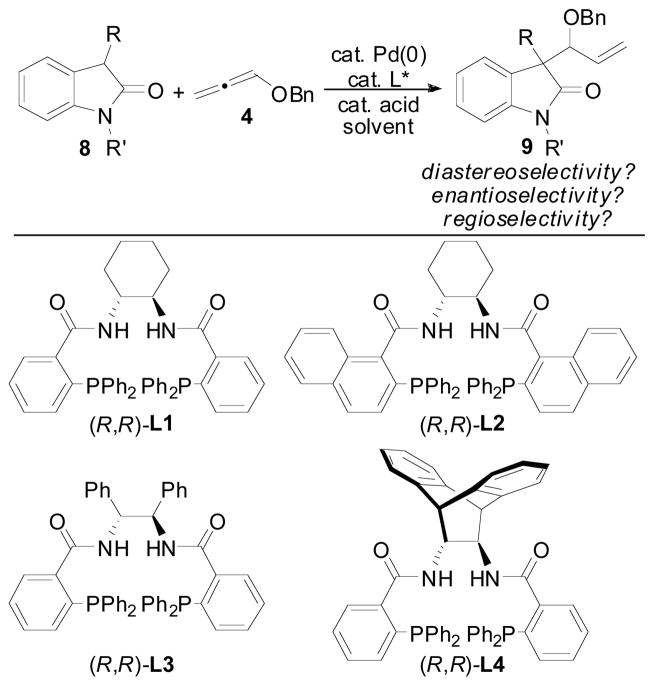
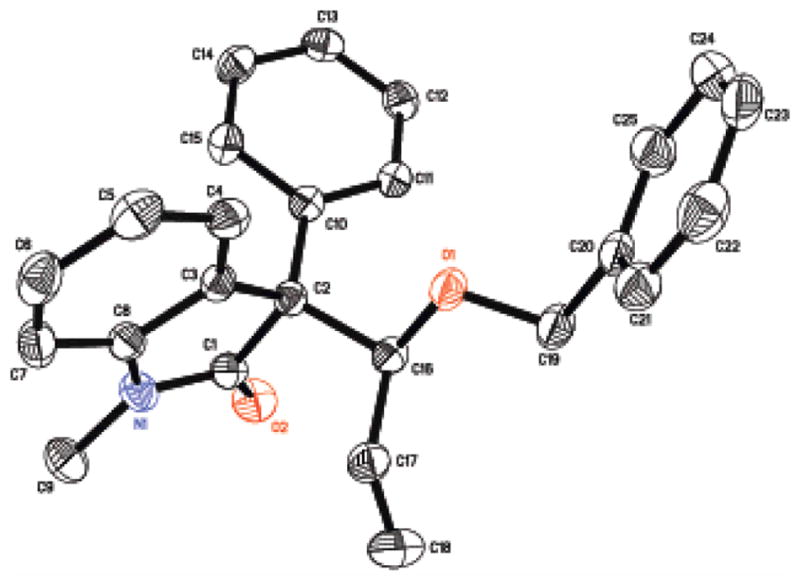
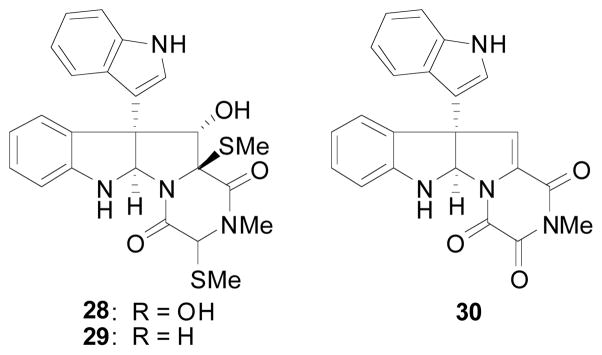
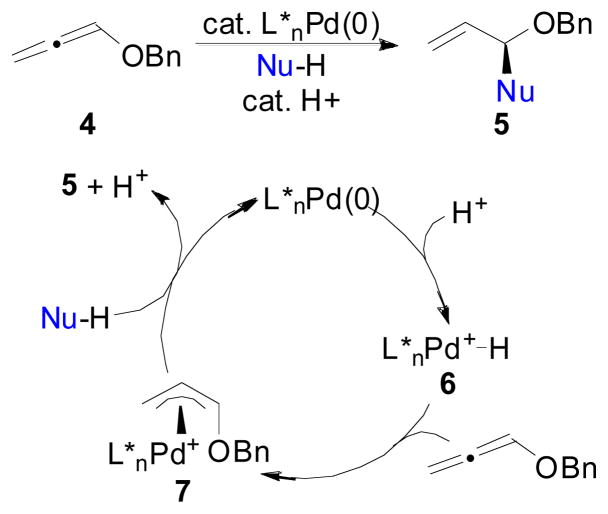
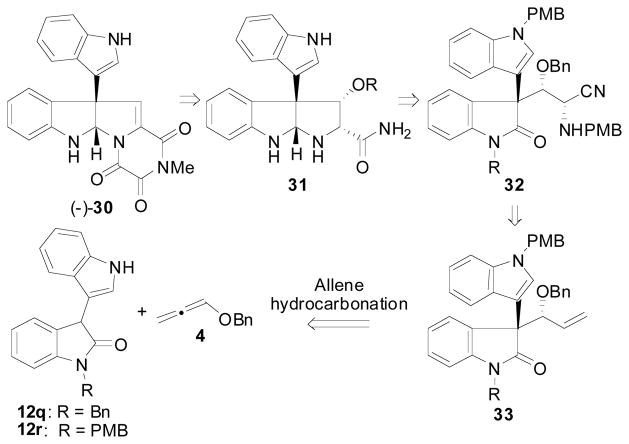
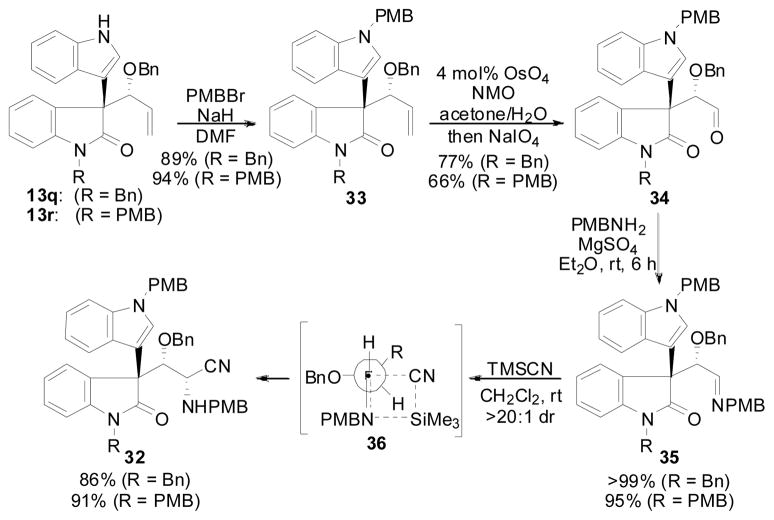
The Pd-catalyzed asymmetric allylic alkylation (AAA) is one of the most useful and versatile methods for asymmetric synthesis known in organometallic chemistry. Development of this reaction over the past 30 years has typically relied on the use of an allylic electrophile bearing an appropriate leaving group to access the reactive Pd(π-allyl) intermediate that goes on to the desired coupling product after attack by the nucleophile present in the reaction. Our group has been interested in developing alternative approaches to access the reactive Pd(π-allyl) intermediate that does not require the use of an activated electrophile, which ultimately generates a stoichiometric byproduct in the reaction that is derived from the leftover leaving group. Along these lines, we have demonstrated that allenes can be used to generate the reactive Pd(π-allyl) intermediate in the presence of an acid cocatalyst, and this system is compatible with nucleophiles to allow for formation of formal AAA products by Pd-catalyzed additions to allenes. This article describes our work regarding the use of oxindoles as carbon-based nucleophiles in a Pd-catalyzed asymmetric addition of oxindoles to allenes (Pd-catalyzed hydrocarbonation of allenes). By using the chiral standard Trost ligand (L1) and 3-aryloxindoles as nucleophiles, this hydrocarbonation reaction provides products with two vicinal stereocenters, with one being quaternary, in excellent chemo-, regio-, diastereo-, and enantioselectivities in high chemical yields.
© 2011 American Chemical Society
Figures

References
-
-
Reviews: Trost BM, Van Vranken DL. Chem Rev. 1996;96:395.Lu Z, Ma S. Angew Chem Int Ed. 2008;47:258.Trost BM, Crawley ML. Chem Rev. 2003;103:2921.Trost BM, Zhang T, Sieber JD. Chem Sci. 2010;1:427.
-
-
- Trost BM. Science. 1991;254:1471. - PubMed
-
-
For reviews on atom-economic reactions, see: Trost BM, Toste FD, Pinkerton AB. Chem Rev. 2001;101:2067.Trost BM. Acc Chem Res. 2002;35:695.Trost BM, Frederiksen MR, Rudd MT. Angew Chem, Int Ed. 2005;44:6630.Li C. Acc Chem Res. 2010;43:581.Basavaiah D, Reddy BS, Badsara SS. Chem Rev. 2010;110:5447.Aubert C, Fensterbank L, Garcia P, Malacria M, Simmonneau A. Chem Rev. 2011;111:1954.Corma A, Leyva-Prez A, Sabater MJ. Chem Rev. 2011;111:1657.Yu DG, Li BJ, Shi ZT. Acc Chem Res. 2010;43:1486.You SL, Cai Q, Zeng M. Chem Soc Rev. 2009;38:2190.Abu S, Shariar M, Liu RS. Chem Soc Rev. 2009;38:2269.McGlacken GP, Bateman LM. Chem Soc Rev. 2009;38:2447.Ganem B. Acc Chem Res. 2009;42:463.Kumagai N, Shibasaki M. Angew Chem Int Ed. 2011;50:4760.Yadav JS, Antony A, Rao TS, Reddy BVS. J Organomet Chem. 2011;696:16.Alonso F, Foubelo F, González-Gómez TC, Martínez R, Ramón DJ, Riente P, Yus M. Mol Divers. 2010;14:411.Fustero S, Sanchez-Rosello M, del Pozo C. Pure Appl Chem. 2010;82:669.Li CJ, Trost BM. Proc Natl Acad Sci. 2008;105:13197.Kondo T. Synlett. 2008;5:692.Trost BM. Angew Chem Int Ed. 1995;34:259.
-
-
- Trost BM, Gerusz VJ. J Am Chem Soc. 1995;117:5156.
- Trost BM, Simas ABC, Plietker B, Jäkel C, Xie J. Chem Eur –J. 2005;11:7075. - PubMed
- Trost BM, Xie J. J Am Chem Soc. 2006;128:6044. - PMC - PubMed
- Trost BM, Xie J. J Am Chem Soc. 2008;130:6231. - PubMed
- Trost BM, Jäkel C, Plietker B. J Am Chem Soc. 2003;125:4438. - PubMed
-
-
For non-enantioselective variants, see: Yamamato Y, Al-Masum M, Asao N. J Am Chem Soc. 1994;116:6019.Yamamoto Y. Tetrahedron Lett. 1995;36:2811.
-
Publication types
MeSH terms
Substances
Grants and funding
LinkOut - more resources
Full Text Sources
Other Literature Sources
Research Materials
Miscellaneous
