


National Diabetes Data Group vs Carpenter-Coustan criteria to diagnose gestational diabetes
- PMID: 22071053
- PMCID: PMC3670957
- DOI: 10.1016/j.ajog.2011.06.026
National Diabetes Data Group vs Carpenter-Coustan criteria to diagnose gestational diabetes
Abstract
Objective: The objective of the study was to compare perinatal outcomes among women diagnosed with gestational diabetes by the National Diabetes Data Group (NDDG) criteria with women meeting only Carpenter-Coustan criteria.
Study design: This was a 14 year retrospective cohort. Women who screened positive with 1 hour glucose load 140 mg/dL or greater underwent a diagnostic 3 hour oral glucose tolerance test. We report adjusted prevalence ratios (aPRs) of perinatal outcome risk.
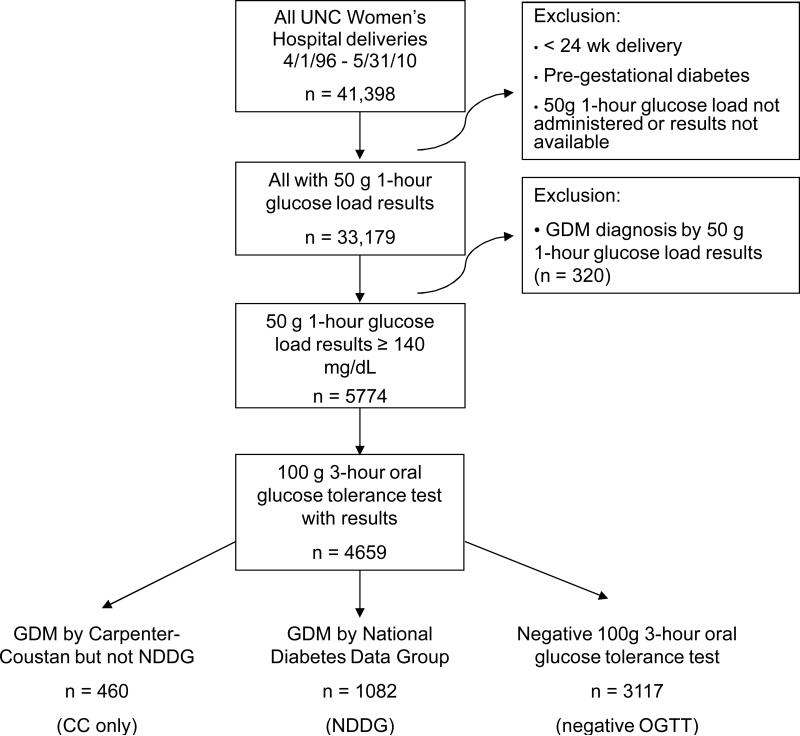
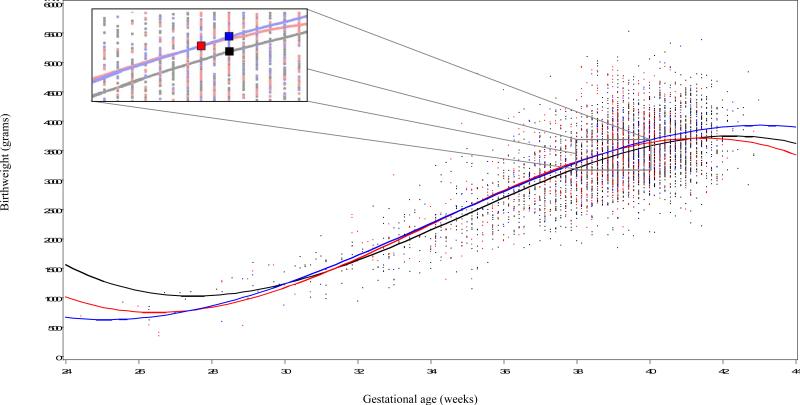
Results: Of the 4659 screen-positive women with diagnostic testing, 1082 (3.3%, of 33,179) met NDDG criteria; 1542 (4.6%, of 33,179), or 460 more, met Carpenter-Coustan criteria. These 460 untreated women had greater risk of preeclampsia than women diagnosed by NDDG criteria (aPR, 1.70; 95% confidence interval [CI], 1.23-2.35). They had a greater risk of cesarean delivery (aPR, 1.16; 95% CI, 1.04-1.30) and infants greater than 4000 g (aPR, 1.25; 95% CI, 1.01-1.56) than women not meeting either diagnostic criteria.
Conclusion: The 42.5% additional women diagnosed only by Carpenter-Coustan criteria are at greater risk for some adverse outcomes. Cost-effectiveness of a change remains to be determined.
Copyright © 2011 Mosby, Inc. All rights reserved.
Figures
References
-
- Bantle JP, Wylie-Rosett J, Albright AL, et al. Nutrition recommendations and interventions for diabetes: a position statement of the American Diabetes Association. Diabetes Care. 2008;31(Suppl 1):S61–78. - PubMed
-
- Dabelea D, Snell-Bergeon JK, Hartsfield CL, et al. Increasing prevalence of gestational diabetes mellitus (GDM) over time and by birth cohort: Kaiser Permanente of Colorado GDM Screening Program. Diabetes Care. 2005;28:579–84. - PubMed
-
- Langer O, Yogev Y, Most O, Xenakis EM. Gestational diabetes: the consequences of not treating. Am J Obstet Gynecol. 2005;192:989–97. - PubMed
-
- Metzger BE, Lowe LP, Dyer AR, et al. Hyperglycemia and adverse pregnancy outcomes. N Engl J Med. 2008;358:1991–2002. - PubMed
-
- Crowther CA, Hiller JE, Moss JR, et al. Effect of treatment of gestational diabetes mellitus on pregnancy outcomes. N Engl J Med. 2005;352:2477–86. - PubMed
Publication types
MeSH terms
Grants and funding
LinkOut - more resources
Full Text Sources
Miscellaneous
