. 2012 Apr;6(4):847-62.
doi: 10.1038/ismej.2011.141. Epub 2011 Nov 10.

Methanogenic archaea are globally ubiquitous in aerated soils and become active under wet anoxic conditions

Affiliations

Methanogenic archaea are globally ubiquitous in aerated soils and become active under wet anoxic conditions

Roey Angel et al. ISME J. 2012 Apr.

Abstract

The prototypical representatives of the Euryarchaeota--the methanogens--are oxygen sensitive and are thought to occur only in highly reduced, anoxic environments. However, we found methanogens of the genera Methanosarcina and Methanocella to be present in many types of upland soils (including dryland soils) sampled globally. These methanogens could be readily activated by incubating the soils as slurry under anoxic conditions, as seen by rapid methane production within a few weeks, without any additional carbon source. Analysis of the archaeal 16S ribosomal RNA gene community profile in the incubated samples through terminal restriction fragment length polymorphism and quantification through quantitative PCR indicated dominance of Methanosarcina, whose gene copy numbers also correlated with methane production rates. Analysis of the δ(13)C of the methane further supported this, as the dominant methanogenic pathway was in most cases aceticlastic, which Methanocella cannot perform. Sequences of the key methanogenic enzyme methyl coenzyme M reductase retrieved from the soil samples before incubation confirmed that Methanosarcina and Methanocella are the dominant methanogens, though some sequences of Methanobrevibacter and Methanobacterium were also detected. The global occurrence of only two active methanogenic archaea supports the hypothesis that these are autochthonous members of the upland soil biome and are well adapted to their environment.


Figures
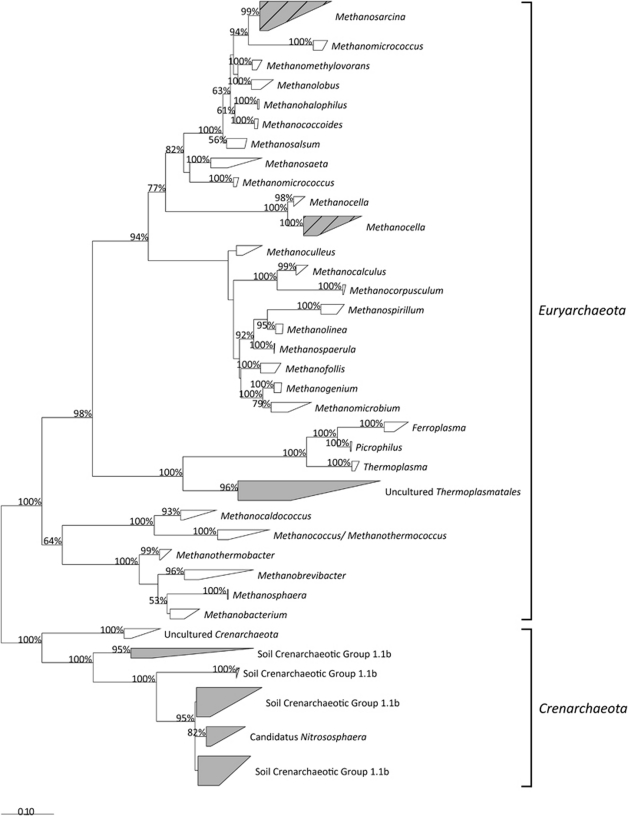
Figure 1
Figure 1
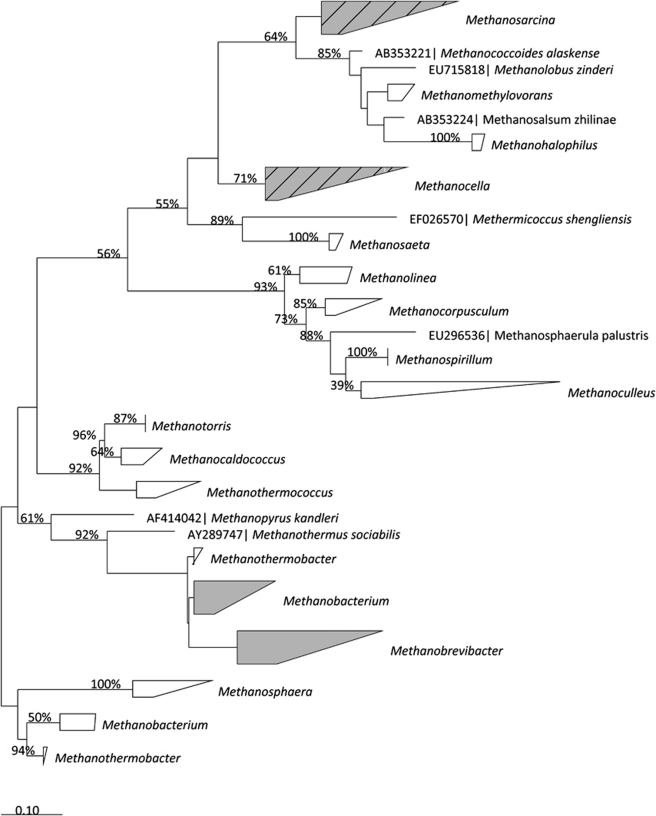
Maximum likelihood phylogenetic tree based on aligned partial archaeal 16S rRNA gene sequences. Sequences were aligned against the SILVA 102 database using the SINA aligner, and the tree was calculated with RAxML 7.04 using rapid hill climbing algorithm and GTRMIX evolutionary model. Bootstrap values above 50% (out of 100 trials) are displayed next to the nodes. Shaded clusters contain sequences that were only detected in the preincubated soil samples, whereas sequences from the post-incubated slurries cluster both into the shaded clusters and into the shaded clusters with diagonal lines.
Figure 2
Figure 2
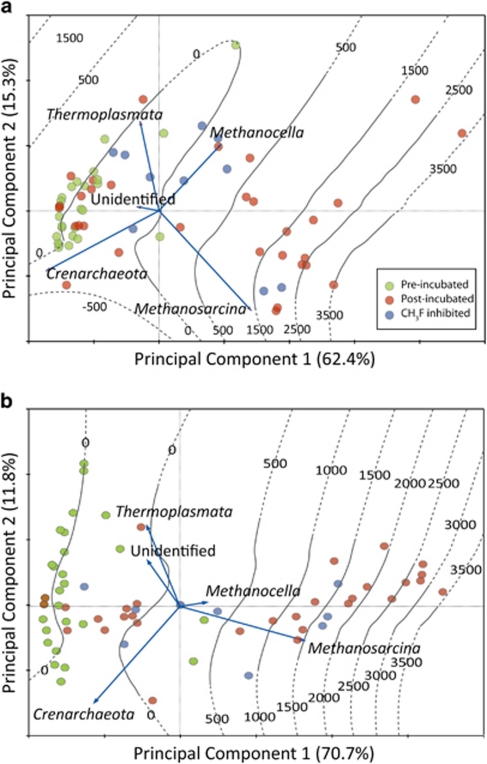
Principal component analysis plots of the archaeal community as deciphered from the 16S rRNA gene TRFLP profiles. Circles indicate individual samples. The relative abundance of each of the archaeal types can be estimated from the perpendicular projection of each sample to the individual vectors, whereas the length of each vector indicates the variance (range of relative abundance values) of its respective archaeal type. CH3F was used to inhibit aceticlastic methanogenesis. Fitted methane production rates are shown as isolines; (a) DNA TRFLP profiles and (b) rRNA TRFLP profiles.
Figure 3
Figure 3
Maximum likelihood phylogenetic tree based on aligned partial amino-acid sequences of the mcrA. Amino-acid composition was deduced from DNA sequences, and the tree was calculated with RAxML 7.04 using rapid hill climbing algorithm and PROTMIX-JTT evolutionary model. Bootstrap values above 50% (out of 100 trials) are displayed next to the nodes. Shaded clusters contain sequences that were only detected in the preincubated soil samples, whereas sequences from the post-incubated slurries cluster both into the shaded clusters and into the shaded clusters with diagonal lines clusters.
Figure 4
Figure 4
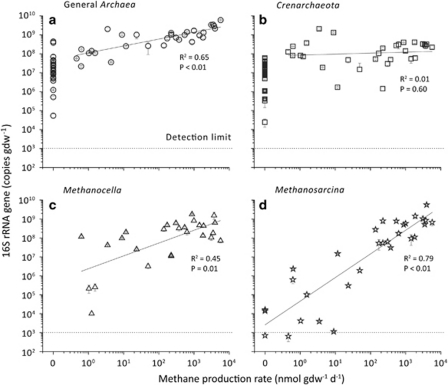
Archaeal 16S rRNA gene copy numbers are quantified using qPCR plotted against potential methane production rates. Both preincubated soil samples as well as post-incubated slurries are shown in these plots. The preincubated samples as well as the slurries that showed no methanogenic potential are positioned at 0 on the x axis.

References

    1. Amann R, Ludwig W, Schleifer K. Phylogenetic identification and in situ detection of individual microbial cells without cultivation. Microbiol Rev. 1995;59:143–169. - PMC - PubMed
    1. Angel R, Conrad R. In situ measurement of methane fluxes and analysis of transcribed particulate methane monooxygenase in desert soils. Environ Microbiol. 2009;11:2598–2610. - PubMed
    1. Angel R, Matthies D, Conrad R. Activation of methanogenesis in arid biological soil crusts despite the presence of oxygen. PLoS One. 2011;6:e20453. - PMC - PubMed
    1. Angel R, Soares MIM, Ungar ED, Gillor O. Biogeography of soil archaea and bacteria along a steep precipitation gradient. ISME J. 2010;4:553–563. - PubMed
    1. Ashelford KE, Weightman AJ, Fry JC. PRIMROSE: a computer program for generating and estimating the phylogenetic range of 16S rRNA oligonucleotide probes and primers in conjunction with the RDP-II database. Nucleic Acids Res. 2002;30:3481–3489. - PMC - PubMed

Publication types