. 2011 Nov 9;31(45):16185-93.
doi: 10.1523/JNEUROSCI.3721-11.2011.

Optimal control of natural eye-head movements minimizes the impact of noise

Affiliations

Optimal control of natural eye-head movements minimizes the impact of noise

Murat Saglam et al. J Neurosci. .

Abstract

When shifting gaze to foveate a new target, humans mostly choose a unique set of eye and head movements from an infinite number of possible combinations. This stereotypy suggests that a general principle governs the movement choice. Here, we show that minimizing the impact of uncertainty, i.e., noise affecting motor performance, can account for the choice of combined eye-head movements. This optimization criterion predicts all major features of natural eye-head movements-including the part where gaze is already on target and the eye counter-rotates-such as movement durations, relative eye-head contributions, velocity profiles, and the dependency of gaze shifts on initial eye position. As a critical test of this principle, we show that it also correctly predicts changes in eye and head movement imposed by an experimental increase in the head moment of inertia. This suggests that minimizing the impact of noise is a simple and powerful principle that explains the choice of a unique set of movement profiles and segment coordination in goal-directed action.


Figures
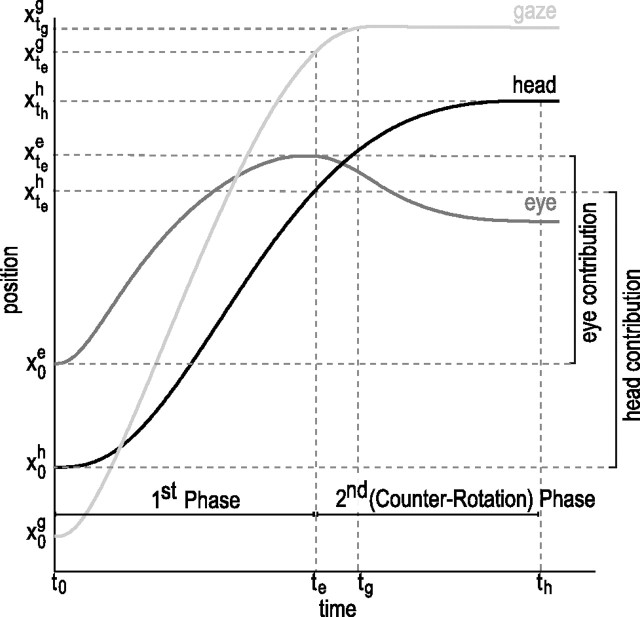
Figure 1.
Figure 1.
Eye-in-head (eye), head-in-space (head), and eye-in-space (gaze) position traces during an exemplary gaze shift following a horizontal target step. The gaze shift has two phases: (1) a movement of eye and head toward the target and (2) a phase where gaze is on target and the eyes counter-rotate while the head continues to move toward the target. The first phase lasts from the start (t0) to the point where the eyes reach maximum eccentricity (te), the second from te to maximum head eccentricity (th). At te, the eyes start to counter-rotate. Gaze lands on the desired position at tg. x0e, x0h, and x0g are initial positions, xtee, xthh, and xtgg maximum eccentricities of eye, head, and gaze, respectively. Eye contribution is defined as xteex0e, head contribution is xtehx0h
Figure 2.
Figure 2.
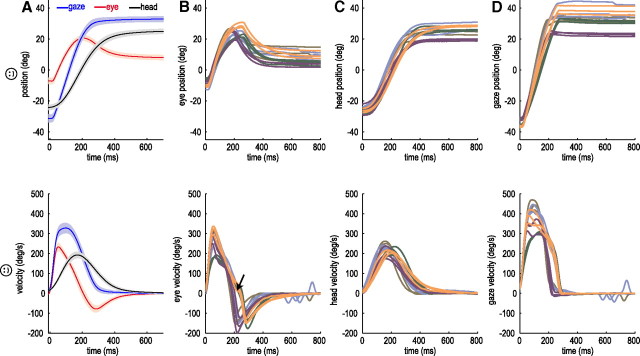
Position (top) and velocity (bottom) traces during gaze shifts in the unweighted, natural condition. A, Mean (solid line) and SEM (shaded area) traces of eye (red), head (black), and gaze (blue) from 10 subjects. Whereas head movement velocity profiles are symmetrically bell-shaped, eye-movement trajectories are skewed, with acceleration taking less time than deceleration. B–D, Individual traces of eye (B), head (C), and gaze (D) from single subjects (each subject's trajectories are depicted with a different color). Note that the deceleration phase of the eye movement does not smoothly continue to the counter-rotation phase (arrow). This discontinuity can only be appreciated in the individual and not the average traces, due to the low-pass filtering effect of averaging.
Figure 3.
Figure 3.
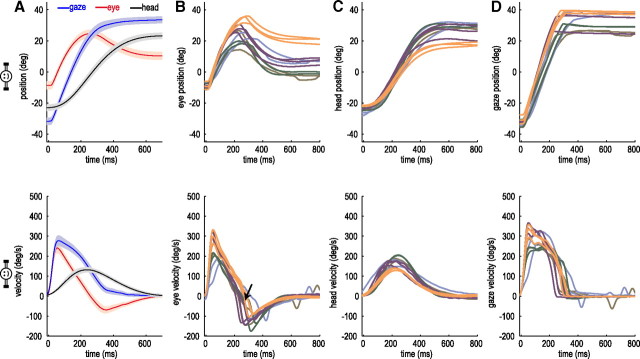
Position (top) and velocity (bottom) traces when the head moment of inertia is experimentally increased. A, Mean traces (solid line) and SEM (shaded area) of eye (red), head (black), and gaze (blue) from the same 10 subjects as in Figure 2. Increasing the head moment of inertia leads to a decrease in peak head velocity and in head contribution and to an increase in head movement duration (compare to Fig. 2A). Note that the gaze velocity profile (bottom) is more skewed than in the natural condition (compare to Fig. 2A, bottom). Gaze positions at the beginning and the end of the gaze shift are not significantly different from the natural condition (Fig. 2A, top). Individual traces of eye (B), head (C), and gaze (D) from single subjects (colors for each subject as in Fig. 2). Note the discontinuity in the eye velocity trace between phase one and two of the gaze shift (arrow).
Figure 4.
Figure 4.
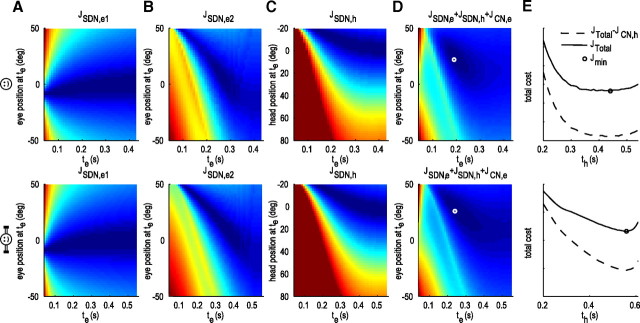
Simulated cost surfaces for a 70° gaze shift in the natural condition (top) and with the head moment of inertia increased (bottom), illustrating how the compromise between SDN and CN costs determines optimal eye–head movements. Costs are color coded in log scale (red, high cost; blue, low cost) with the same ranges for the natural and the weighted conditions. A, SDN cost of the eye (JSDN,e1) until it reaches maximum eccentricity (phase 1; defined in Fig. 1) for different movement durations (te) and contributions (eye position at te). SDN cost is a decreasing function of movement duration and gets higher for eccentric positions away from the center. The initial state of the eye is x = [0,0,−10°] and xtee and te are swept within the ranges of [−50°, 50°] and [0,th], respectively. B, SDN cost of the eye during the counter-rotation phase (JSDN,e2). SDN cost of the eye movement is both dependent on the duration and the amplitude of the counter-rotation of the eye. C, JSDN,h for head movements from x = [0,0,−25°] to x = [0,0,xthh], which satisfy xtee + xteh = xteg for xtee and te within the ranges given in A. The y-axis is inverted to better visualize the sum of JSDN,e and JSDN,h. D, JSDN,e1 + JSDN,e2 + JSDN,h + JCN,e1 + JCN,e2. The gray circle indicates the global minimum of the surface which determines the optimal te, xtee, and xteh for a given th. E, Minimum of the surface costs given in D (dashed line) and of the total cost (JTotal, solid line) versus th. The circle indicates the optimal th for the global minimum of the total costs.
Figure 5.
Figure 5.
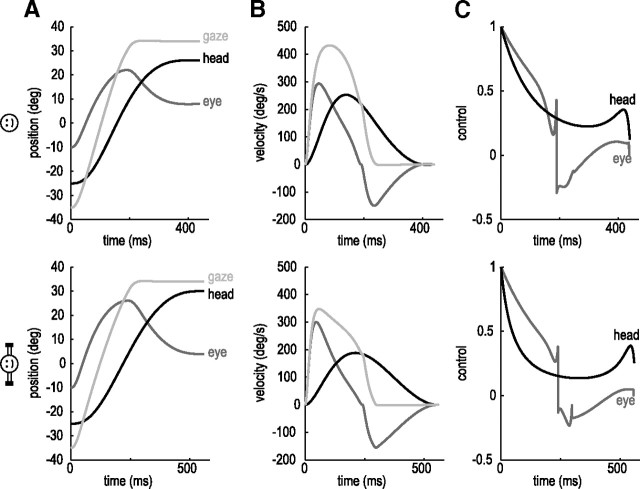
Simulation of eye and head movements with initial eye position at −10°, head position at −25°, and final gaze position at 35° (70° gaze shift, velocity, and acceleration of eye and head are set to zero at the beginning and the end of the movement). Top, results in the natural condition; bottom, results for the weighted condition. A, Positions of eye (dark gray), head (black), and gaze (light gray). B, Velocity profiles of eye (dark gray), head (black), and gaze (light gray). C, Optimal control signals of eye (ue, dark gray) and head (uh, black). For illustration purposes, control signals are normalized.
Figure 6.
Figure 6.
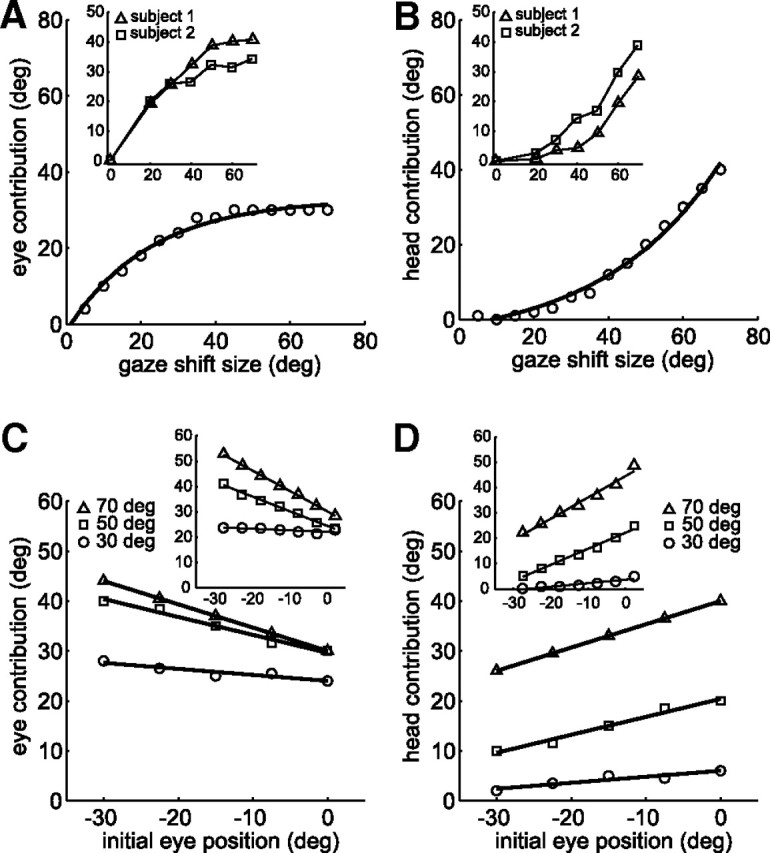
Main sequence and initial position dependency of simulated eye and head movements. A, Eye contribution for different gaze shift sizes. B, Head contribution for different gaze shifts. A, B, Initial eye and head positions are set to central positions. Insets are adapted from Guitton and Volle (1987) and show experimental results of human subjects. C, Eye contribution to gaze shifts of 30° (circle), 50° (square), and 70° (triangle) with different initial eye positions. D, Head contribution to gaze shifts of 30° (circle), 50° (square), and 70° (triangle) for different initial eye positions. C, D, Initial head position is set to the central position. Insets are adapted from Freedman and Sparks (1997) and show the dependency of eye and head contributions to different initial eye positions in rhesus monkeys.
Figure 7.
Figure 7.
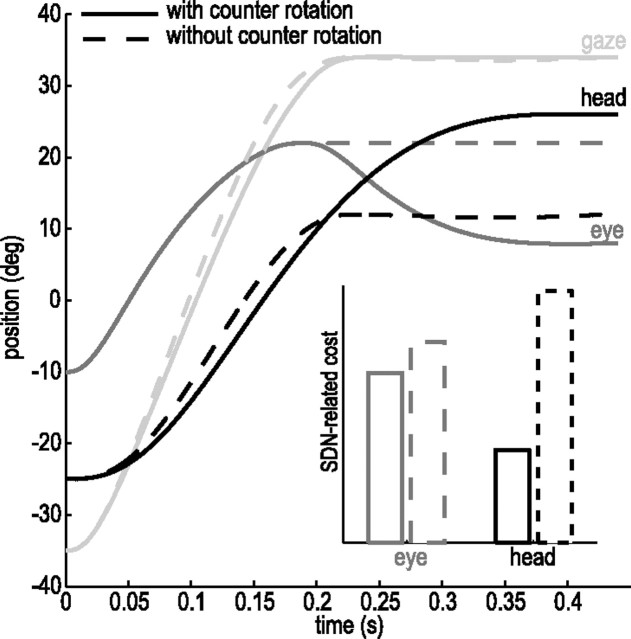
Eye, head, and gaze position traces for the simulated optimized movement (solid lines, with counter-rotation) and for a simulated hypothetical movement (dashed lines) producing a similar gaze shift but without counter-rotation of the eye. Inset shows eye and head SDN-related costs for the two strategies. For the eye and the head, SDN costs are higher during the hypothetical movement since larger control signals are required to keep the eye at an eccentric position and to stop the head at an earlier time. Note that the total elapsed time is equal for both strategies, thus CN-related costs are identical.

References

    1. Collewijn H, Erkelens CJ, Steinman RM. Binocular coordination of human horizontal saccadic eye-movements. J Physiol. 1988;404:157–182. - PMC - PubMed
    1. Freedman EG, Sparks DL. Eye-head coordination during head-unrestrained gaze shifts in rhesus monkeys. J Neurophysiol. 1997;77:2328–2348. - PubMed
    1. Freedman EG, Sparks DL. Coordination of the eyes and head: movement kinematics. Exp Brain Res. 2000;131:22–32. - PubMed
    1. Glasauer S. Cerebellar contribution to saccades and gaze holding: a modeling approach. Ann N Y Acad Sci. 2003;1004:206–219. - PubMed
    1. Glasauer S, Hoshi M, Kempermann U, Eggert T, Büttner U. Three-dimensional eye position and slow phase velocity in humans with downbeat nystagmus. J Neurophysiol. 2003;89:338–354. - PubMed

Publication types