. 2012 Jan;86(1):185-94.
doi: 10.1128/JVI.05245-11. Epub 2011 Nov 9.

The toll-like receptor 3-mediated antiviral response is important for protection against poliovirus infection in poliovirus receptor transgenic mice

Affiliations

The toll-like receptor 3-mediated antiviral response is important for protection against poliovirus infection in poliovirus receptor transgenic mice

Yuko Abe et al. J Virol. 2012 Jan.

Abstract

RIG-I-like receptors and Toll-like receptors (TLRs) play important roles in the recognition of viral infections. However, how these molecules contribute to the defense against poliovirus (PV) infection remains unclear. We characterized the roles of these sensors in PV infection in transgenic mice expressing the PV receptor. We observed that alpha/beta interferon (IFN-α/β) production in response to PV infection occurred in an MDA5-dependent but RIG-I-independent manner in primary cultured kidney cells in vitro. These results suggest that, similar to the RNA of other picornaviruses, PV RNA is recognized by MDA5. However, serum IFN-α levels, the viral load in nonneural tissues, and mortality rates did not differ significantly between MDA5-deficient mice and wild-type mice. In contrast, we observed that serum IFN production was abrogated and that the viral load in nonneural tissues and mortality rates were both markedly higher in TIR domain-containing adaptor-inducing IFN-β (TRIF)-deficient and TLR3-deficient mice than in wild-type mice. The mortality rate of MyD88-deficient mice was slightly higher than that of wild-type mice. These results suggest that multiple pathways are involved in the antiviral response in mice and that the TLR3-TRIF-mediated signaling pathway plays an essential role in the antiviral response against PV infection.


Figures
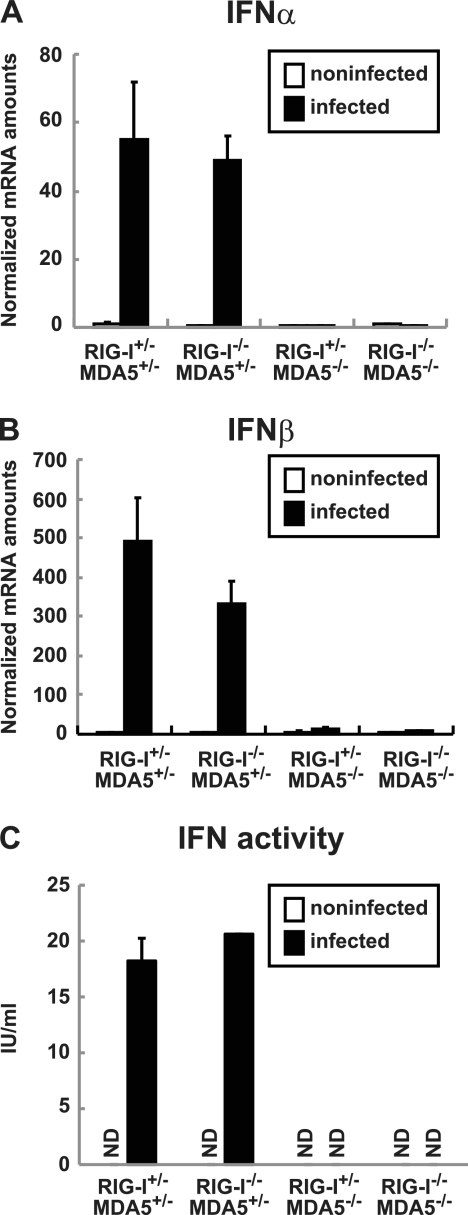
Fig 1
Fig 1
Production of IFNs in primary cultured kidney cells prepared from RIG-I- and MDA5-deficient mice. Kidney cells were pretreated with 100 U of IFN-β for 2 h and infected with PV at an MOI of 10. RNA was prepared from the infected cells at 6 hpi. The amounts of IFN-α mRNA (A) and IFN-β mRNA (B) were determined using quantitative real-time PCR. Cells were prepared in duplicate, and the experiments were repeated three times. Representative data are shown. The amount of IFN activity in the supernatant of infected kidney cells at 8 hpi was determined by the cytopathic effect dye uptake method using L929 cells (C). ND, not detected.
Fig 2
Fig 2
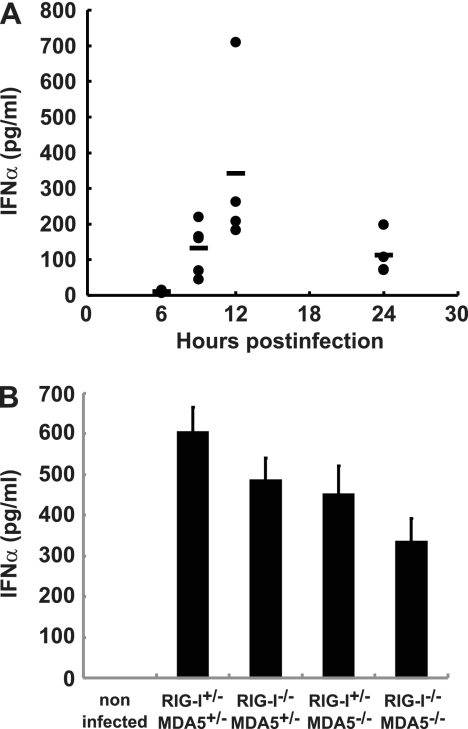
Production of serum IFN-α in RIG-I- and MDA5-deficient mice. (A) Time course of IFN-α levels in serum. PVR-tg mice in the B6 background (n = 4 or n = 5) were intravenously infected with 2 × 10⁷ PFU of PV. Serum samples were collected at the indicated time points, and the concentration of IFN-α was determined using ELISA. (B) IFN-α levels of RIG-I- and MDA5-deficient mice in the ICR background (n = 8) at 12 hpi were compared. The experiments were repeated twice, and representative data are shown.
Fig 3
Fig 3
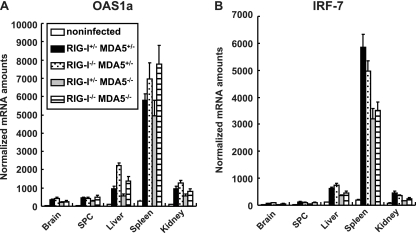
ISG induction in RIG-I- and MDA5-deficient mice. Mice (n = 4) were intravenously infected with 2 × 10⁷ PFU of PV. At 12 hpi, RNA was isolated from the indicated tissues of the infected mice and OAS1a (A) and IRF-7 (B) mRNA levels were determined using quantitative real-time PCR. The experiments were repeated twice, and representative data are shown. SPC, spinal cord.
Fig 4
Fig 4
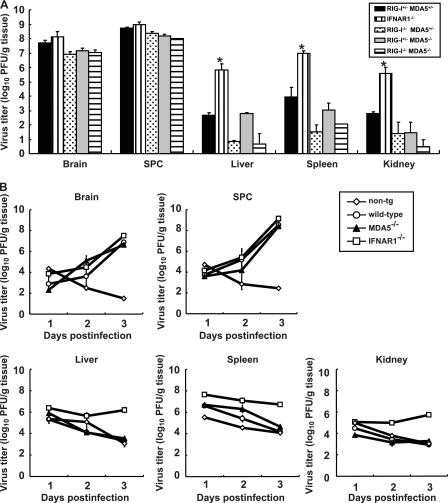
(A) PV replication in RIG-I- and MDA5-deficient mice. RIGI-I+/− MDA5+/−, RIGI-I−/− MDA5+/−, RIGI-I−/− MDA5+/−, and RIGI-I−/− MDA5−/− mice in the ICR background and IFNAR1−/− mice in the B6 background (n = 3) were intravenously infected with 2 × 10⁷ PFU of PV. Infected mice were paralyzed or dead at 3 to 5 days postinfection. The tissues of the paralyzed mice were collected, and the viral titers were determined using a plaque assay (*, P < 0.01 by t test compared to RIGI-I+/− MDA5+/− mice). (B) PV replication kinetics in MDA5-deficient mice. Nontransgenic (non-tg) mice, wild-type mice, MDA5−/− mice, and IFNAR1−/− mice in the B6 background (n = 3) were infected as described above. Tissues were collected daily, and viral titers were determined. SPC, spinal cord.
Fig 5
Fig 5
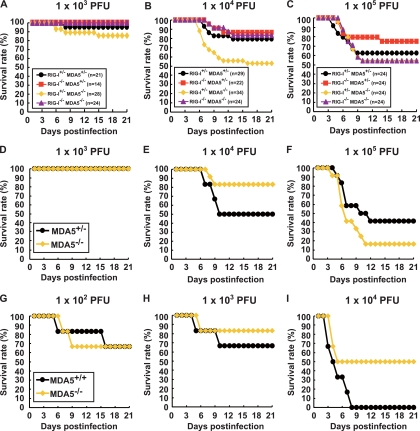
Mortality rates of RIG-I- and MDA5-deficient mice. Littermates of the genotypes indicated were obtained by mating RIGI-I+/− MDA5+/− and RIGI-I−/− MDA5−/− mice in the ICR background. The mice were infected intravenously with 103 (A), 104 (B), or 105 (C) PFU of PV. The results shown are the sums of several independent experiments. The total numbers of mice of the different genotypes that were used are boxed, and the doses used are shown at the top. Littermates of MDA5+/− and MDA5−/− mice were obtained in the B6 background. The mice (n = 12) were intravenously infected with 103 (D), 104 (E), or 105 (F) of PV. MDA5+/+ and MDA5−/− mice (n = 6) were intracerebrally infected with 102 (G), 103 (H), or 104 (I) PFU of PV, respectively. We monitored the survival rates of the mice for 3 weeks after infection.
Fig 6
Fig 6
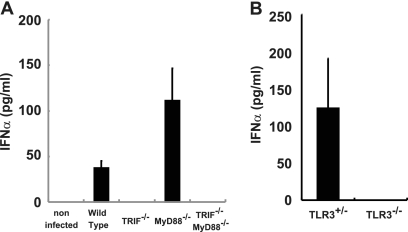
Production of serum IFN-α in TRIF-, MyD88-, and TLR3-deficient mice. Mice (n = 3 or 8) were intravenously infected with 107 PFU of PV. IFN-α levels of TRIF- and MyD88-deficient mice (A) and TLR3-deficient mice (B) at 12 hpi were compared. The experiments were repeated twice, and representative data are shown.
Fig 7
Fig 7
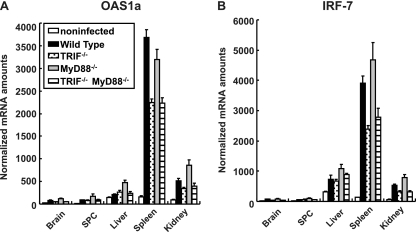
ISG induction in TRIF- and MyD88-deficient mice. Mice (n = 4) were intravenously infected with 107 PFU of PV. At 12 hpi, RNA was isolated from the indicated tissues of the infected mice and OAS1a (A) and IRF-7 (B) mRNA levels were determined by quantitative real-time PCR. The experiments were repeated twice, and representative data are shown. SPC, spinal cord.
Fig 8
Fig 8
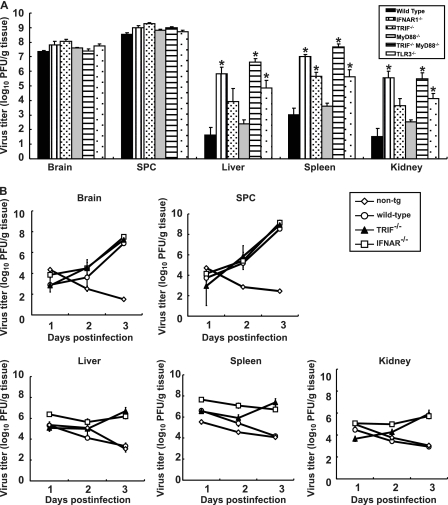
(A) PV replication in TRIF- and MyD88-deficient mice. Wild-type (n = 4), TRIF−/− (n = 4), MyD88−/− (n = 6), TRIF−/− MyD88−/− (n = 4), TLR3−/− (n = 5), and IFNAR1−/− (n = 4) mice were intravenously infected with 107 PFU of PV. The infected mice were paralyzed or dead at 3 to 5 days postinfection. The indicated tissues were collected, and viral titers were determined using a plaque assay (*, P < 0.01 by t test compared to wild-type mice). (B) PV replication kinetics in TRIF-deficient mice. Nontransgenic mice, wild-type mice, TRIF−/− mice, and IFNAR1−/− mice (n = 3) were infected as described above. Tissues were collected daily, and viral titers were determined. The results for nontransgenic (non-tg) mice, wild-type mice, and IFNAR1−/− mice are the same as those in Fig. 4B. SPC, spinal cord.
Fig 9
Fig 9
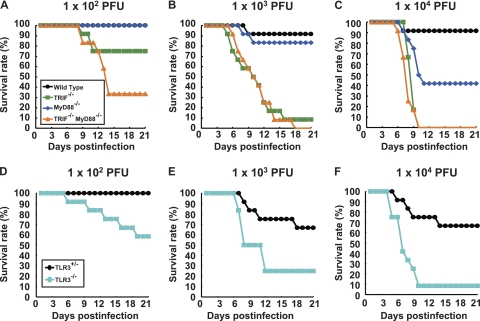
Mortality rates of TRIF-, MyD88-, and TLR3-deficient mice. (A) Wild-type, TRIF−/−, MyD88−/−, and TRIF−/− MyD88−/− mice (n = 12) were intravenously inoculated with the indicated doses of PV. (B) Littermates of TLR3+/− and TLR3−/− mice (n = 12) were used.

References

    1. Akira S, Uematsu S, Takeuchi O. 2006. Pathogen recognition and innate immunity. Cell 124:783–801 - PubMed
    1. Alexopoulou L, Holt AC, Medzhitov R, Flavell RA. 2001. Recognition of double-stranded RNA and activation of NF-kappaB by Toll-like receptor 3. Nature 413:732–738 - PubMed
    1. Barral PM, et al. 2007. MDA-5 is cleaved in poliovirus-infected cells. J. Virol. 81:3677–3684 - PMC - PubMed
    1. Bodian D. 1959. Poliomyelitis: pathogenesis and histopathology, p 479–518 InRivers TM, Horsfall FL., Jr (ed), Viral and rickettsial infections of man, vol 3 J. B. Lippincott, Philadelphia, PA
    1. Cella M, et al. 1999. Plasmacytoid monocytes migrate to inflamed lymph nodes and produce large amounts of type I interferon. Nat. Med. 5:919–923 - PubMed

Publication types

MeSH terms