


A molecular mechanism for bacterial susceptibility to zinc
- PMID: 22072971
- PMCID: PMC3207923
- DOI: 10.1371/journal.ppat.1002357
A molecular mechanism for bacterial susceptibility to zinc
Abstract
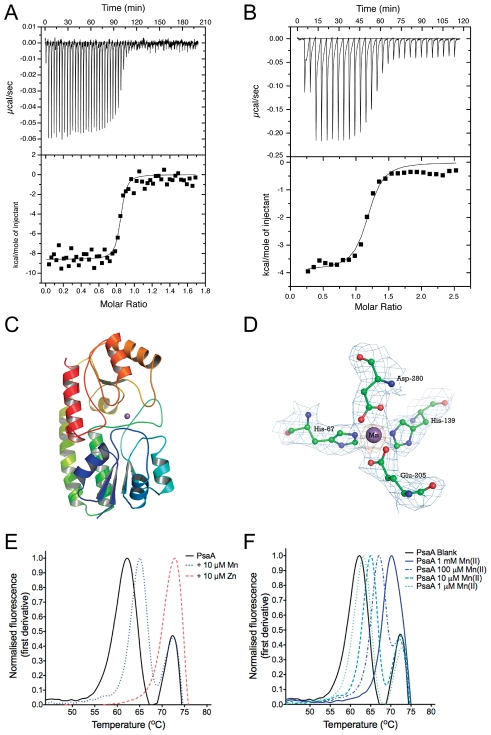
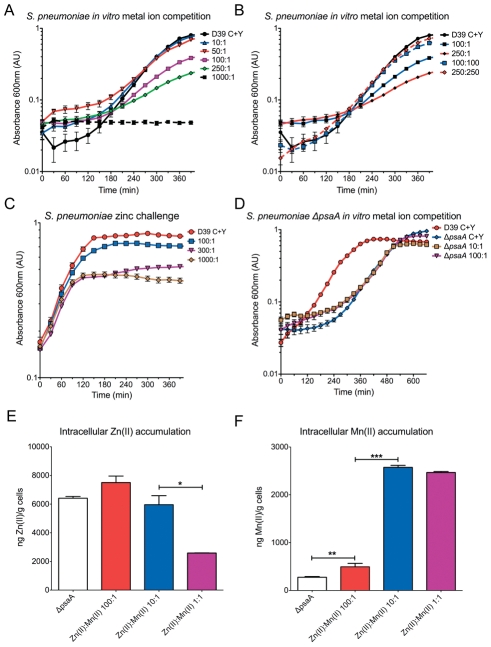
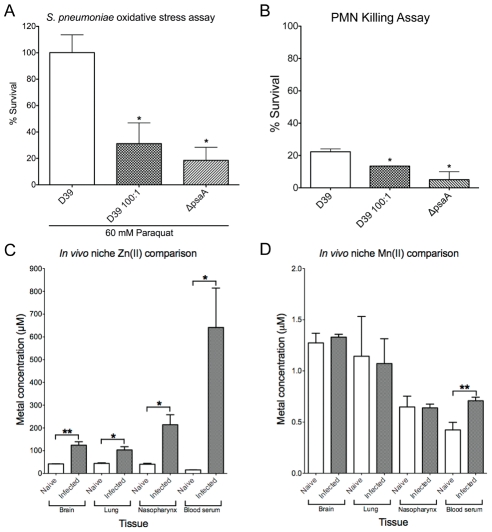
Transition row metal ions are both essential and toxic to microorganisms. Zinc in excess has significant toxicity to bacteria, and host release of Zn(II) at mucosal surfaces is an important innate defence mechanism. However, the molecular mechanisms by which Zn(II) affords protection have not been defined. We show that in Streptococcus pneumoniae extracellular Zn(II) inhibits the acquisition of the essential metal Mn(II) by competing for binding to the solute binding protein PsaA. We show that, although Mn(II) is the high-affinity substrate for PsaA, Zn(II) can still bind, albeit with a difference in affinity of nearly two orders of magnitude. Despite the difference in metal ion affinities, high-resolution structures of PsaA in complex with Mn(II) or Zn(II) showed almost no difference. However, Zn(II)-PsaA is significantly more thermally stable than Mn(II)-PsaA, suggesting that Zn(II) binding may be irreversible. In vitro growth analyses show that extracellular Zn(II) is able to inhibit Mn(II) intracellular accumulation with little effect on intracellular Zn(II). The phenotype of S. pneumoniae grown at high Zn(II):Mn(II) ratios, i.e. induced Mn(II) starvation, closely mimicked a ΔpsaA mutant, which is unable to accumulate Mn(II). S. pneumoniae infection in vivo elicits massive elevation of the Zn(II):Mn(II) ratio and, in vitro, these Zn(II):Mn(II) ratios inhibited growth due to Mn(II) starvation, resulting in heightened sensitivity to oxidative stress and polymorphonuclear leucocyte killing. These results demonstrate that microbial susceptibility to Zn(II) toxicity is mediated by extracellular cation competition and that this can be harnessed by the innate immune response.
Conflict of interest statement
The authors have declared that no competing interests exist.
Figures
References
-
- Saha SK, Naheed A, El Arifeen S, Islam M, Al-Emran H, et al. Surveillance for invasive Streptococcus pneumoniae disease among hospitalized children in Bangladesh: antimicrobial susceptibility and serotype distribution. Clin Infect Dis 48 Suppl. 2009;2:S75–81. - PubMed
-
- Zaidi AK, Thaver D, Ali SA, Khan TA. Pathogens associated with sepsis in newborns and young infants in developing countries. Pediatr Infect Dis J. 2009;28:S10–18. - PubMed
-
- Broome C. Progress of vaccine research and development - 1996. Geneva: WHO; 1996. Meningococcal and pneumococcal disease vaccines. pp. 28–32.
-
- Mahalanabis D, Lahiri M, Paul D, Gupta S, Gupta A, et al. Randomized, double-blind, placebo-controlled clinical trial of the efficacy of treatment with zinc or vitamin A in infants and young children with severe acute lower respiratory infection. Am J Clin Nutr. 2004;79:430–436. - PubMed
-
- Brooks WA, Yunus M, Santosham M, Wahed MA, Nahar K, et al. Zinc for severe pneumonia in very young children: double-blind placebo-controlled trial. Lancet. 2004;363:1683–1688. - PubMed
Publication types
MeSH terms
Substances
Associated data
- Actions
- Actions
LinkOut - more resources
Full Text Sources
Other Literature Sources
Medical
