Review
. 2011;9(10):2106-2130.
doi: 10.3390/md9102106. Epub 2011 Oct 24.

Important determinants for fucoidan bioactivity: a critical review of structure-function relations and extraction methods for fucose-containing sulfated polysaccharides from brown seaweeds

Affiliations
Review

Important determinants for fucoidan bioactivity: a critical review of structure-function relations and extraction methods for fucose-containing sulfated polysaccharides from brown seaweeds

Marcel Tutor Ale et al. Mar Drugs. 2011.

Abstract

Seaweeds--or marine macroalgae--notably brown seaweeds in the class Phaeophyceae, contain fucoidan. Fucoidan designates a group of certain fucose-containing sulfated polysaccharides (FCSPs) that have a backbone built of (1→3)-linked α-L-fucopyranosyl or of alternating (1→3)- and (1→4)-linked α-L-fucopyranosyl residues, but also include sulfated galactofucans with backbones built of (1→6)-β-D-galacto- and/or (1→2)-β-D-mannopyranosyl units with fucose or fuco-oligosaccharide branching, and/or glucuronic acid, xylose or glucose substitutions. These FCSPs offer several potentially beneficial bioactive functions for humans. The bioactive properties may vary depending on the source of seaweed, the compositional and structural traits, the content (charge density), distribution, and bonding of the sulfate substitutions, and the purity of the FCSP product. The preservation of the structural integrity of the FCSP molecules essentially depends on the extraction methodology which has a crucial, but partly overlooked, significance for obtaining the relevant structural features required for specific biological activities and for elucidating structure-function relations. The aim of this review is to provide information on the most recent developments in the chemistry of fucoidan/FCSPs emphasizing the significance of different extraction techniques for the structural composition and biological activity with particular focus on sulfate groups.

Keywords: anticoagulant; antitumor; extraction; fucoidan; sulfated polysaccharides.


Figures
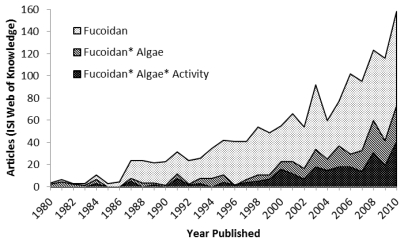
Figure 1
Figure 1
The trend during three decades of research on fucoidan as depicted by the number of published articles (Thomson Reuters, ISI Web of Knowledge). The number of articles was obtained according to topics being assigned in the ISI Web of Knowledge search engine with the following topic search terms: Fucoidan; Fucoidan*Algae; Fucoidan*Algae*Activity.
Figure 2
Figure 2
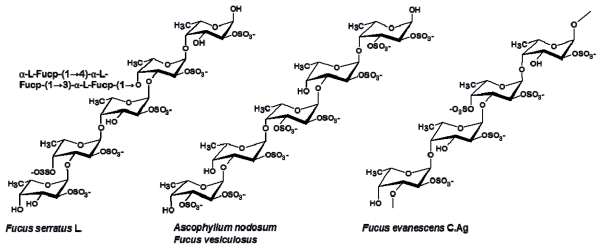
Typical structure of fucoidan (FCSPs) obtained from some brown seaweed species in the order of Fucales. The l-fucopyranose backbone of the fucoidan (FCSPs) extracted from A. nodosum and F. vesiculosus is connected by alternating α(1→3) and α(1→4) linkages [11]; The FCSPs from F. evanescens have a similar backbone built up with sulfate substituted at the 2- and 4-position of the fucose residues [20] (only sulfate substitutions on C-2 of fucose are shown in the Figure). Acetate substitutions may also be found at the C-4-position of 3-linked fucose and at C3 of 4-linked fucose units [22] (acetate substitutions not shown in the figure). For F. serratus L. a possible fucoside side chain at C-4 is also shown.
Figure 3
Figure 3
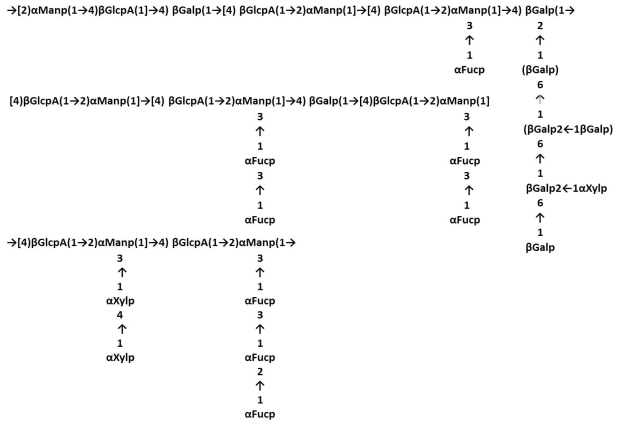
Suggested structures of the FCSPs (fucoidan) from H. fusiforme [23] also known as Sargassum fusiforme (Fucales); sulfate substitutions not shown. The structures also represent typical FCSPs structures from other Sargassum spp. [18].
Figure 4
Figure 4
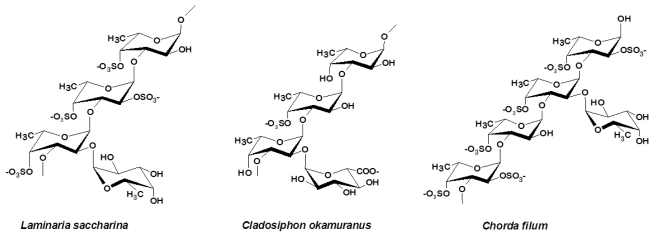
Structural motifs of FCSPs (fucoidan) from some brown seaweed species of the order Laminariales and Chordariales. FCSPs of Chorda filum and Laminaria saccharina consist of a poly-α-(1→3)-fucopyranoside backbone with sulfate mainly at C-4 and sometimes at the C-2 position; some of the backbone fucose residues may be acetylated at C-2 (not shown) [24,25]. Cladosiphon okamuranus derived FCSPs also consist of a backbone of α(1→3)-linked-l-fucopyranose residues with sulfate substitutions at C-4 and/or with α(1→2)-linked single α-l-fucopyranosyl substitutions and vicinal glucuronic acid substitutions. Some of the side chain fucose residues may be O-acetylated (not shown) [14].
Figure 5
Figure 5
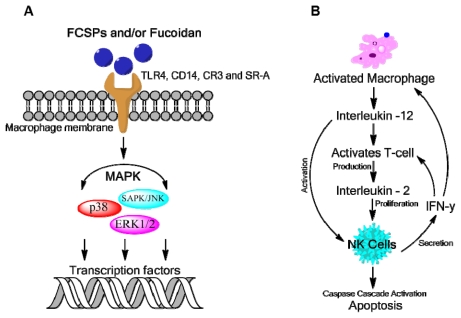
Proposed mechanism responsible for fucoidan bioactivity: (A) Macrophage activation by FCSPs as mediated through specific membrane receptor activation namely TLR-4, CD14, CR-3 and SR which in turn induce intracellular signaling via mitogen-activated protein kinases (MAPKs); (B) Activation of macrophages lead to production of cytokines such as IL-12, IL-2 and IFN-γ which enhance NK cell activation that may stimulate T-cell activation further via IFN-γ.

References

    1. Jiao G, Yu G, Zhang J, Ewart SE. Chemical structure and bioactivities of sulfated polysaccharides from marine algae. Mar. Drugs. 2011;9:196–223. - PMC - PubMed
    1. Kylin H. Biochemistry of sea algae. H. Z. Physiol. Chem. 1913;83:171–197.
    1. Kylin H. Analysis of the biochemistry of the seaweed. H. Z. Physiol. Chem. 1915;94:337–425.
    1. Hoagland DR, Lieb LL. The complex carbohydrates and forms of sulphur in marine algae of the Pacific coast. J. Biol. Chem. 1915;23:287–297.
    1. Bird GM, Hass P. On the nature of the cell wall constituents of Laminaria sp. mannuronic acid. Biochem. J. 1931;25:403–411. - PMC - PubMed

MeSH terms

LinkOut - more resources