


An epidemiological reappraisal of the familial aggregation of prostate cancer: a meta-analysis
- PMID: 22073129
- PMCID: PMC3205054
- DOI: 10.1371/journal.pone.0027130
An epidemiological reappraisal of the familial aggregation of prostate cancer: a meta-analysis
Abstract
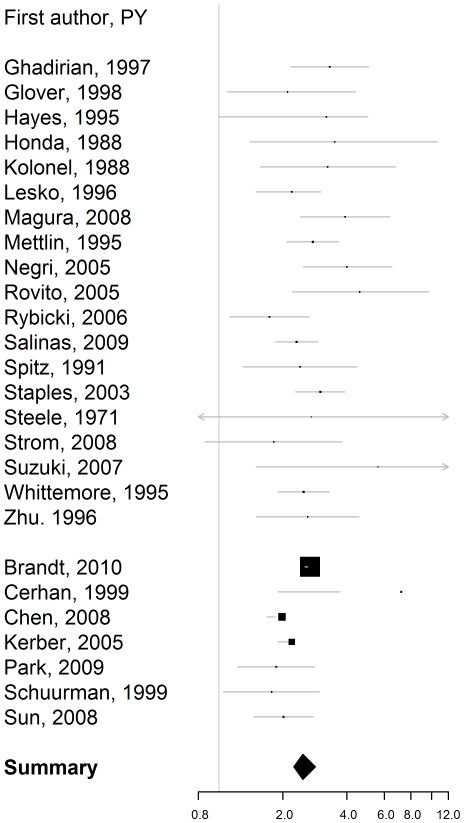
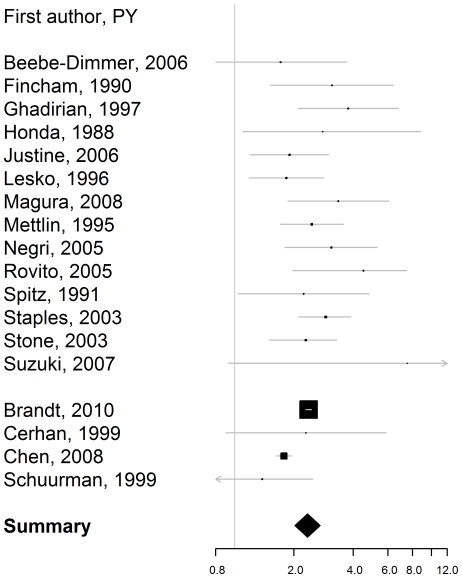
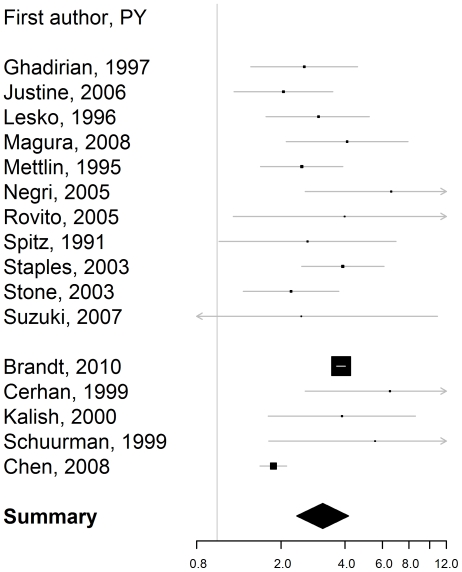
Studies on familial aggregation of cancer may suggest an overall contribution of inherited genes or a shared environment in the development of malignant disease. We performed a meta-analysis on familial clustering of prostate cancer. Out of 74 studies reporting data on familial aggregation of prostate cancer in unselected populations retrieved by a Pubmed search and browsing references, 33 independent studies meeting the inclusion criteria were used in the analysis performed with the random effects model. The pooled rate ratio (RR) for first-degree family history, i.e. affected father or brother, is 2.48 (95% confidence interval: 2.25-2.74). The incidence rate for men who have a brother who got prostate cancer increases 3.14 times (CI:2.37-4.15), and for those with affected father 2.35 times (CI:2.02-2.72). The pooled estimate of RR for two or more affected first-degree family members relative to no history in father and in brother is 4.39 (CI:2.61-7.39). First-degree family history appears to increase the incidence rate of prostate cancer more in men under 65 (RR:2.87, CI:2.21-3.74), than in men aged 65 and older (RR:1.92, CI:1.49-2.47), p for interaction = 0.002. The attributable fraction among those having an affected first-degree relative equals to 59.7% (CI:55.6-63.5%) for men at all ages, 65.2% (CI:57.7-71.4%) for men younger than 65 and 47.9% (CI:37.1-56.8%) for men aged 65 or older. For those with a family history in 2 or more first-degree family members 77.2% (CI:65.4-85.0%) of prostate cancer incidence can be attributed to the familial clustering. Our combined estimates show strong familial clustering and a significant effect-modification by age meaning that familial aggregation was associated with earlier disease onset (before age 65).
Conflict of interest statement
Figures
References
-
- Damber JE, Aus G. Prostate cancer. Lancet. 2008;371:1710–21. - PubMed
-
- Noe M, Schroy P, Marie-France D, Babayan R, Geller A. Increased cancer risk for individuals with a family history of prostate cancer, colorectal cancer, and melanoma and their associated screening recommendations and practices. Cancer Causes and Control. 2007;19:1–12. - PubMed
-
- Bruner DB, Moore D, Parlanti A, Dorgan J, Engstrom P. Relative risk of prostate cancer for men with affected relatives: systematic review and meta-analysis. Int J Cancer. 2003;107:797–803. - PubMed
-
- Johns LE, Houlston RS. A systematic review and meta-analysis of familial prostate cancer risk. BJU International. 2003;91:789–794. - PubMed
-
- Zeegers MPA, Jellema A, Ostrer H. Empiric risk of prostate carcinoma for relatives of patients with prostate carcinoma. A meta-analysis. Cancer. 2003;97:1894–1903. - PubMed
Publication types
MeSH terms
LinkOut - more resources
Full Text Sources
Medical
