


Willingness to share research data is related to the strength of the evidence and the quality of reporting of statistical results
- PMID: 22073203
- PMCID: PMC3206853
- DOI: 10.1371/journal.pone.0026828
Willingness to share research data is related to the strength of the evidence and the quality of reporting of statistical results
Abstract
Background: The widespread reluctance to share published research data is often hypothesized to be due to the authors' fear that reanalysis may expose errors in their work or may produce conclusions that contradict their own. However, these hypotheses have not previously been studied systematically.
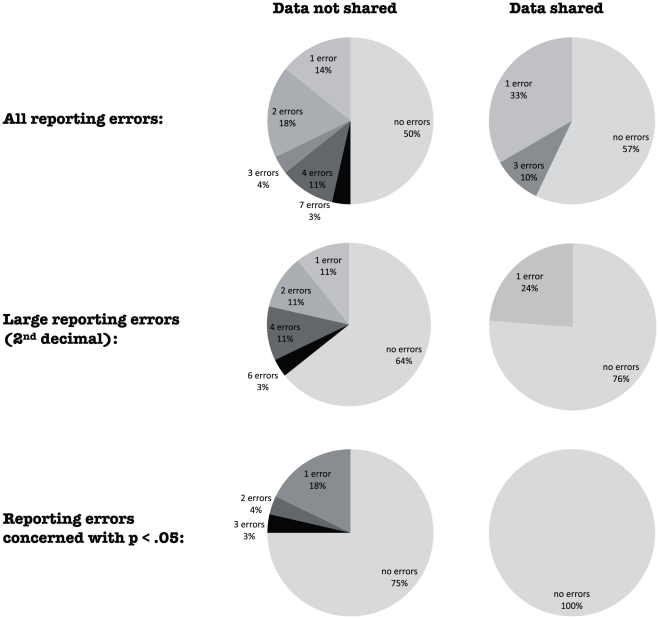
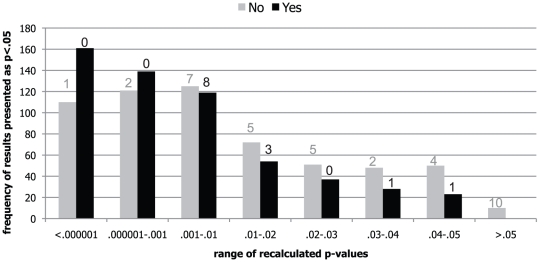
Methods and findings: We related the reluctance to share research data for reanalysis to 1148 statistically significant results reported in 49 papers published in two major psychology journals. We found the reluctance to share data to be associated with weaker evidence (against the null hypothesis of no effect) and a higher prevalence of apparent errors in the reporting of statistical results. The unwillingness to share data was particularly clear when reporting errors had a bearing on statistical significance.
Conclusions: Our findings on the basis of psychological papers suggest that statistical results are particularly hard to verify when reanalysis is more likely to lead to contrasting conclusions. This highlights the importance of establishing mandatory data archiving policies.
Conflict of interest statement
Figures
References
-
- Wolins L. Responsibility for raw data. American Psychologist. 1962;17:657–658.
-
- Murphy JR. Statistical errors in immunologic research. Journal of Allergy and Clinical Immunology. 2004;114:1259–1264. - PubMed
-
- Strasak AM, Zaman Q, Marinell G, Pfeiffer KP, Ulmer H. The use of statistics in medical research: A comparison of The New England Journal of Medicine and Nature Medicine. American Statistician. 2007;61:47–55.
-
- Barber TX. Pitfalls in Human Research: Ten Pivotal Points. New York: Pergamon Press; 1976.
Publication types
MeSH terms
LinkOut - more resources
Full Text Sources
