. 2011;6(11):e26921.
doi: 10.1371/journal.pone.0026921. Epub 2011 Nov 3.

Excess circulating alternatively activated myeloid (M2) cells accelerate ALS progression while inhibiting experimental autoimmune encephalomyelitis

Affiliations

Excess circulating alternatively activated myeloid (M2) cells accelerate ALS progression while inhibiting experimental autoimmune encephalomyelitis

Ilan Vaknin et al. PLoS One. 2011.

Abstract

Background: Circulating immune cells including autoreactive T cells and monocytes have been documented as key players in maintaining, protecting and repairing the central nervous system (CNS) in health and disease. Here, we hypothesized that neurodegenerative diseases might be associated, similarly to tumors, with increased levels of circulating peripheral myeloid derived suppressor cells (MDSCs), representing a subset of suppressor cells that often expand under pathological conditions and inhibit possible recruitment of helper T cells needed for fighting off the disease.

Methods and findings: We tested this working hypothesis in amyotrophic lateral sclerosis (ALS) and its mouse model, which are characterized by a rapid progression once clinical symptoms are evident. Adaptive transfer of alternatively activated myeloid (M2) cells, which homed to the spleen and exhibited immune suppressive activity in G93A mutant superoxide dismutase-1 (mSOD1) mice at a stage before emergence of disease symptoms, resulted in earlier appearance of disease symptoms and shorter life expectancy. The same protocol mitigated the inflammation-induced disease model of multiple sclerosis, experimental autoimmune encephalomyelitis (EAE), which requires circulating T cells for disease induction. Analysis of whole peripheral blood samples obtained from 28 patients suffering from sporadic ALS (sALS), revealed a two-fold increase in the percentage of circulating MDSCs (LIN(-/Low)HLA-DR(-)CD33(+)) compared to controls.

Conclusions: Taken together, these results emphasize the distinct requirements for fighting the inflammatory neurodegenerative disease, multiple sclerosis, and the neurodegenerative disease, ALS, though both share a local inflammatory component. Moreover, the increased levels of circulating MDSCs in ALS patients indicates the operation of systemic mechanisms that might lead to an impairment of T cell reactivity needed to overcome the disease conditions within the CNS. This high level of suppressive immune cells might represent a risk factor and a novel target for therapeutic intervention in ALS at least at the early stage.


Conflict of interest statement

Competing Interests: The authors have read the journal's policy and have the following conflicts: E.Y. was an employee of NeuroQuest Ltd. (Misgav Venture Accelerator, Misgav Business Park 20179, Israel) during the research period. There are no other relevant declarations relating to employment, consultancy, patents and products in development. This does not alter the authors' adherence to all the PLoS ONE policies on sharing data and materials.

Figures

Figure 1
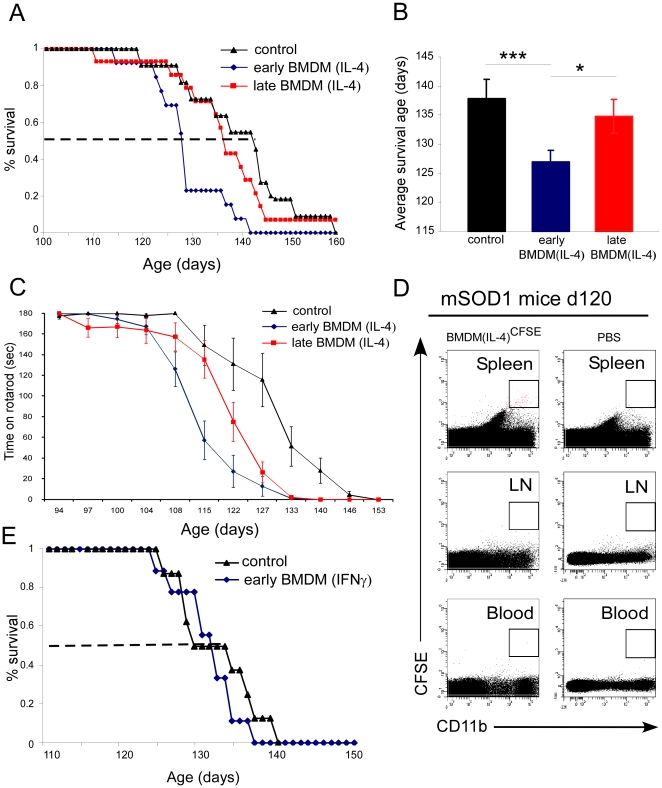
Figure 1. Shorter survival times and earlier appearance of disease symptoms following repeated administration of IL-4 treated BMDM.
(A–B) Male mSOD1 mice on a B6/SJL genetic background receiving repeated injections of IL-4-activated BMDM starting from day 70 (early BMDMIL-4) had a shorter survival time (127±2 days, n = 13) than non-injected mSOD1 control littermates (138±3 days, n = 11; P = 0.003, log-rank-sum test). Survival of male mSOD1 mice receiving repeated IL-4-activated BMDM starting from day 90 (late BMDMIL-4) was similar to control mSOD1 littermates (135±3 days, n = 14; P = 0.515). (C) Effects of early and late treatment with IL-4-activated BMDM on Rotarod performance compared to control mice. Rotarod performance in mice with early treatment declined at most time points, between 109 and 150 days of age, compared with untreated control mSOD1 littermates (P<0.0001, one-way ANOVA; each pair Student's t test, *early vs. control; § late vs. control; #early vs. late). (D) Survival of male mSOD1 mice receiving repeated injections of IFNγ activated BMDM starting from day 70 (early BMDMIFNγ) was similar (130±1.4 days, n = 9) to untreated control mSOD1 littermates (131±1.9 days, n = 8).
Figure 2
Figure 2. IL-4 activated BMDM cells inhibit CD4 T cell activation and ameliorate EAE.
Bone marrow derived myeloid cells (BMDM) were cultured from Cx3cr1 GFP/+ mice (B6.129P- Cx3cr1tm1Litt/J, in which one of the CX3CR1 chemokine receptor alleles was replaced with a gene encoding GFP [green fluorescent protein]), and treated with IL-4 or IFNγ as described in Methods. (A) Acquired cells were first gated for live cells and the fraction of cells expressing CD11b and Cx3cr1 GFP+ (high and low) was determined. (B) Histograms showing the expression levels of CD11c and CD115 within the CD11b+ Cx3cr1 GFP+ cell population are shown. (C) Histograms showing the expression levels of MHCII, CD80 and CD86 within D11b+ Cx3cr1 GFP+ cells are shown. (D) Effect of BMDM on T cell proliferation in vitro. Total splenocytes were labeled with CFSE, stimulated with or without anti-CD3 (1 µg/ml), and co-cultured with IL-4 or IFNγ– activated BMDM cells. On day 3, cells were harvested and CFSE dilution in CD4 T cells (CD4+TCRβ+) was measured by flow cytometry. (E) Chronic EAE was induced in C57BL/6J mice. EAE scores in mice injected with IL-4-activated BMDM (MOG+BMDMIL-4) (n = 6) or with nonactivated BMDM (MOG+ BMDMMedium) (n = 7), administered every 6th day starting 9d after MOG vaccination are shown. Intravenously injected IL-4-activated BMDM cells significantly improved clinical features in mice with chronic EAE compared to mice treated with non-activated BMDM cells (2-factor repeated measures ANOVA; P<0.001; **P<0.01, ***P<0.001, Student's t test).
Figure 3
Figure 3. Higher percentage of circulating MDSCs in sALS patients relative to controls.
(A) Representative flow diagrams from one ALS patient are shown. Acquired cells were first gated (R1) based on the expression of CD45; this population was comprised of total peripheral mononuclear cells (PBMCs). Acquired cells were then gated (R2) by selecting Lin −/Low, HLA-DR negative cells. Within this population, the fraction of cells expressing CD33 was determined (R3). The MDSC population was defined as Lin−/Low, HLA DR negative, and CD33 positive cells. MDSC percentage was calculated as the percentage of total CD45 positive PBMCs in the whole blood samples. (B) The percentage of circulating MDSC was significantly higher in ALS patients compared with control donors (p = 0.001); bar represents the median. (C) The proportion of MDSC in ALS patients (n = 28) was increased compared to both healthy controls (n = 15; p = 0.004) and to neurologic disease controls (n = 5; p = 0.027).

References

    1. Boillee S, Vande Velde C, Cleveland DW. ALS: a disease of motor neurons and their nonneuronal neighbors. Neuron. 2006;52:39–59. - PubMed
    1. Haverkamp LJ, Appel V, Appel SH. Natural history of amyotrophic lateral sclerosis in a database population. Validation of a scoring system and a model for survival prediction. Brain. 1995;118(Pt 3):707–719. - PubMed
    1. Rowland LP, Shneider NA. Amyotrophic lateral sclerosis. N Engl J Med. 2001;344:1688–1700. - PubMed
    1. Beers DR, Henkel JS, Zhao W, Wang J, Appel SH. CD4+ T cells support glial neuroprotection, slow disease progression, and modify glial morphology in an animal model of inherited ALS. Proc Natl Acad Sci U S A. 2008;105:15558–15563. - PMC - PubMed
    1. London A, Itskovich E, Benhar I, Kalchenko V, Mack M, et al. Neuroprotection and progenitor cell renewal in the injured adult murine retina requires healing monocyte-derived macrophages. J Exp Med. 2011;208:23–39. - PMC - PubMed

Publication types