


Vision is adapted to the natural level of blur present in the retinal image
- PMID: 22073247
- PMCID: PMC3206891
- DOI: 10.1371/journal.pone.0027031
Vision is adapted to the natural level of blur present in the retinal image
Abstract
Background: The image formed by the eye's optics is inherently blurred by aberrations specific to an individual's eyes. We examined how visual coding is adapted to the optical quality of the eye.
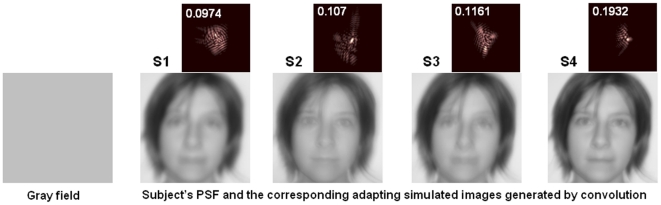
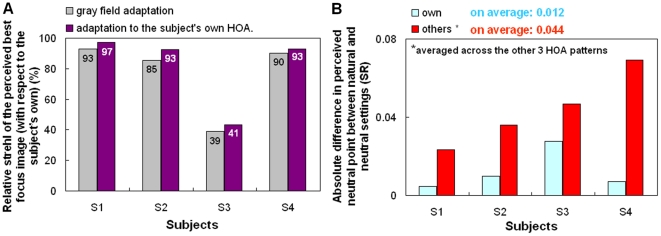
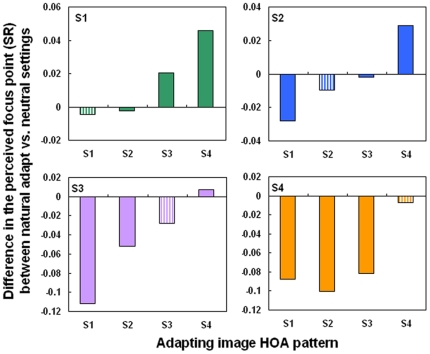
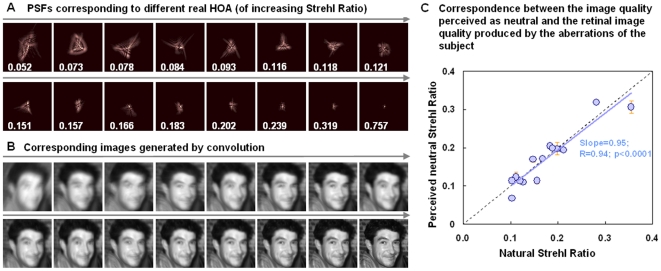
Methods and findings: We assessed the relationship between perceived blur and the retinal image blur resulting from high order aberrations in an individual's optics. Observers judged perceptual blur in a psychophysical two-alternative forced choice paradigm, on stimuli viewed through perfectly corrected optics (using a deformable mirror to compensate for the individual's aberrations). Realistic blur of different amounts and forms was computer simulated using real aberrations from a population. The blur levels perceived as best focused were close to the levels predicted by an individual's high order aberrations over a wide range of blur magnitudes, and were systematically biased when observers were instead adapted to the blur reproduced from a different observer's eye.
Conclusions: Our results provide strong evidence that spatial vision is calibrated for the specific blur levels present in each individual's retinal image and that this adaptation at least partly reflects how spatial sensitivity is normalized in the neural coding of blur.
Conflict of interest statement
Figures
References
-
- Thibos LN, Hong X, Bradley A, Cheng X. Statistical variation of aberration structure and image quality in a normal population of healthy eyes. J Opt Soc Am A Opt Image Sci Vis. 2002;19:2329–2348. - PubMed
-
- Webster MA, Georgeson MA, Webster SM. Neural adjustments to image blur. Nat Neurosc. 2002;5:839–840. - PubMed
-
- Pesudovs K. Involvement of neural adaptation in the recovery of vision after laser Refractive surgery. J Refract Surg. 2005;21:144–147. - PubMed
Publication types
MeSH terms
Grants and funding
LinkOut - more resources
Full Text Sources
