. 2011;6(11):e27137.
doi: 10.1371/journal.pone.0027137. Epub 2011 Nov 4.

Hyaluronan signaling during ozone-induced lung injury requires TLR4, MyD88, and TIRAP

Affiliations

Hyaluronan signaling during ozone-induced lung injury requires TLR4, MyD88, and TIRAP

Zhuowei Li et al. PLoS One. 2011.

Abstract

Ozone exposure is associated with exacerbation of reactive airways disease. We have previously reported that the damage-associated molecular pattern, hyaluronan, is required for the complete biological response to ambient ozone and that hyaluronan fragments signal through toll-like receptor 4 (TLR4). In this study, we further investigated the role of TLR4 adaptors in ozone-induced airway hyperresponsiveness (AHR) and the direct response to hyaluronan fragments (HA). Using a murine model of AHR, C57BL/6J, TLR4-/-, MyD88-/-, and TIRAP-/- mice were characterized for AHR after exposure to either ozone (1 ppm × 3 h) or HA fragments. Animals were characterized for AHR with methacholine challenge, cellular inflammation, lung injury, and production of pro-inflammatory cytokines. Ozone-exposed C57BL/6J mice developed cellular inflammation, lung injury, pro-inflammatory cytokines, and AHR, while mice deficient in TLR4, MyD88 or TIRAP demonstrated both reduced AHR and reduced levels of pro-inflammatory cytokines including TNFα, IL-1β, MCP-1, IL-6 and KC. The level of hyaluronan was increased after inhalation of ozone in each strain of mice. Direct challenge of mice to hyaluronan resulted in AHR in C57BL/6J mice, but not in TLR4-/-, MyD88-/-, or TIRAP-/- mice. HA-induced cytokine production in wild-type mice was significantly reduced in TLR4-/-, MyD88-/-, or TIRAP-/- mice. In conclusion, our findings support that ozone-induced airway hyperresponsiveness is dependent on the HA-TLR4-MyD88-TIRAP signaling pathway.


Conflict of interest statement

Competing Interests: The authors have declared that no competing interests exist.

Figures

Figure 1
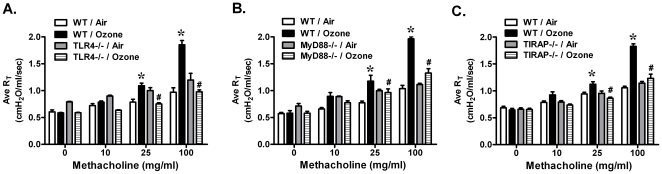
Figure 1. Ozone inhalation increased airway sensitivity to methacholine challenge and was dependent on the TLR4-MyD88-TIRAP signaling pathway.
Animals were exposed to filtered air (FA) or 1 ppm of ozone for 3 hours. Airway responsiveness to methacholine challenge was measured 24 h later. A) Ozone-induced AHR was increased in WT mice but not in TLR4−/− mice, B) MyD88−/−mice, or C) TIRAP−/− mice (*p<0.05 vs. FA-WT; #p<0.05 vs. O3-WT, N = 5–6 per group).
Figure 2
Figure 2. Ozone exposure increased neutrophilic lung inflammation in a manner partially dependent on MyD88, but not TLR4 and TIRAP.
Ozone-exposed mice demonstrated increased neutrophil cell counts in BALF when compared to air-exposed animals. Neutrophil recruitment to the airspace was independent of TLR4 (A) and TIRAP (C), but was partially dependent of MyD88 (B) (* p<0.05, vs. FA exposed group; # p<0.05 vs. O3-WT, N = 4–6 per group).
Figure 3
Figure 3. Ozone inhalation increased the level of pro-inflammatory factors in alveolar lavage fluid in a manner partially dependent on TLR4, MyD88, and TIRAP.
The level of (A) KC, (B) IL-1β, (C) IL-6, (D) MCP-1 and (E) TNFα in BALF from air and ozone-exposed WT, TLR4−/−, MyD88−/− and TIRAP−/− mice were measured by luminex beads (*p<0.05, vs. FA exposed group; #p<0.05, vs. O3-exposed group comparisons between strains; N = 4–5 per group).
Figure 4
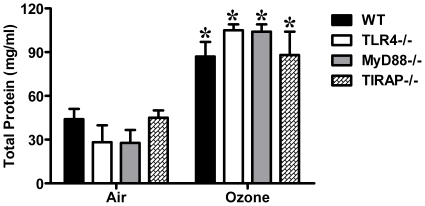
Figure 4. Increased lavage total protein level after ozone exposure was independent of TLR4, MyD88, and TIRAP (*p<0.01, vs. FA exposed group; N = 5–6 per group).
Figure 5
Figure 5. Level of HA in the BALF was increased after exposure to ozone.
HA levels were significantly increased in all ozone-exposed groups (*p<0.01, vs. FA exposed group; #p<0.05, vs. O3-exposed WT, group, N = 4–5 per group).
Figure 6
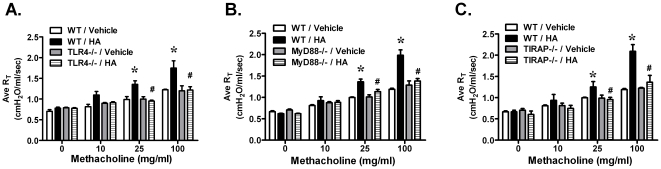
Figure 6. Airway reactivity to HA challenge was dependant on TLR4, MyD88, and TIRAP.
HA increased AHR in WT mice, but not in (A) TLR4−/−mice, (B) MyD88−/−mice, or (C) TIRAP−/− mice (*p<0.05 vs. vehicle-WT; #p<0.05 vs. HA-WT, N = 5 per group).
Figure 7
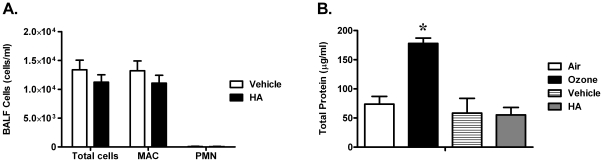
Figure 7. HA challenge was not sufficient for either neutrophilic inflammation or epithelial injury.
(A) There were no observed differences in cellular inflammation in the airspace 2 hours after direct challenge to HA, (B) When compared to ozone challenge, HA challenge had no observed effect on the level of BALF total protein (*p<0.05, vs. FA exposed group, N = 5).
Figure 8
Figure 8. Direct challenge to hyaluronan fragments increased the level of pro-inflammatory factors in alveolar lavage fluid in a manner partially dependent on TLR4, MyD88, and TIRAP.
The level of (A) KC, (B) IL-1β, (C) IL-6, (D) MCP-1 and (E) TNFα in BALF from vehicle or HA-challenged WT, TLR4−/−, MyD88−/− and TIRAP−/− mice were measured by luminex beads (*p<0.05, vs. FA exposed group; #: p<0.05, vs. O3-exposed group comparisons between strains; N = 4 per group).

Comment in

  • Findings of Research Misconduct.
    [No authors listed] [No authors listed] Fed Regist. 2019 Nov 7;84(216):60097-60098. Fed Regist. 2019. PMID: 37547121 Free PMC article. No abstract available.

References

    1. Katsouyanni K, Zmirou D, Spix C, Sunyer J, Schouten JP, et al. Short-term effects of air pollution on health: a European approach using epidemiological time-series data. The APHEA project: background, objectives, design. Eur Respir J. 1995;8:1030–1038. - PubMed
    1. Gryparis A, Forsberg B, Katsouyanni K, Analitis A, Touloumi G, et al. Acute Effects of Ozone on Mortality from the “Air Pollution and Health: A European Approach” Project. Am J Respir Crit Care Med. 2004;28:28. - PubMed
    1. Ito K, De Leon SF, Lippmann M. Associations between ozone and daily mortality: analysis and meta-analysis. Epidemiology. 2005;16:446–457. - PubMed
    1. Levy JI, Chemerynski SM, Sarnat JA. Ozone exposure and mortality: an empiric bayes metaregression analysis. Epidemiology. 2005;16:458–468. - PubMed
    1. Bell M, McDermott A, Zeger S, Samet J, Dominici F. Ozone and short-term mortality in 95 US urban communities, 1987–2000. JAMA. 2004;292:2372–2378. - PMC - PubMed

Publication types