


Prognostic significance of hemoglobin A1c level in patients hospitalized with coronary artery disease. A systematic review and meta-analysis
- PMID: 22074110
- PMCID: PMC3225330
- DOI: 10.1186/1475-2840-10-98
Prognostic significance of hemoglobin A1c level in patients hospitalized with coronary artery disease. A systematic review and meta-analysis
Abstract
Background: The prognostic value of hemoglobin A1c (HbA1c) in coronary artery disease (CAD) remains controversial. Herein, we conducted a systematic review to quantify the association between elevated HbA1c levels and all-cause mortality among patients hospitalized with CAD.
Methods: A systematic search of electronic databases (PubMed, EMBASE, OVID, Web of Science, The Cochrane Library) for studies published from 1970 to May 2011 was performed. Cohort, case-control studies, and randomized controlled trials that examined the effect of HbA1c on all-cause mortality were included.
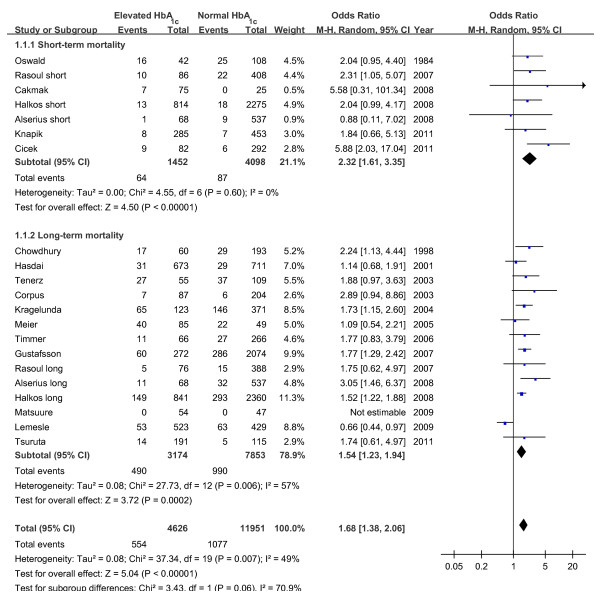
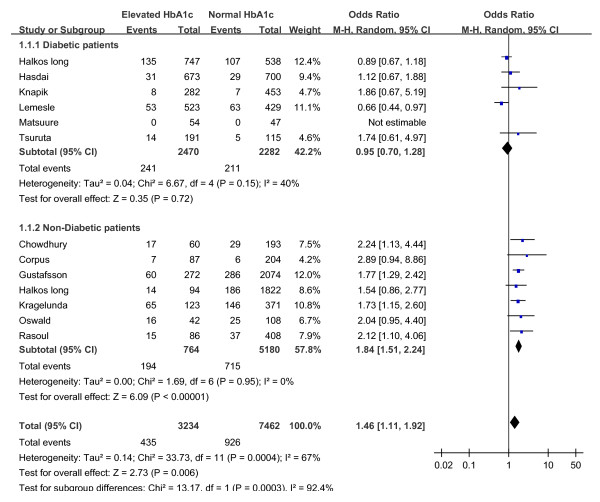
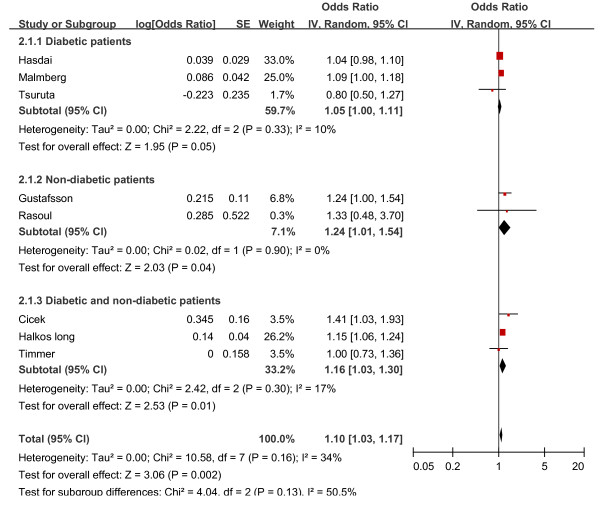
Results: Twenty studies met final inclusion criteria (total n = 13, 224). From the pooled analyses, elevated HbA1c level was significantly associated with increased short-term (OR 2.32, 95% CI, 1.61 to 3.35) and long-term (OR 1.54, 95% CI, 1.23 to 1.94) mortality risk. Subgroup analyses suggested elevated HbA1c level predicted higher mortality risk in patients without diabetes (OR 1.84, 95% CI, 1.51 to 2.24). In contrast, in patients with diabetes, elevated HbA1c level was not associated with increased risk of mortality (OR 0.95, 95% CI, 0.70 to 1.28). In a risk-adjusted sensitivity analyses, elevated HbA1c was also associated with a significantly high risk of adjusted mortality in patients without diabetes (adjusted OR 1.49, 95% CI, 1.24 to 1.79), but had a borderline effect in patients with diabetes (adjusted OR 1.05, 95% CI, 1.00 to 1.11).
Conclusions: Our findings demonstrate that elevated HbA1c level is an independent risk factor for mortality in CAD patients without diabetes, but not in patients with established diabetes. Prospective studies should further investigate whether glycemic control might improve outcomes in CAD patients without previously diagnosed diabetes.
© 2011 Liu et al; licensee BioMed Central Ltd.
Figures
References
-
- Kosiborod M, Rathore SS, Inzucchi SE, Masoudi FA, Wang Y, Havranek EP, Krumholz HM. Admission glucose and mortality in elderly patients hospitalized with acute myocardial infarction: implications for patients with and without recognized diabetes. Circulation. 2005;111:3078–3086. doi: 10.1161/CIRCULATIONAHA.104.517839. - DOI - PubMed
-
- Deedwania P, Kosiborod M, Barrett E, Ceriello A, Isley W, Mazzone T, Raskin P. American Heart Association Diabetes Committee of the Council on Nutrition, Physical Activity, and Metabolis. Hyperglycemia and acute coronary syndrome: a scientific statement from the American Heart Association Diabetes Committee of the Council on Nutrition, Physical Activity, and Metabolism. Circulation. 2008;117:1610–9. doi: 10.1161/CIRCULATIONAHA.107.188629. - DOI - PubMed
-
- Suleiman M, Hammerman H, Boulos M, Kapeliovich MR, Suleiman A, Agmon Y, Markiewicz W, Aronson D. Fasting glucose is an important independent risk factor for 30-day mortality in patients with acute myocardial infarction: a prospective study. Circulation. 2005;111:754–760. doi: 10.1161/01.CIR.0000155235.48601.2A. - DOI - PubMed
-
- Straumann E, Kurz DJ, Muntwyler J, Stettler I, Furrer M, Naegeli B, Frielingsdorf J, Schuiki E, Mury R, Bertel O, Spinas GA. Admission glucose concentrations independently predict early and late mortality in patients with acute myocardial infarction treated by primary or rescue percutaneous coronary intervention. Am Heart J. 2005;150:1000–6. doi: 10.1016/j.ahj.2005.01.033. - DOI - PubMed
Publication types
MeSH terms
Substances
LinkOut - more resources
Full Text Sources
Medical
Miscellaneous
