. 2012 Jan;40(Database issue):D876-80.
doi: 10.1093/nar/gkr1011. Epub 2011 Nov 9.

STITCH 3: zooming in on protein-chemical interactions

Affiliations

STITCH 3: zooming in on protein-chemical interactions

Michael Kuhn et al. Nucleic Acids Res. 2012 Jan.

Abstract

To facilitate the study of interactions between proteins and chemicals, we have created STITCH, an aggregated database of interactions connecting over 300,000 chemicals and 2.6 million proteins from 1133 organisms. Compared to the previous version, the number of chemicals with interactions and the number of high-confidence interactions both increase 4-fold. The database can be accessed interactively through a web interface, displaying interactions in an integrated network view. It is also available for computational studies through downloadable files and an API. As an extension in the current version, we offer the option to switch between two levels of detail, namely whether stereoisomers of a given compound are shown as a merged entity or as separate entities. Separate display of stereoisomers is necessary, for example, for carbohydrates and chiral drugs. Combining the isomers increases the coverage, as interaction databases and publications found through text mining will often refer to compounds without specifying the stereoisomer. The database is accessible at http://stitch.embl.de/.


Figures
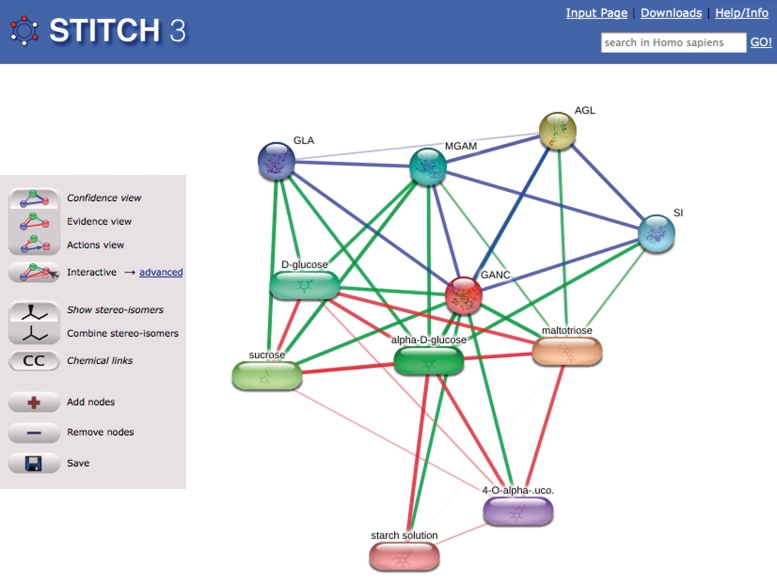
Figure 1.
Figure 1.
The interaction network of neutral alpha-glucosidase C. The example screenshot shows the STITCH interface, with buttons to change the network view on the left side. With the top three buttons, views can be selected to different types of information on the edges: in confidence view (shown), the thickness corresponds to the confidence of the interaction. In evidence and actions view, multiple lines are shown representing the types of supporting evidence or types of interactions. Note that ‘show stereo-isomers’ is selected in the next set of buttons, to distinguish the different isomeric carbohydrates.
Figure 2.
Figure 2.
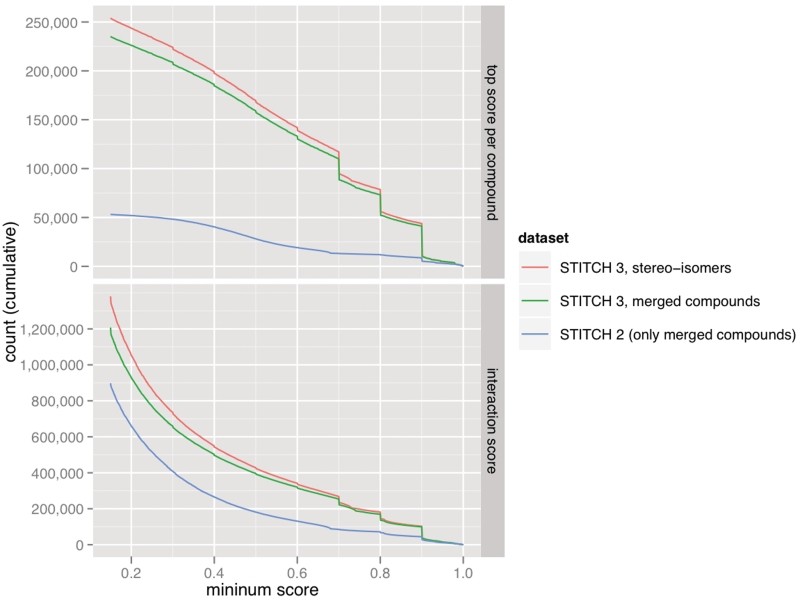
Cumulative distribution of scores. For each confidence score cutoff, the number of chemicals (top) and protein–chemical interactions (bottom) that have at least this confidence score in the human protein–chemical network. For example, there are 110 000 chemicals with a high-confidence interaction (score at least 0.7). Note that interactions with confidence scores below 0.15 are not stored in STITCH. Steps in the data correspond to large numbers of compounds that have a maximum score in manually curated databases or the ChEMBL database (with different confidence levels).
Figure 3.
Figure 3.
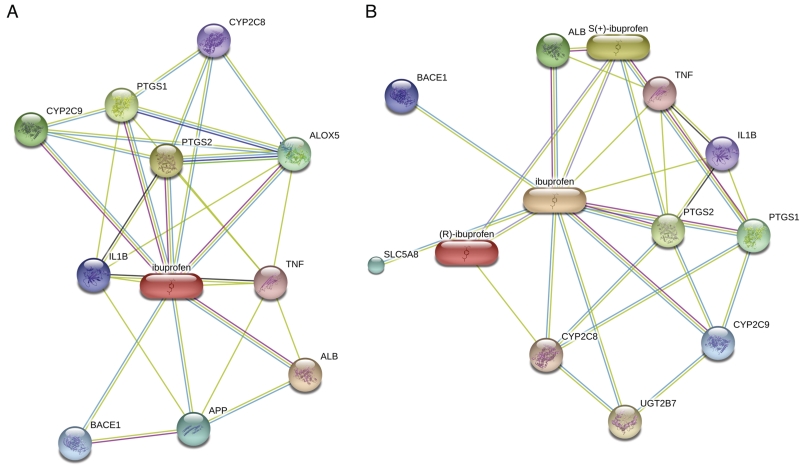
Stereo-specific interactions of S(+)-ibuprofen. (A) The interaction network of ibuprofen with merged stereoisomers. (B) When isomers are not merged, most interactions still connect to the form without assigned stereochemistry (labeled ibuprofen). There is also interaction evidence for the active isomer, S(+)-ibuprofen, while R(-)-ibuprofen has almost no high-confidence edges.

References

    1. Gaulton A, Bellis LJ, Bento AP, Chambers J, Davies M, Hersey A, Light Y, McGlinchey S, Michalovich D, Al-Lazikani B, et al. ChEMBL: a large-scale bioactivity database for drug discovery. Nucleic Acids Res. 2012;40:D1100–D1107. - PMC - PubMed
    1. Kuhn M, Szklarczyk D, Franceschini A, Campillos M, Mering von,C, Jensen LJ, Beyer A, Bork P. STITCH 2: an interaction network database for small molecules and proteins. Nucleic Acids Res. 2010;38:D552–D556. - PMC - PubMed
    1. Kuhn M, Mering von,C, Campillos M, Jensen LJ, Bork P. STITCH: interaction networks of chemicals and proteins. Nucleic Acids Res. 2008;36:D684–D688. - PMC - PubMed
    1. Kapitzky L, Beltrao P, Berens TJ, Gassner N, Zhou C, Wüster A, Wu J, Babu MM, Elledge SJ, Toczyski D, et al. Cross-species chemogenomic profiling reveals evolutionarily conserved drug mode of action. Mol. Syst. Biol. 2010;6:451. - PMC - PubMed
    1. Kalinina OV, Wichmann O, Apic G, Russell RB. Combinations of protein-chemical complex structures reveal new targets for established drugs. PLoS Comput. Biol. 2011;7:e1002043. - PMC - PubMed

Publication types