


Recognition of morphometric vertebral fractures by artificial neural networks: analysis from GISMO Lombardia Database
- PMID: 22076144
- PMCID: PMC3208634
- DOI: 10.1371/journal.pone.0027277
Recognition of morphometric vertebral fractures by artificial neural networks: analysis from GISMO Lombardia Database
Abstract
Background: It is known that bone mineral density (BMD) predicts the fracture's risk only partially and the severity and number of vertebral fractures are predictive of subsequent osteoporotic fractures (OF). Spinal deformity index (SDI) integrates the severity and number of morphometric vertebral fractures. Nowadays, there is interest in developing algorithms that use traditional statistics for predicting OF. Some studies suggest their poor sensitivity. Artificial Neural Networks (ANNs) could represent an alternative. So far, no study investigated ANNs ability in predicting OF and SDI. The aim of the present study is to compare ANNs and Logistic Regression (LR) in recognising, on the basis of osteoporotic risk-factors and other clinical information, patients with SDI≥1 and SDI≥5 from those with SDI = 0.
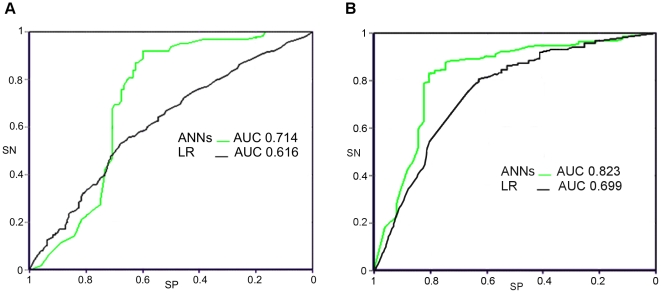
Methodology: We compared ANNs prognostic performance with that of LR in identifying SDI≥1/SDI≥5 in 372 women with postmenopausal-osteoporosis (SDI≥1, n = 176; SDI = 0, n = 196; SDI≥5, n = 51), using 45 variables (44 clinical parameters plus BMD). ANNs were allowed to choose relevant input data automatically (TWIST-system-Semeion). Among 45 variables, 17 and 25 were selected by TWIST-system-Semeion, in SDI≥1 vs SDI = 0 (first) and SDI≥5 vs SDI = 0 (second) analysis. In the first analysis sensitivity of LR and ANNs was 35.8% and 72.5%, specificity 76.5% and 78.5% and accuracy 56.2% and 75.5%, respectively. In the second analysis, sensitivity of LR and ANNs was 37.3% and 74.8%, specificity 90.3% and 87.8%, and accuracy 63.8% and 81.3%, respectively.
Conclusions: ANNs showed a better performance in identifying both SDI≥1 and SDI≥5, with a higher sensitivity, suggesting its promising role in the development of algorithm for predicting OF.
Conflict of interest statement
Figures
References
-
- NIH Consensus Statement. Osteoporosis prevention, diagnosis, and therapy. Mar 27–29. 2000;17(1):1–45. - PubMed
-
- World Health Organization. Assessment of osteoporosis at the primary health care level. 2007. Summary Report of a WHO Scientific Group. WHO, Geneva. Available: http://www.who.int/chp/topics/rheumatic/en/index.html. Accessed 2011 Sep 1.
-
- Kanis JA, Johnell O, Oden A, De Laet C, Jonsson B, et al. Ten-year risk of osteoporotic fracture and the effect of risk factors on screening strategies. Bone. 2002;30:251–258. - PubMed
-
- De Laet C, Oden A, Johansson H, Johnell O, Jonsson B, et al. The impact of the use of multiple risk indicators for fracture on case-finding strategies: a mathematical approach. Osteoporos Int. 2005;16:313–318. - PubMed
MeSH terms
LinkOut - more resources
Full Text Sources
Medical
Research Materials
