The Early Experience of Laparoscopy-assisted Gastrectomy for Gastric Cancer at a Low-volume Center
- PMID: 22076192
- PMCID: PMC3204498
- DOI: 10.5230/jgc.2010.10.4.241
The Early Experience of Laparoscopy-assisted Gastrectomy for Gastric Cancer at a Low-volume Center
Abstract
Purpose: Laparoscopy-assisted gastrectomy (LAG) has become a technically feasible and safe procedure for early gastric cancer treatment. LAG is being increasingly performed in many centers; however, there have been few reports regarding LAG at low-volume centers. The aim of this study was to report our early experience with LAG in patients with gastric cancer at a low-volume center.
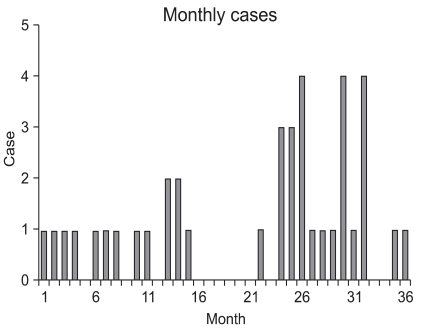
Materials and methods: The clinicopathologic data and surgical outcomes of 39 patients who underwent LAG for gastric cancer between April 2007 and March 2010 were retrospectively reviewed.
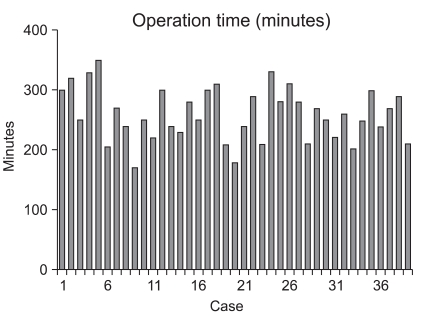
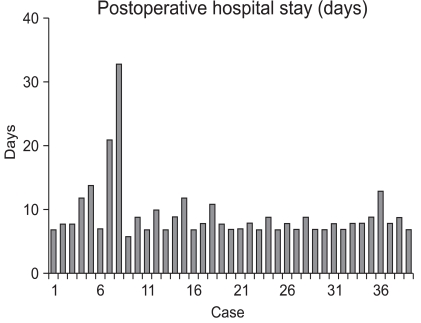
Results: The mean age was 68.3 years. Thirty-one patients had medical co-morbidities. The mean patient ASA score was 2.0. Among the 39 patients, 4 patients underwent total gastrectomies and 35 patients underwent distal gastrectomies. The mean blood loss was 145.4 ml and the mean operative time was 259.4 minutes. The mean time-to-first flatus, first oral intake, and the postoperative hospital stay was 2.8, 3.1, and 9.3 days, respectively. The 30-day mortality rate was 0%. Postoperative complications developed in 9 patients, as follows: anastomotic leakage, 1; wound infection, 1; gastric stasis, 2; postoperative ileus, 1; pneumonia, 1; cerebral infarction, 1; chronic renal failure, 1; and postoperative psychosis, 1.
Conclusions: LAG is technically feasible and can be performed safely at a low-volume center, but an experienced surgical team and careful patient selection are necessary. Furthermore, for early mastery of the learning curve for LAG, surgeons need education and training in addition to an accumulation of cases.
Keywords: Gastrectomy; Laparoscopy; Stomach neoplasms.
Figures
References
-
- Azagra JS, Goergen M, De Simone P, Ibanez-Aguirre J. The current role of laparoscopic surgery in the treatment of benign gastroduodenal diseases. Hepatogastroenterology. 1999;46:1522–1526. - PubMed
-
- Keats AS. The ASA classification of physical status--a recapitulation. Anesthesiology. 1978;49:233–236. - PubMed
-
- Korea Gastric Cancer Association. Nationwide gastric cancer report in Korea. J Korean Gastric Cancer Assoc. 2002;2:105–114.
LinkOut - more resources
Full Text Sources
Miscellaneous