. 2011 Nov 11:8:44.
doi: 10.1186/1742-4682-8-44.

The feasibility of age-specific travel restrictions during influenza pandemics

Affiliations

The feasibility of age-specific travel restrictions during influenza pandemics

Elson H Y Lam et al. Theor Biol Med Model. .

Abstract

Background: Epidemiological studies have shown that imposing travel restrictions to prevent or delay an influenza pandemic may not be feasible. To delay an epidemic substantially, an extremely high proportion of trips (~99%) would have to be restricted in a homogeneously mixing population. Influenza is, however, strongly influenced by age-dependent transmission dynamics, and the effectiveness of age-specific travel restrictions, such as the selective restriction of travel by children, has yet to be examined.

Methods: A simple stochastic model was developed to describe the importation of infectious cases into a population and to model local chains of transmission seeded by imported cases. The probability of a local epidemic, and the time period until a major epidemic takes off, were used as outcome measures, and travel restriction policies in which children or adults were preferentially restricted were compared to age-blind restriction policies using an age-dependent next generation matrix parameterized for influenza H1N1-2009.

Results: Restricting children from travelling would yield greater reductions to the short-term risk of the epidemic being established locally than other policy options considered, and potentially could delay an epidemic for a few weeks. However, given a scenario with a total of 500 imported cases over a period of a few months, a substantial reduction in the probability of an epidemic in this time period is possible only if the transmission potential were low and assortativity (i.e. the proportion of contacts within-group) were unrealistically high. In all other scenarios considered, age-structured travel restrictions would not prevent an epidemic and would not delay the epidemic for longer than a few weeks.

Conclusions: Selectively restricting children from traveling overseas during a pandemic may potentially delay its arrival for a few weeks, depending on the characteristics of the pandemic strain, but could have less of an impact on the economy compared to restricting adult travelers. However, as long as adults have at least a moderate potential to trigger an epidemic, selectively restricting the higher risk group (children) may not be a practical option to delay the arrival of an epidemic substantially.


Figures
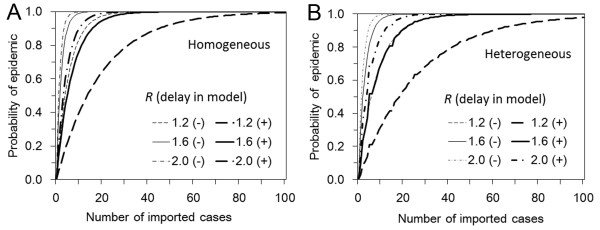
Figure 1
Figure 1
The probability of epidemic with and without accounting for delay in infection-age among imported cases. A. The probability of epidemic is calculated as a function of the number of imported cases and the reproduction number (R) for a homogeneously mixing population with (+) or without (-) consideration of delay in infection-age among imported cases. B. The case of heterogeneously mixing population.
Figure 2
Figure 2
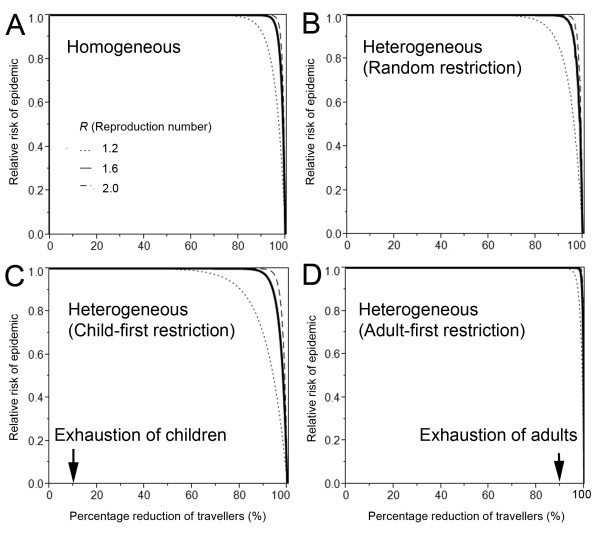
Relative risk of epidemic by selective and non-selective travel restrictions. Relative risk of epidemic is shown as a function of the percentage reduction of travelers. In the absence of travel reduction, it is assumed that a total of 500 imported cases arrive in a virgin soil country. Three different reproduction numbers, 1.2 (dotted line), 1.6 (solid line) and 2.0 (dashed line) are considered. A. Non-selective travel restriction in a homogeneously mixing population. B. Non-selective travel restriction in a heterogeneously mixing population. C. Child-first restriction in heterogeneously mixing population. D. Adult-first restriction in heterogeneously mixing population. In C at 10% reduction of travel (specified with arrow), all travels involving children are restricted and the host to restrict travel is switched to adults. Similarly, adult travelers are exhausted at 90% reduction of travel in D.
Figure 3
Figure 3
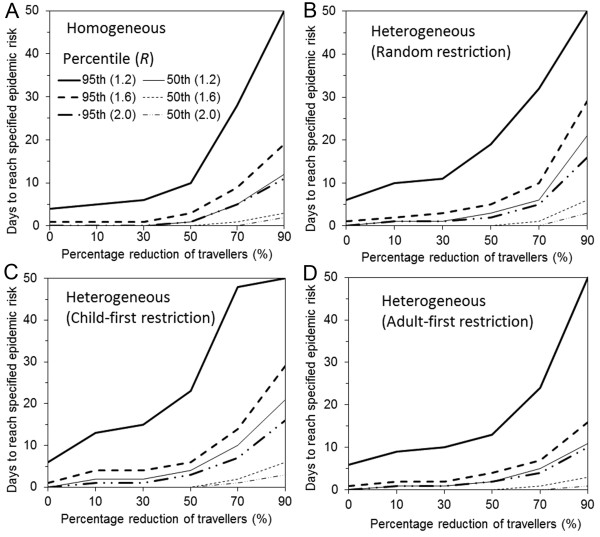
Delay effect of travel restriction by selective and non-selective travel restrictions. The first day at which the probability of epidemic reaches 50% or 95% is examined as a function of the percentage reduction of travelers. In the absence of travel reduction, it is assumed that a total of 10 imported cases arrive every day and the importation continues for 50 days (with a total of 500 imported cases). The number of days with travel restriction minus that without restriction gives the delay in epidemic gained by the travel restriction policy. Three different reproduction numbers, 1.2 (solid line), 1.6 (dotted line) and 2.0 (dashed line) are considered. Scenarios A-D are the same as those in Figure 2 (A. homogeneously mixing population; B. random restriction in heterogeneously mixing population; C. child-first restriction and D. adult-first restriction in heterogeneously mixing population).
Figure 4
Figure 4
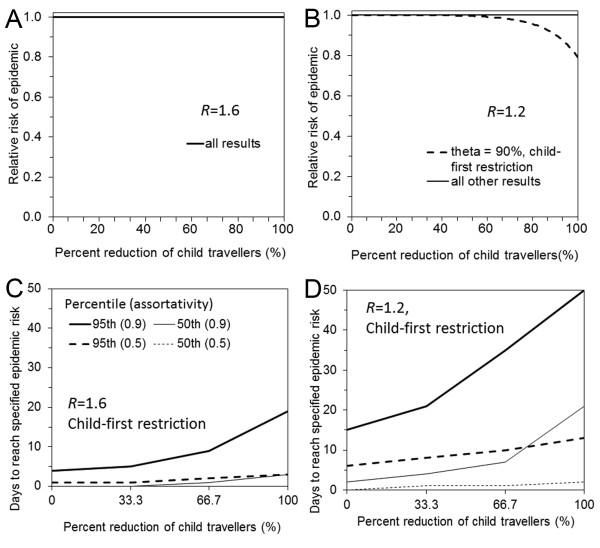
Sensitivity of the probability of epidemic and days taken to observe epidemic to assortativity coefficient during child-first travel restriction. Child-first travel restriction is implemented with a total of 500 imported cases (where there are 10 imported cases per day for 50 days). A. Relative risk of epidemic with the reproduction number 1.6 is examined as a function of travel restriction volume. We examine three assortativity coefficient (0.10, 0.50 and 0.90), but the epidemic risk remains consistently 1. B. Relative risk of epidemic with the reproduction number 1.2. Only when the assortativity coefficient (theta = 0.90), a small reduction in the probability of epidemic is observed. C. The first day at which the probability of epidemic reaches 50% or 95% with the reproduction number 1.6. The day with 50% in the case of assortativity coefficient 0.5 is not distinguishable from horizontal axis. D. The first day at which the probability of epidemic reaches 50% or 95% with the reproduction number 1.2.

References

    1. Khan K, Arino J, Hu W, Raposo P, Sears J, Calderon F, Heidebrecht C, Macdonald M, Liauw J, Chan A, Gardam M. Spread of a novel influenza A (H1N1) virus via global airline transportation. N Engl J Med. 2009;361:212–214. doi: 10.1056/NEJMc0904559. - DOI - PubMed
    1. Neumann G, Noda T, Kawaoka Y. Emergence and pandemic potential of swine-origin H1N1 influenza virus. Nature. 2009;459:931–939. doi: 10.1038/nature08157. - DOI - PMC - PubMed
    1. Roberts MG, Nishiura H. Early estimation of the reproduction number in the presence of imported cases: pandemic influenza H1N1-2009 in New Zealand. PLoS One. 2011;6:e17835. doi: 10.1371/journal.pone.0017835. - DOI - PMC - PubMed
    1. Paine S, Mercer GN, Kelly PM, Bandaranayake D, Baker MG, Huang QS, Mackereth G, Bissielo A, Glass K, Hope V. Transmissibility of 2009 pandemic influenza A(H1N1) in New Zealand: effective reproduction number and influence of age, ethnicity and importations. Euro Surveill. 2010;15 pii = 19591. - PubMed
    1. Scalia Tomba G, Wallinga J. A simple explanation for the low impact of border control as a countermeasure to the spread of an infectious disease. Math Biosci. 2008;214:70–72. doi: 10.1016/j.mbs.2008.02.009. - DOI - PubMed

Publication types