. 2012 Jan;283(1-2):162-8.
doi: 10.1016/j.heares.2011.10.009. Epub 2011 Nov 6.

Undirected head movements of listeners with asymmetrical hearing impairment during a speech-in-noise task

Affiliations

Undirected head movements of listeners with asymmetrical hearing impairment during a speech-in-noise task

W Owen Brimijoin et al. Hear Res. 2012 Jan.

Abstract

It has long been understood that the level of a sound at the ear is dependent on head orientation, but the way in which listeners move their heads during listening has remained largely unstudied. Given the task of understanding a speech signal in the presence of a simultaneous noise, listeners could potentially use head orientation to either maximize the level of the signal in their better ear, or to maximize the signal-to-noise ratio in their better ear. To establish what head orientation strategy listeners use in a speech comprehension task, we used an infrared motion-tracking system to measure the head movements of 36 listeners with large (>16 dB) differences in hearing threshold between their left and right ears. We engaged listeners in a difficult task of understanding sentences presented at the same time as a spatially separated background noise. We found that they tended to orient their heads so as to maximize the level of the target sentence in their better ear, irrespective of the position of the background noise. This is not ideal orientation behavior from the perspective of maximizing the signal-to-noise ratio (SNR) at the ear, but is a simple, easily implemented strategy that is often effective in an environment where the spatial position of multiple noise sources may be difficult or impossible to determine.


Figures

Fig. 1
Fig. 1
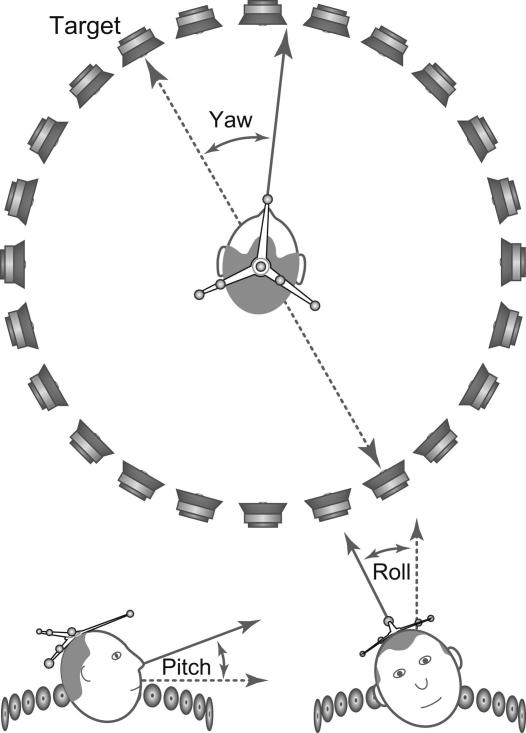
A schematic of the loudspeaker ring and infrared markers. Listeners were seated at the center of a 1.9 m diameter ring of 24 loudspeakers arranged in 15° intervals. Listeners wore a crown to which were attached an array of retroreflective markers. The 3D positions of these markers were used to establish the yaw pitch and roll and the listener’s head. Yaw is reported relative to the target loudspeaker, pitch relative to the plane of the loudspeaker ring, and roll relative to the vertical axis.
Fig. 2
Fig. 2
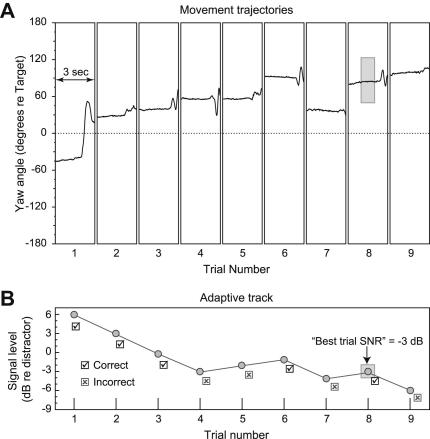
Yaw angle during an adaptive track. The top panel (A) plots an illustrative listener’s head yaw as a function of time for a set of nine trials. Negative values indicate orientation to the left and positive values indicate orientation to the right of the target loudspeaker. The bottom panel (B) shows the level of the target sentence varying over the course of the adaptive track. When the listener correctly repeated the target sentence (black checkmarks), the target was made 3 dB less intense on the subsequent trial. When the listener failed to repeat the target (gray × marks) the target was made 1 dB more intense on the subsequent trial. The trial with the lowest level accurately repeated sentence was selected for further analysis (indicated by the gray boxes in 2A and B), the SNR from this trial was termed the “best trial SNR.”
Fig. 3
Fig. 3
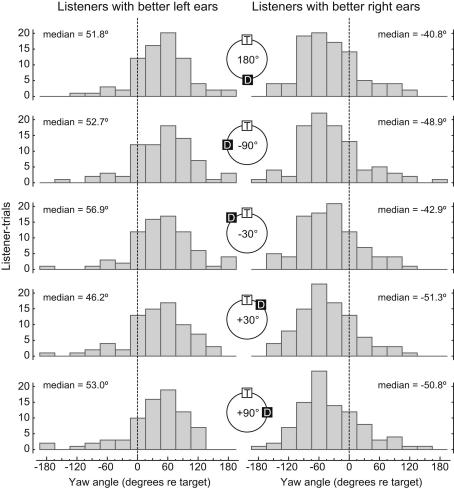
Head yaw for left-ear and right-ear listeners. The top pair of histograms show the results for the ±180° distractor condition, with left-ear listeners on the left, and right-ear listeners on the right. The rows of histograms underneath represent data for the remaining distractor conditions of −90, −30, +30, and +90° respectively.
Fig. 4
Fig. 4
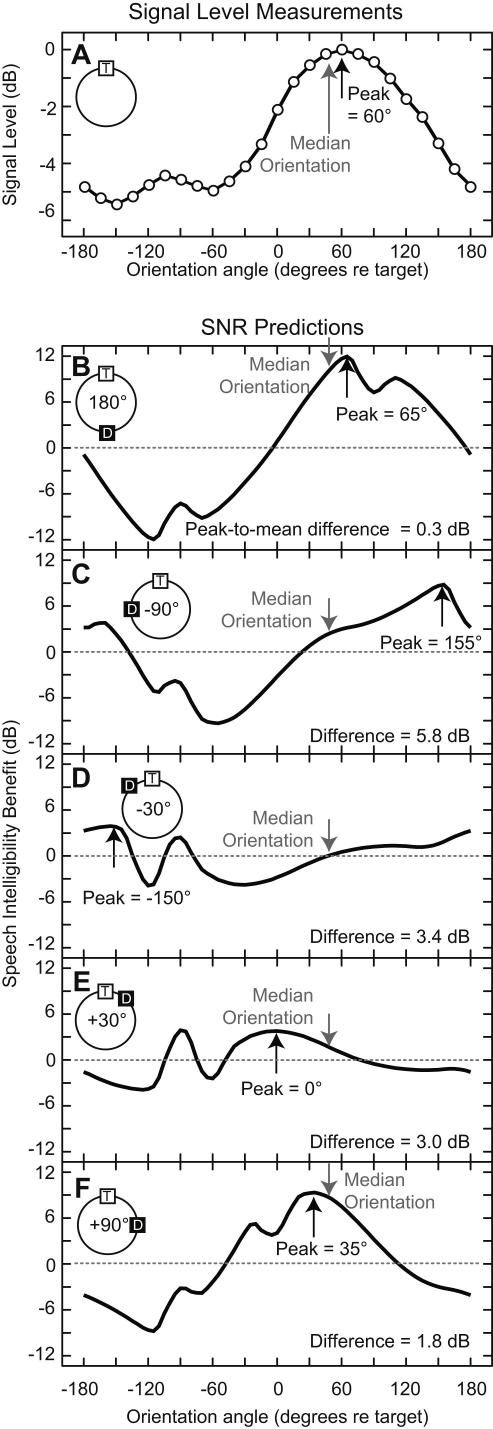
Head yaw and predicted speech intelligibility. A speech intelligibility model predicted the yaw angle at which listeners would receive the greatest benefit (in decibels) in understanding a target sentence paired with a simultaneous noise distractor. For each of the distractor conditions (stacked vertically as in the previous figure) the black upward arrows indicate the peak of these curves. The gray arrows indicate the median yaw behavior of listeners.
Fig. 5
Fig. 5
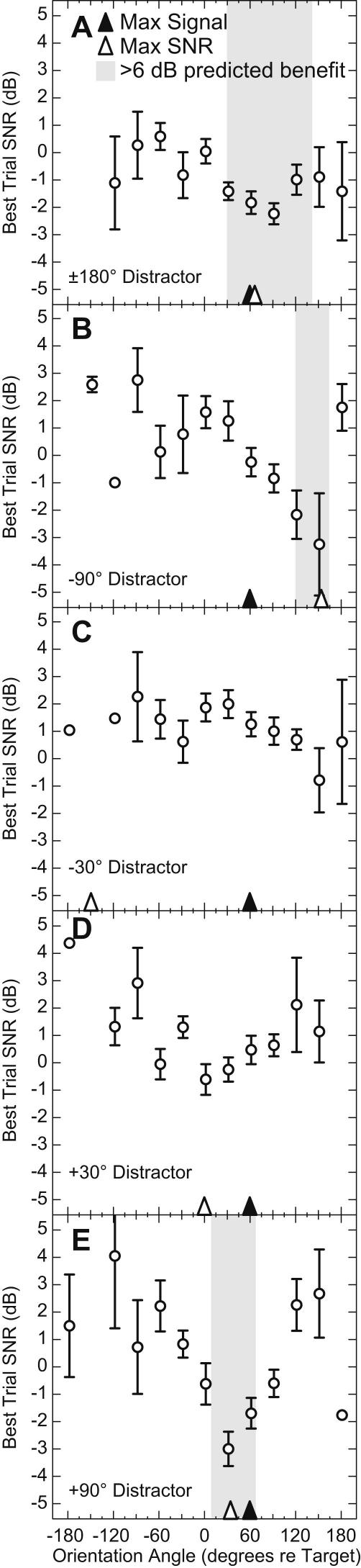
Head yaw and task performance. Performance (best trial SNR) is plotted as function of head yaw for each of the five distractor angles. Error bars are standard error of the mean. The filled arrowheads indicate the orientation angle associated with maximum signal level and the open arrowheads indicate the angle of maximum SNR. The gray bar represents the range of head angles over which the model predicts a listener would receive at least 6 dB of speech intelligibility benefit.

References

    1. ANSI . American National Standards Institute; New York: 1997. Methods for Calculation of The Speech Intelligibility Index. ANSI S3.5-1997.
    1. Berens P. CircStat, A MATLAB toolbox for circular statistics. J. Stat. Soft. 2009;30:1–21.
    1. Blauert J. MIT Press; Cambridge: 1983. Spatial Hearing.
    1. Brimijoin W.O., McShefferty D., Akeroyd M.A. Auditory and visual orienting responses in listeners with and without hearing-impairment. J. Acoust. Soc. Am. 2010;127:3678–3688. - PMC - PubMed
    1. Ching T.Y., O’Brien A., Dillon H., Chalupper J., Hartley L., Hartley D., Raicevich G., Hain J. Directional effects on infants and young children in real life: implications for amplification. J. Speech Lang. Hear. Res. 2009;52:1241–1254. - PubMed

Publication types