Review
. 2012 Feb 1;52(3):539-555.
doi: 10.1016/j.freeradbiomed.2011.10.445. Epub 2011 Oct 24.

The redox stress hypothesis of aging

Affiliations
Review

The redox stress hypothesis of aging

Rajindar S Sohal et al. Free Radic Biol Med. .

Abstract

The main objective of this review is to examine the role of endogenous reactive oxygen/nitrogen species (ROS) in the aging process. Until relatively recently, ROS were considered to be potentially toxic by-products of aerobic metabolism, which, if not eliminated, may inflict structural damage on various macromolecules. Accrual of such damage over time was postulated to be responsible for the physiological deterioration in the postreproductive phase of life and eventually the death of the organism. This "structural damage-based oxidative stress" hypothesis has received support from the age-associated increases in the rate of ROS production and the steady-state amounts of oxidized macromolecules; however, there are increasing indications that structural damage alone is insufficient to satisfactorily explain the age-associated functional losses. The level of oxidative damage accrued during aging often does not match the magnitude of functional losses. Although experimental augmentation of antioxidant defenses tends to enhance resistance to induced oxidative stress, such manipulations are generally ineffective in the extension of life span of long-lived strains of animals. More recently, in a major conceptual shift, ROS have been found to be physiologically vital for signal transduction, gene regulation, and redox regulation, among others, implying that their complete elimination would be harmful. An alternative notion, advocated here, termed the "redox stress hypothesis," proposes that aging-associated functional losses are primarily caused by a progressive pro-oxidizing shift in the redox state of the cells, which leads to the overoxidation of redox-sensitive protein thiols and the consequent disruption of the redox-regulated signaling mechanisms.


Figures

Fig. 1
Fig. 1
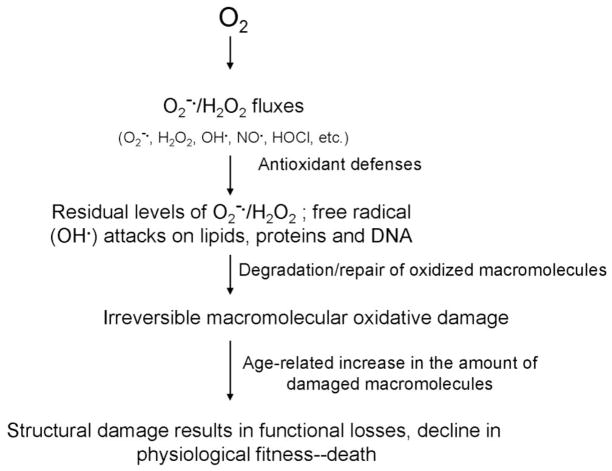
Schematic representation of the structural damage-based oxidative stress hypothesis of aging. The key features of the hypothesis are that ROS cause structural damage, which accumulates with time causing corresponding losses in function, and that antioxidant defenses are the primary modulator of oxidative damage.
Fig. 2
Fig. 2
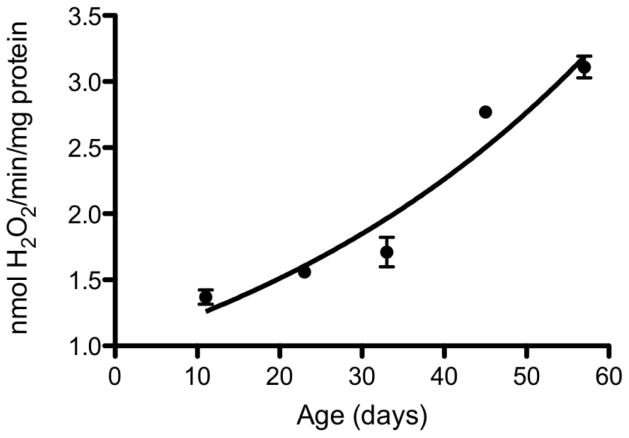
Rates of H2O2 release by mitochondria of Drosophila melanogaster at different ages. Rate of H2O2 release was measured in isolated flight muscle mitochondria as an increase in fluorescence due to oxidation of p-hydroxyphenylacetate and the coupled reduction of H2O2 by horseradish peroxidase, using alpha-glycerophosphate as a substrate. From .
Fig. 3
Fig. 3
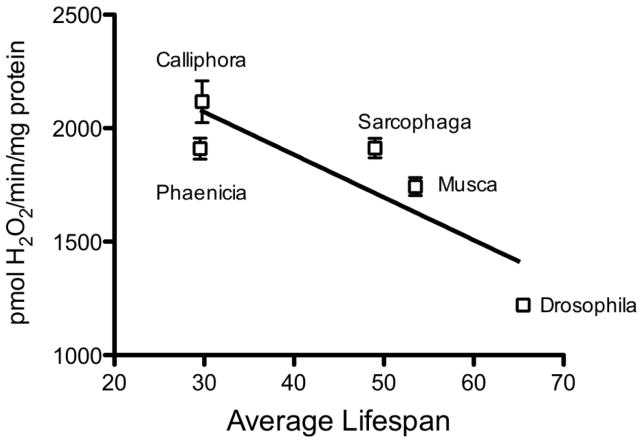
Relationship between the rates of H2O2 release from mitochondria and the average life spans of five different species of dipteran flies. H2O2 release was measured in flight muscle mitochondria of 2-week-old flies. From .
Fig. 4
Fig. 4
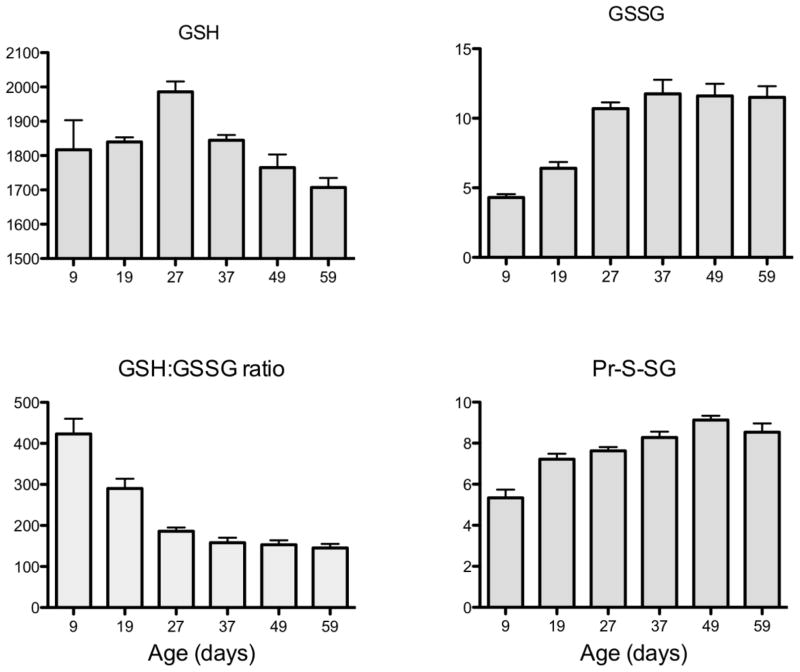
Age-related changes in GSH, GSSG, GSH:GSSG ratios and total mixed protein disulfides (Pr-S-SG) in whole body homogenates of Drosophila melanogaster. From .
Fig. 5
Fig. 5
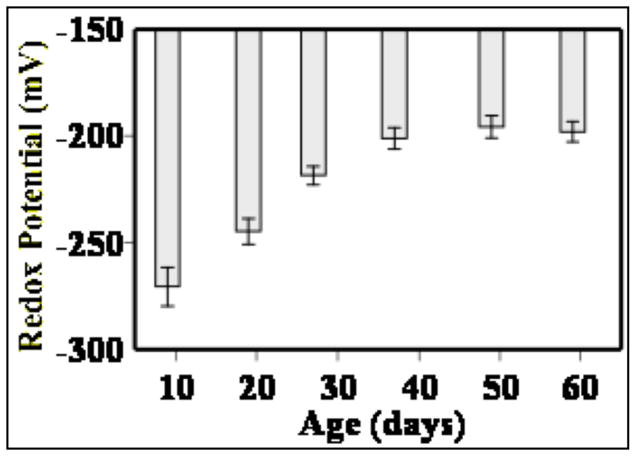
Age-related changes in glutathione redox potential in whole body homogenates of Drosophila melanogaster. Redox potential was calculated using the experimentally determined GSH and GSSG concentrations the Nernst equation. Relatively more negative values indicate higher reducing state, whereas more positive values indicate the converse. Based on data in .
Fig. 6
Fig. 6
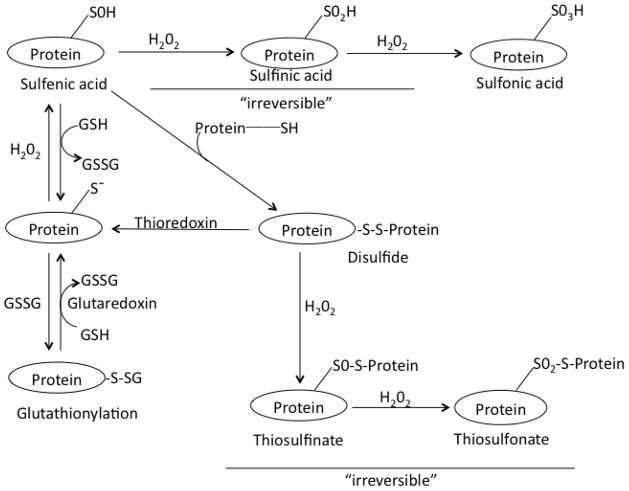
Modifications of cysteinyl thiols of redox-sensitive proteins. Oxidation of protein cysteinyl thiolates (Pr-S) by H2O2 results in the formation of sulfenic acid (Protein-SOH), which may react with an adjacent protein thiol (protein-SH) to form a protein disulfide (protein-S-S-protein). Under conditions of oxidative stress, such as those created by the progressive increases in the rate of H2O2 production during aging, protein-SOH may be converted sequentially into sulfinic acid (protein-SO2H) and sulfonic acid (protein-SO3H); the latter two are believed to be mostly irreversible modifications. In the presence of excessive H2O2, protein disulfide (protein-S-S-protein) can be converted into a thiosulfenate (protein-SO-S-protein) and then into thiosulfonate (protein-SO2-S-protein); both of these steps are not readily reversible. Protein cysteinyl thiolate (protein-S) can also react with glutathione disulfide (GSSG) or other low molecular weight thiols, forming mixed disulfides (protein-S-SG), a reaction often referred to as S-glutathionylation of proteins. Glutaredoxin and thioredoxin systems catalyze the reductions of mixed disulfides and protein disulfides, respectively. Gratefully adapted from Brandes et al. .
Fig. 7
Fig. 7
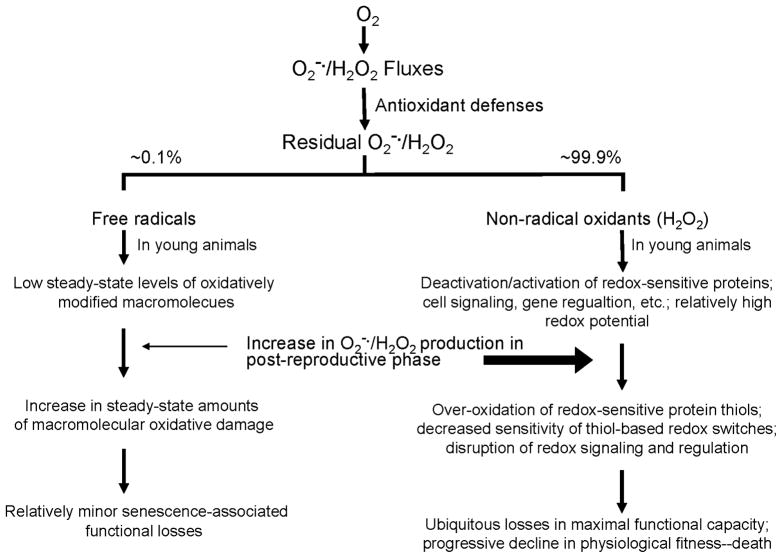
Diagrammatic representation of the redox stress hypothesis of aging. The key features of this hypothesis are that: most of the residual ROS are non-radical oxidants rather than free radicals; ROS are physiologically essential molecules involved in the regulation of protein activity; in young organisms the rates of ROS generation are relatively low and the thiol redox potential is high; in the latter part of life, ROS production increases resulting in a decrease in redox potential and over-oxidation of the regulatory protein thiols; the pro-oxidizing shift in the redox state and the attendant changes result in the loss of sensitivity and co-ordination among regulatory mechanisms, thereby increasing the inefficiency of processes involved in the maintenance of homeostasis; this hypothesis relegates the cumulative structural damage to an auxiliary status rather than a primary role in the causation of senescence; and an elevation of antioxidant defenses that fails to alter redox-sensitive signaling is predicted to have little impact on the progression of the aging process.

References

    1. Finch CE, Ruvkun G. Annu Rev Genomics Hum Genet. 2001;2:435–462. - PubMed
    1. Hayflick L. Ann N Y Acad Sci. 2007;1100:1–13. - PubMed
    1. Harman D. J Gerontol. 1956;11:298–300. - PubMed
    1. Sohal RS, Weindruch R. Science. 1996;273:59–63. - PMC - PubMed
    1. Weindruch R, Sohal RS. N Engl J Med. 1997;337:986–994. - PMC - PubMed

Publication types

Substances