


A randomized placebo-controlled trial of varenicline for smoking cessation allowing flexible quit dates
- PMID: 22080588
- PMCID: PMC3281242
- DOI: 10.1093/ntr/ntr220
A randomized placebo-controlled trial of varenicline for smoking cessation allowing flexible quit dates
Abstract
Introduction: Current smoking cessation guidelines recommend setting a quit date prior to starting pharmacotherapy. However, providing flexibility in the date of quitting may be more acceptable to some smokers. The objective of this study was to compare varenicline 1 mg twice daily (b.i.d.) with placebo in subjects using a flexible quit date paradigm after starting medication.
Methods: In this double-blind, randomized, placebo-controlled international study, smokers of ≥10 cigarettes/day, aged 18-75 years, and who were motivated to quit were randomized (3:1) to receive varenicline 1 mg b.i.d. or placebo for 12 weeks. Subjects were followed up through Week 24. Subjects were instructed to quit between Days 8 and 35 after starting medication. The primary endpoint was carbon monoxide-confirmed continuous abstinence during Weeks 9-12, and a key secondary endpoint was continuous abstinence during Weeks 9-24.
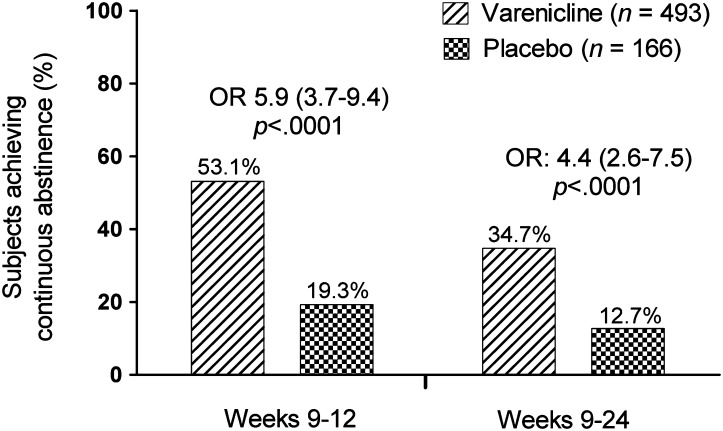
Results: Overall, 493 subjects were randomized to varenicline and 166 to placebo. Continuous abstinence was higher for varenicline than for placebo subjects at the end of treatment (Weeks 9-12: 53.1% vs. 19.3%; odds ratio [OR] 5.9; 95% CI, 3.7-9.4; p < .0001) and through 24 weeks follow-up (Weeks 9-24: 34.7% vs. 12.7%; OR 4.4; 95% CI, 2.6-7.5; p < .0001). Serious adverse events occurred in 1.2% varenicline (none were psychiatric) and 0.6% placebo subjects. Fewer varenicline than placebo subjects reported depression-related adverse events (2.3% vs. 6.7%, respectively).
Conclusions: Varenicline 1 mg b.i.d. using a flexible quit date paradigm had similar efficacy and safety compared with previous fixed quit date studies.
Trial registration: ClinicalTrials.gov NCT00691483.
Figures
References
-
- Cahill K, Stead LF, Lancaster T. Nicotine receptor partial agonists for smoking cessation. Cochrane Database of Systemic Reviews. 2008;(3) CD006103. doi:10.1002/14651858.CD006103.pub3.
-
- Chambers M. NHS stop smoking services: Service and monitoring guidance 2010/11. 2009. Retrieved. from http://www.scsrn.org/policy_guidance/2010_11_NHS_Stop_Smoking_Services_s....
-
- Coe JW, Brooks PR, Vetelino MG, Wirtz MC, Arnold EP, Huang J, et al. Varenicline: An α4β2 nicotinic receptor partial agonist for smoking cessation. Journal of Medicinal Chemistry. 2005;48:3474–3477. doi:10.1021/jm050069n. - PubMed
-
- Fiore MC, Jaén CR, Baker TB, Bailey WC, Benowitz NL, Curry SJ, et al. Treating tobacco use and dependence: 2008 update. Clinical practice guideline. 2008. Retrieved from http://www.surgeongeneral.gov/tobacco/treating_tobacco_use08.pdf.
-
- Gonzales D, Rennard SI, Nides M, Oncken C, Azoulay S, Billing CB, et al. Varenicline, an α4β2 nicotinic acetylcholine receptor partial agonist, vs sustained-release bupropion and placebo for smoking cessation: A randomized controlled trial. Journal of the American Medical Association. 2006;296:47–55. doi:10.1001/jama.296.1.47. - PubMed
Publication types
MeSH terms
Substances
Associated data
LinkOut - more resources
Full Text Sources
Medical
