


A novel recurrent mutation in MITF predisposes to familial and sporadic melanoma
- PMID: 22080950
- PMCID: PMC3266855
- DOI: 10.1038/nature10630
A novel recurrent mutation in MITF predisposes to familial and sporadic melanoma
Abstract
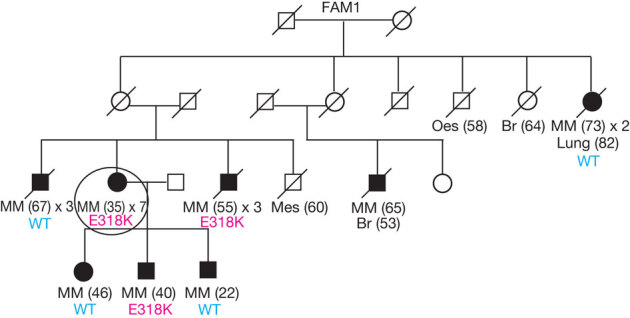
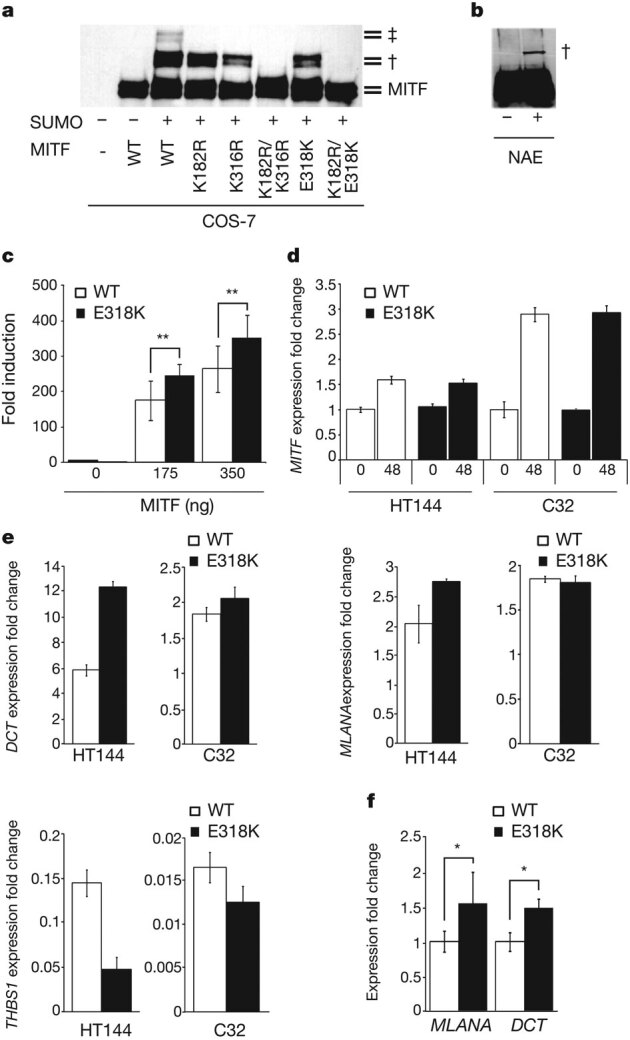
So far, two genes associated with familial melanoma have been identified, accounting for a minority of genetic risk in families. Mutations in CDKN2A account for approximately 40% of familial cases, and predisposing mutations in CDK4 have been reported in a very small number of melanoma kindreds. Here we report the whole-genome sequencing of probands from several melanoma families, which we performed in order to identify other genes associated with familial melanoma. We identify one individual carrying a novel germline variant (coding DNA sequence c.G1075A; protein sequence p.E318K; rs149617956) in the melanoma-lineage-specific oncogene microphthalmia-associated transcription factor (MITF). Although the variant co-segregated with melanoma in some but not all cases in the family, linkage analysis of 31 families subsequently identified to carry the variant generated a log of odds (lod) score of 2.7 under a dominant model, indicating E318K as a possible intermediate risk variant. Consistent with this, the E318K variant was significantly associated with melanoma in a large Australian case-control sample. Likewise, it was similarly associated in an independent case-control sample from the United Kingdom. In the Australian sample, the variant allele was significantly over-represented in cases with a family history of melanoma, multiple primary melanomas, or both. The variant allele was also associated with increased naevus count and non-blue eye colour. Functional analysis of E318K showed that MITF encoded by the variant allele had impaired sumoylation and differentially regulated several MITF targets. These data indicate that MITF is a melanoma-predisposition gene and highlight the utility of whole-genome sequencing to identify novel rare variants associated with disease susceptibility.
Conflict of interest statement
The authors declare no competing financial interests.
Figures
Comment in
-
Cancer genomics: Finding a rare variant.Nat Rev Cancer. 2011 Dec 8;12(1):1. doi: 10.1038/nrc3190. Nat Rev Cancer. 2011. PMID: 22158021 No abstract available.
-
Microphthalmia-associated transcription factor, melanoma, and renal carcinoma: the small ubiquitin-like modifier connection.Pigment Cell Melanoma Res. 2011 Dec;24(6):1079-80. doi: 10.1111/j.1755-148X.2011.00925.x. Pigment Cell Melanoma Res. 2011. PMID: 22216437 No abstract available.
References
-
- Zuo L, et al. Germline mutations in the p16INK4a binding domain of CDK4 in familial melanoma. Nature Genet. 1996;12:97–99. - PubMed
-
- Naldi L, et al. Cutaneous malignant melanoma in women. Phenotypic characteristics, sun exposure, and hormonal factors: a case–control study from Italy. Ann. Epidemiol. 2005;15:545–550. - PubMed
-
- Titus-Ernstoff L, et al. Pigmentary characteristics and moles in relation to melanoma risk. Int. J. Cancer. 2005;116:144–149. - PubMed
-
- Holly EA, Aston DA, Cress RD, Ahn DK, Kristiansen JJ. Cutaneous melanoma in women. I. Exposure to sunlight, ability to tan, and other risk factors related to ultraviolet light. Am. J. Epidemiol. 1995;141:923–933. - PubMed
Publication types
MeSH terms
Substances
Associated data
- Actions
Grants and funding
- R01 CA083115/CA/NCI NIH HHS/United States
- C8216/A6129/CRUK_/Cancer Research UK/United Kingdom
- P50CA9368/CA/NCI NIH HHS/United States
- 11022/CRUK_/Cancer Research UK/United Kingdom
- R01 CA83115/CA/NCI NIH HHS/United States
- C588/A10589/CRUK_/Cancer Research UK/United Kingdom
- R01 AR043369/AR/NIAMS NIH HHS/United States
- AR043369-14/AR/NIAMS NIH HHS/United States
- R01 CA088363/CA/NCI NIH HHS/United States
- K24CA149202/CA/NCI NIH HHS/United States
- R01 CA-83115-01A2/CA/NCI NIH HHS/United States
- C490/A11021/CRUK_/Cancer Research UK/United Kingdom
- P50 CA093683/CA/NCI NIH HHS/United States
- C8197/A10123/CRUK_/Cancer Research UK/United Kingdom
- K24 CA149202/CA/NCI NIH HHS/United States
- CA88363/CA/NCI NIH HHS/United States
- C588/A4994/CRUK_/Cancer Research UK/United Kingdom
- 10118/CRUK_/Cancer Research UK/United Kingdom
- 10589/CRUK_/Cancer Research UK/United Kingdom
LinkOut - more resources
Full Text Sources
Other Literature Sources
Medical
Molecular Biology Databases
Miscellaneous
